
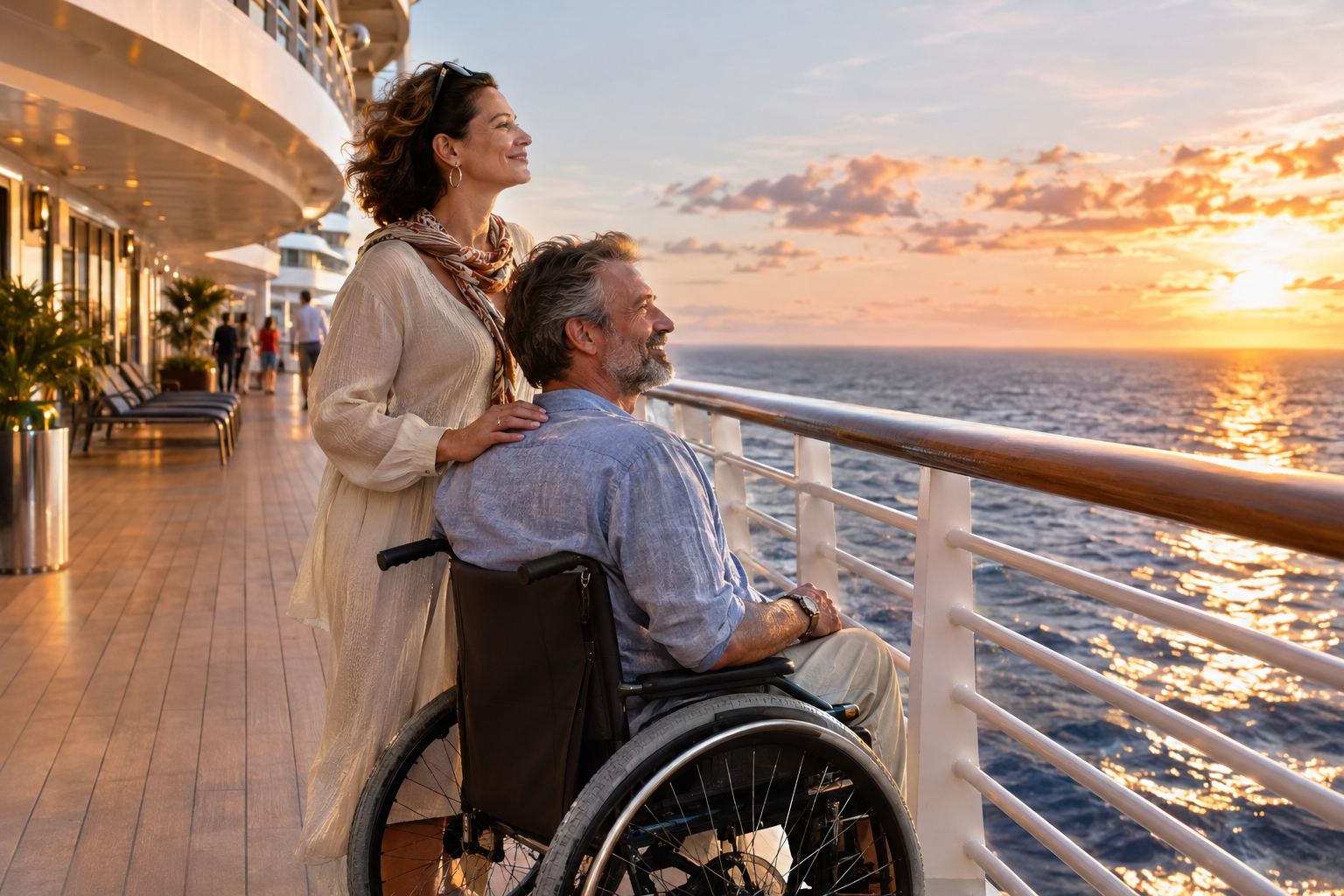
A cruise is, at its heart, a hotel that moves. You unpack once, your meals are a short roll or a short walk away, the entertainment comes to you, and every morning the view has changed while you slept. For travellers with reduced mobility, that simple fact removes many of the hardest parts of ordinary travel: no daily packing, no hunting for an accessible taxi in a strange city, no restaurant roulette every evening.
But an accessible ship is not the same thing as an accessible holiday. The difference lives in the details: the right cabin category, the right itinerary, the right questions asked before booking rather than after boarding. This guide walks through all of it, honestly, including the one chapter too many brochures skip, the tender ports.
Why a Cruise Can Be the Easiest Holiday of All
Start with what a modern cruise ship genuinely does well.
You unpack once. Your accessible cabin is your base for the whole voyage. No transfers between hotels, no daily negotiation with a new bathroom layout, no luggage to wrestle every second day.
Everything is on one level of effort. Restaurants, theatres, lounges, the medical centre and the pool deck are all inside one building, served by lifts. On a well chosen ship, a full sea day can be enjoyed without a single difficult metre.
Help is built in. Cruise lines run dedicated accessibility desks, offer embarkation and disembarkation assistance, and train crew to work with mobility devices every single day. You are not an exception on board. You are a known, expected kind of guest.
The pace is yours. Sea days are natural rest days. A traveller who tires easily can plan effort the way other travellers plan excursions: one big outing, then a quiet day watching the ocean do the travelling.
None of this means every ship and every itinerary works. It means the raw material is excellent, provided the planning is done properly.
The Cabin: Fully Accessible Is Not Ambulatory Accessible
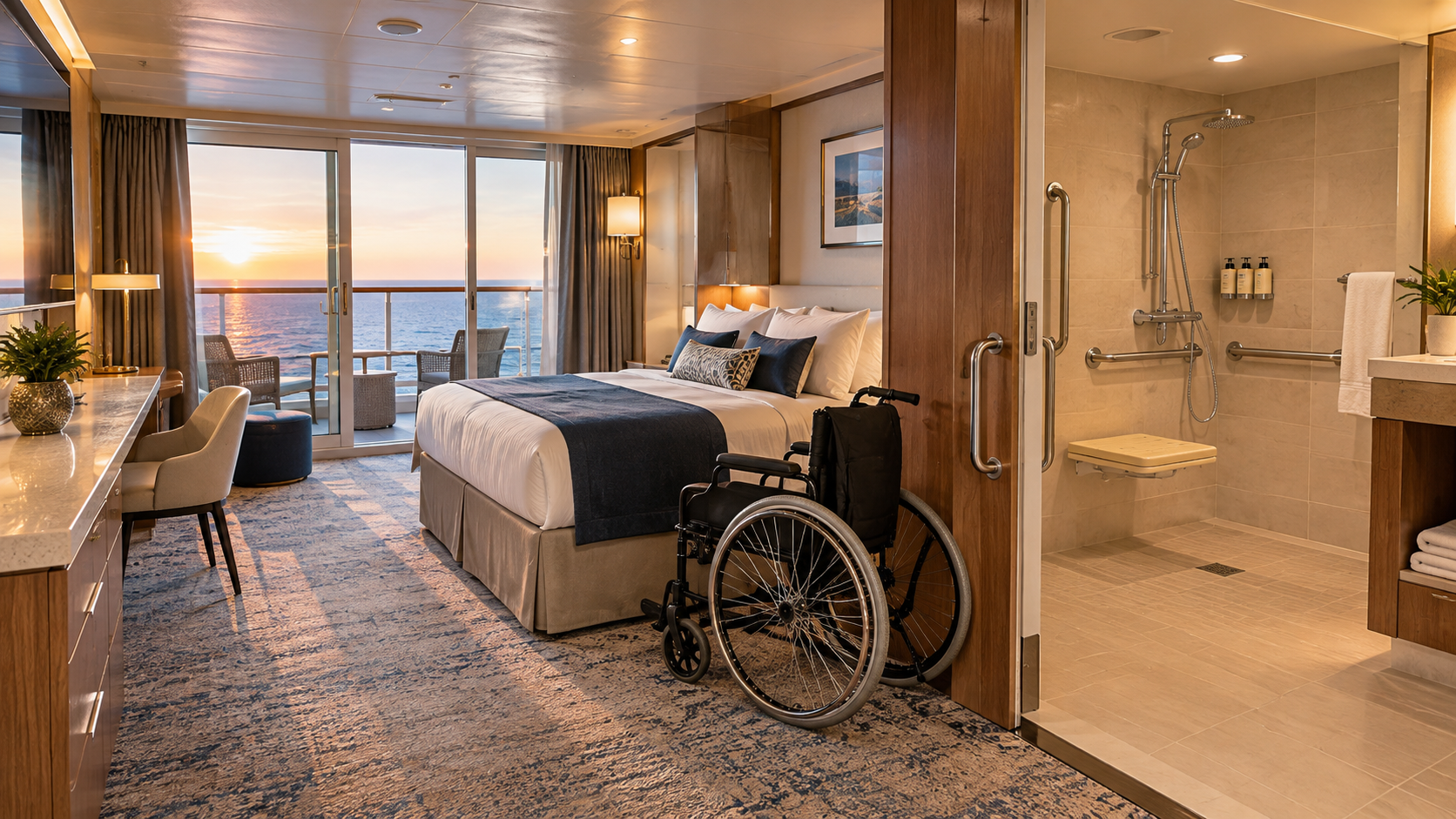
The single most common booking mistake in accessible cruising is choosing the wrong kind of accessible cabin. Most major lines sell two different things under similar names, and they are not interchangeable.
Fully accessible cabins are built for guests who use a wheelchair or a scooter as their main way of moving. Expect wider doorways, typically at least 32 inches (about 81 cm) of clear opening against roughly 23 inches for a standard cabin door, a roll in shower with no threshold, a fold down bench and hand held shower head, grab bars, lowered storage and switches, and enough clear floor space to turn a chair, roughly a 150 cm turning circle.
Ambulatory accessible cabins are built for guests who walk, but with difficulty: a cane, a walker, limited stamina, a need for grab bars and a raised toilet seat. The support features are there, but the doorways and bathroom are closer to standard width. A wheelchair user booked into an ambulatory cabin may physically not get through the bathroom door. This is not a small print detail. It is the whole holiday.
Three practical consequences follow:
- Measure your device, then ask for measurements. Know the width of your wheelchair or scooter, and ask the line's accessibility desk for the exact clear door width, bathroom layout and turning space of the specific cabin, on the specific ship. Deck plans and categories vary from ship to ship, even inside one fleet.
- Book early. Accessible cabins are a small share of any ship's inventory, often only a few dozen on a vessel carrying thousands. On popular sailings they can sell out many months ahead, long before standard cabins do.
- Never store a device in the corridor. Maritime safety rules require clear passageways, and lines require mobility devices to be stored and charged inside the cabin. That is another reason the cabin has to be the right size, not approximately the right size.
Life on Board: Getting Around the Ship
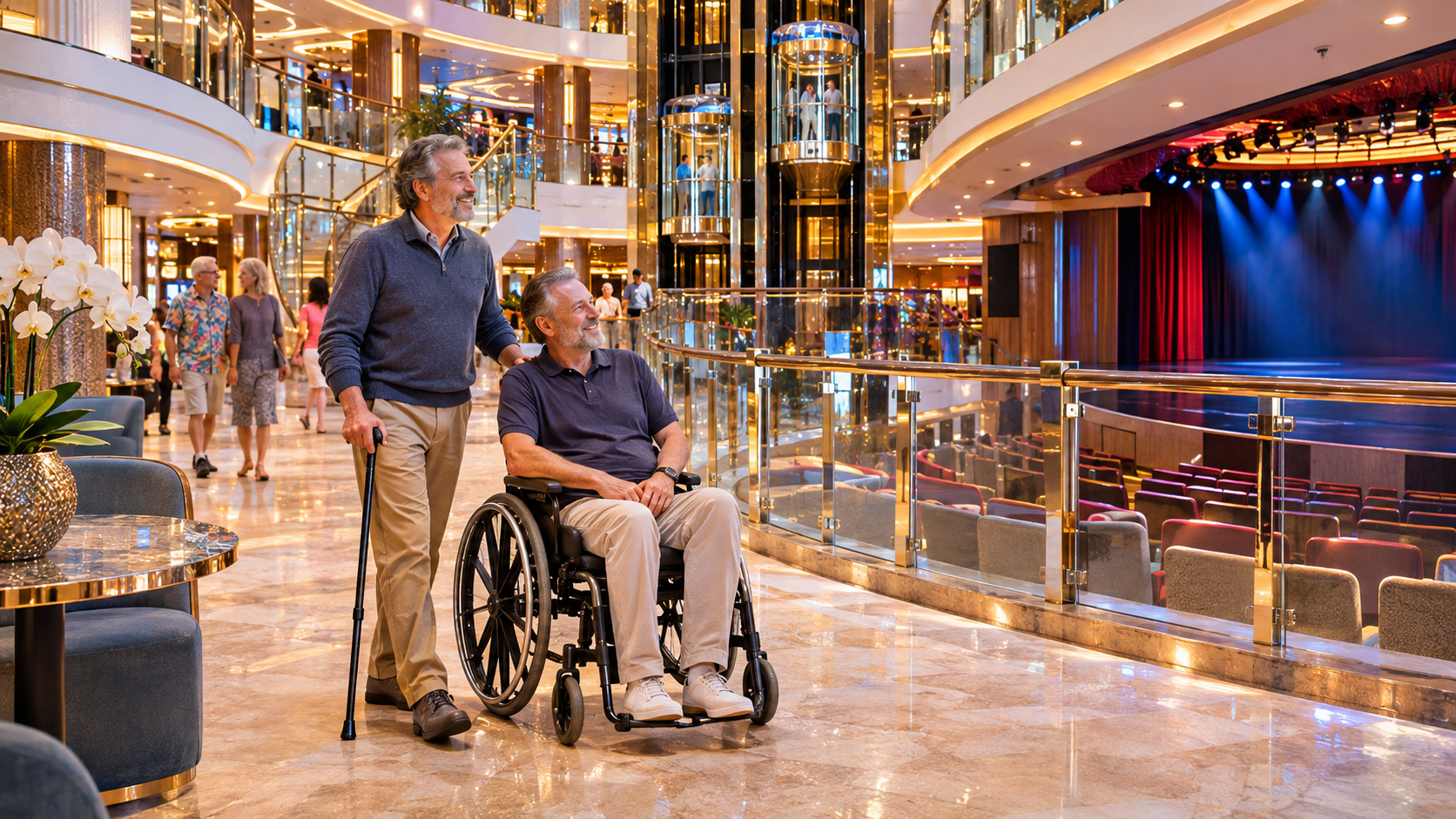
On board a modern ship, the accessible experience is usually the easiest part of the whole trip.
Lifts serve every deck, public rooms are step free on newer ships, and accessible routes are marked on deck plans. Theatres and dining rooms keep wheelchair spaces and transfer seats. Many ships offer pool lifts, accessible Jacuzzis, and lowered sections at bars and service desks. Hearing and vision support exists too: visual alarm and door alert kits, TTY devices on request, large print or Braille materials on some lines, and closed captioning on in cabin television.
A few honest nuances are worth knowing:
- Ship size cuts both ways. The newest large ships have the most accessible cabins, the widest corridors and the best equipment. They also involve long distances. A mid sized ship can mean shorter rolls between cabin, restaurant and theatre, which matters more than one extra facility for many travellers.
- Older ships vary more. A ship launched twenty years ago may have been retrofitted thoughtfully, or may keep awkward thresholds, heavy doors and one slow lift where you need it most. Ask about the specific ship, not the brand in general.
- Sea days are gentle, port days are marathons. Plan your energy accordingly. There is no prize for doing every port at full speed, and the ship itself, quiet while everyone else is ashore, is a pleasure many accessible travellers come to love.
The Honest Chapter: Tender Ports
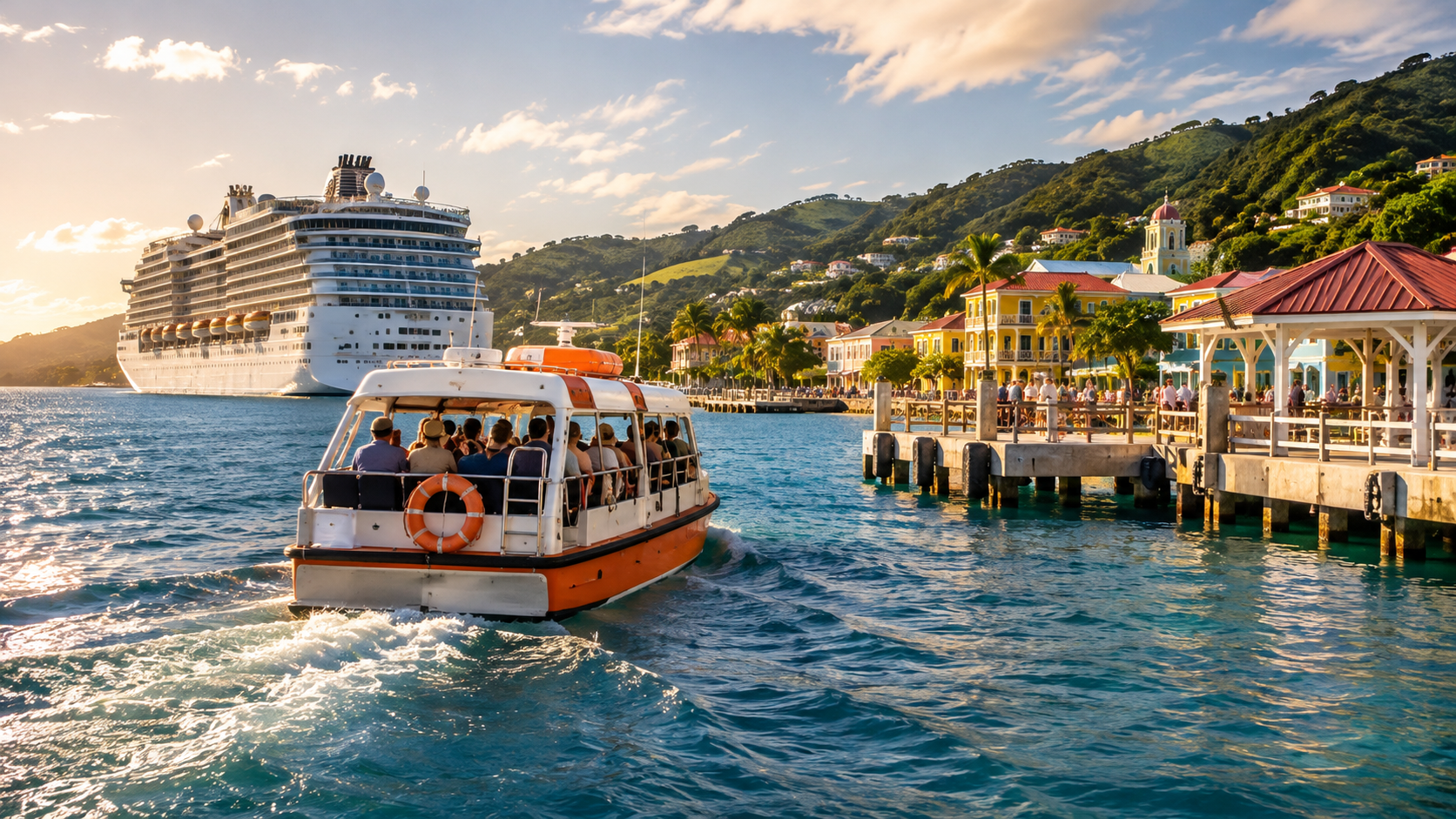
Here is the subject brochures put in small print, and the one that decides whether an itinerary truly works.
At some ports, the ship cannot dock. It anchors offshore, and passengers travel to shore in small boats called tenders. For a traveller with reduced mobility, a tender can be the hardest ten minutes of the entire voyage: a step across a gap between a moving platform and a moving boat, sometimes a difference in height, sometimes in weather that changes by the hour.
The practical rules, stated plainly:
- Power wheelchairs and scooters generally cannot board standard tenders. They are heavy, they cannot be lifted safely, and crew members are not permitted to carry guests or their equipment.
- Manual wheelchairs are a maybe, not a promise. Depending on the line, the port and the sea state, a guest who can transfer, with a collapsible chair, may be able to tender. The captain and safety officer can refuse tendering for anyone when conditions require it, and that decision can be made on the morning itself.
- A missed tender port is normally not refundable. If going ashore matters at a given port, that port's status matters at booking, not on the day.
- A few ships do it better. Some newer ships have purpose built accessible tender platforms, and some lines have invested seriously in accessible tendering across their fleets. If tender ports are on your itinerary, ask exactly how that ship handles them.
The simplest strategy is also the best one: choose itineraries where the ship docks. When every port is a dock port, you roll down the gangway on your own schedule, and the whole question disappears. Gangways have their own quirk, their angle changes with the tide, but crew assistance at embarkation and disembarkation is standard, and a docked ship is a stable ship.
Ports and Excursions: Planning the Days Ashore
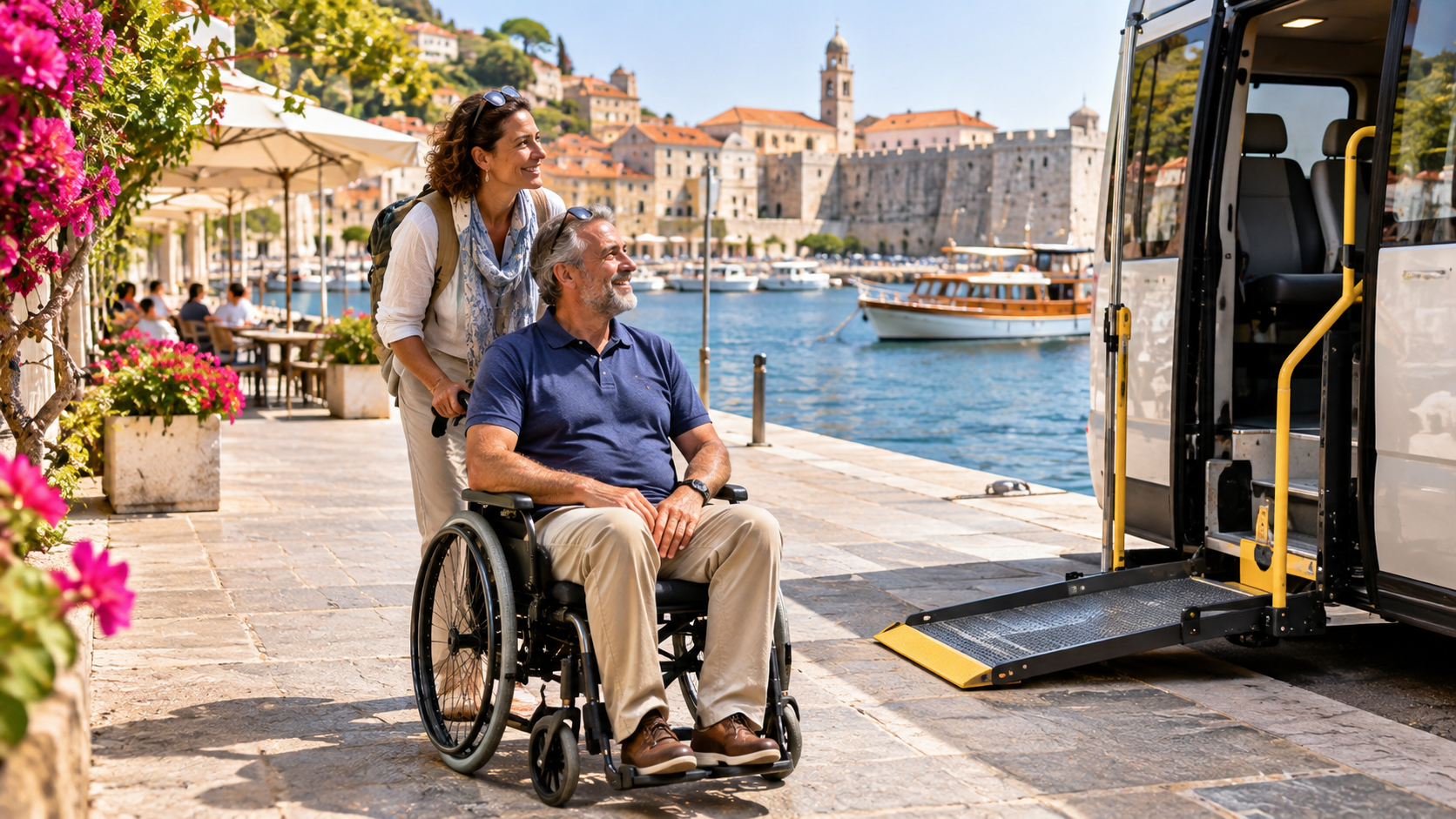
An accessible ship does not guarantee an accessible port. Old towns have cobblestones and hills. Some famous sights have steps that no itinerary can remove. The good news is that this is all knowable in advance.
Accessible excursions exist, and they are growing. Several lines now offer accessible tour programmes, with lift equipped vehicles, step free routes and slower pacing, in selected ports. Independent specialist operators run accessible tours in many major cruise ports as well. Places are limited, so these are booked early, not at the excursion desk on day two.
Read excursion descriptions like a contract. Distance walked, number of steps, time standing, vehicle type: the details are usually published, and when they are not, ask before paying. A tour described as easy can still include a long standing visit that ruins the rest of the day.
Independent exploring is often the most flexible option. In a dock port with a flat, modern waterfront, rolling into town at your own pace, with a café stop whenever you want one, can beat any organised tour. Research the port's terrain the way you would research the ship.
Build the itinerary around your best ports. Every traveller does this instinctively. For reduced mobility, it is simply more deliberate: pick the two or three ports that matter most, rest properly before them, and let the others be optional.
Equipment and Medical Needs: What to Arrange in Advance
Almost everything medical can travel, provided it is declared and arranged before the sailing, not discovered at the pier.
Wheelchairs and scooters. Bring your own, or rent. Specialist companies deliver scooters, power chairs and manual wheelchairs directly to your cabin at many embarkation ports, and collect them at the end. Lines provide wheelchairs for embarkation and disembarkation assistance, but not as your chair for the week.
CPAP and breathing equipment. CPAP and BiPAP machines are welcome on all major lines and travel as medical equipment, not luggage. Tell the line in advance, ask about distilled water, which some lines provide free on request and others supply for a fee, and carry the machine with you rather than in checked luggage.
Oxygen. Oxygen is possible, but it is the item that needs the most advance work. Guests who depend on oxygen generally supply their own, arranged with an approved provider, and must meet the line's requirements before boarding. Airline rules for getting to the ship are separate, and stricter. Start this conversation early.
Dialysis. A ship's medical centre is an urgent care facility, not a hospital. Dedicated dialysis at sea programmes exist on selected sailings with specialist providers, arranged well in advance. If dialysis is part of your life, that programme, or a port intensive itinerary, is a planning conversation to have before any deposit.
Service animals. Trained service animals are welcomed on board by major lines, with paperwork required in advance. Going ashore is a separate question: each port and country sets its own rules for service animals, and permission to board is not permission to land everywhere. The file of documents is prepared port by port.
The special needs form. Every major line has one, sometimes called a special requirements or accessibility form, and deadlines are real: commonly at booking, or at least 30 days before sailing, and longer for service animals on some lines. Treat that form as part of the booking, not as paperwork for later.
River and Expedition Cruising: Where Accessibility Gets Thinner
Honesty requires a separate word about the two formats travellers ask about most.
River cruises are wonderful, and they are the least standardised form of cruising for accessibility. Ships are smaller, lifts may not serve every deck, and the sun deck is often reached by stairs. The bigger variable is ashore: river levels change, gangway angles change with them, and in busy ports ships tie up side by side, a practice called rafting, where reaching shore can mean crossing one or two other ships, sometimes over their sun decks. Some river lines and some newer ships do much better than others, and itineraries on wide, well equipped rivers are easier than small canal routes. This is a format to choose ship by ship, with written answers.
Expedition cruises to polar and remote regions are built around Zodiac landings: climbing into an inflatable boat, sitting on its edge, and stepping onto beaches with no dock at all. A small number of operators can accommodate some mobility limitations on some landings, but expedition cruising is, by design, the least accessible format at sea. Travellers with reduced mobility who dream of the poles should look first at expedition style voyages that stay ship based, with scenic cruising and dock calls, and take very specific advice before considering landings.
At a Glance: The Accessible Cruising Checklist
| Question | Why it matters | When to settle it |
|---|---|---|
| Fully accessible or ambulatory cabin? | Wrong category can mean a bathroom you cannot enter | At booking, with measurements |
| Exact door width vs your device width | A scooter that does not fit does not board | Before any deposit |
| Dock ports or tender ports? | Tenders can exclude power devices entirely | When choosing the itinerary |
| Accessible excursions in your key ports? | Places are limited and sell out | Weeks to months ahead |
| Equipment rental delivered to the cabin? | Avoids flying with heavy equipment | At booking |
| CPAP, oxygen or dialysis arrangements | Each has its own rules and deadlines | At booking, confirmed in writing |
| Special needs form filed? | Lines work to deadlines, often 30 days or more | At booking, never at the pier |
| Service animal paperwork, port by port | Boarding permission is not landing permission | Months ahead |
The ÆRIA Recommendation
Accessible cruising is one of ÆRIA's specialities, and our recommendation is simple: plan the access first and the itinerary second, and let nothing about your mobility be a surprise to anyone, least of all to you.
Choose a modern ship with a true fully accessible cabin if you use a device full time. Prefer dock ports. Protect your energy with sea days. Ask every question in writing, through the line's accessibility desk, and keep the answers. Done this way, a cruise gives back something reduced mobility quietly takes away in ordinary travel: spontaneity inside a safe frame. The restaurants, the shows, the ocean, the new port in the morning, all of it is there, and none of it needs to be given up.
Ready to plan an accessible cruise that truly fits you?
Connect with an accessible travel specialist today!
Yvan Junior Blanchette
Travel and Cruise Specialist
ÆRIA Voyages | ÆRIA Expeditions
☎️ 1 888 460-3388 or 450-820-9720
✉️ yvanblanchette@aeriavoyages.com
🌐 aeriavoyages.com

Member discussion: