

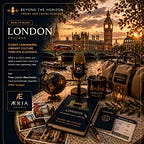
In this episode, we explore London, one of the most layered and endlessly surprising cities in the world, a place that somehow manages to be simultaneously the most visited city in Europe and still genuinely full of things that most visitors never find, where world-class museums are free, where the food has quietly become extraordinary, and where the sheer variety of neighborhoods, cultures, and experiences packed into one city makes it unlike anywhere else on the planet.
We cover everything you need to know before planning a visit, including:
What makes London immediately feel different from other European capitals, from its scale (a city of nine million people that somehow still feels made up of hundreds of distinct villages) to its particular energy, international and self-assured, and the way it absorbs every culture in the world and makes something new out of it
The neighborhoods worth knowing: the City and the South Bank for history and river views, Covent Garden and Soho for theatre, dining, and the energy of central London, Notting Hill and Marylebone for a quieter and more residential feel, Shoreditch and Dalston for the creative east, Greenwich for maritime history and the best view of the city skyline, and the emerging neighborhoods of Peckham and Brixton for the most culturally alive corners of south London
The museums that are among the finest in the world and entirely free: the British Museum and the Rosetta Stone, the National Gallery on Trafalgar Square, the Victoria and Albert Museum in South Kensington, the Natural History Museum, the Tate Modern in a converted power station on the South Bank, and the National Portrait Gallery recently reopened after a major renovation
The historic landmarks that reward more than a photograph: the Tower of London and the Crown Jewels, Westminster Abbey and the density of English history buried beneath its floors, St. Paul’s Cathedral and the view from its dome, Buckingham Palace and the Changing of the Guard, and the Houses of Parliament seen from across the Thames at dusk as one of the great urban views in Europe
The food culture that defines the city today: why London’s restaurant scene is now genuinely world class and has been for over a decade, the Borough Market as the finest food market in Britain, the curry houses of Brick Lane and the broader South Asian food culture that has transformed British cooking, the gastropub tradition done properly, afternoon tea as an experience worth having once, and the neighborhoods (Soho, Marylebone, Shoreditch) where the most interesting eating is currently happening
The theatre culture that makes London the most important stage in the English-speaking world: the West End and how to get last-minute tickets, the National Theatre and the Barbican for serious drama, Shakespeare’s Globe on the South Bank, and why booking at least one performance should be treated as non-negotiable
The parks that make London livable and beautiful in a way that surprises first-time visitors: Hyde Park and Kensington Gardens as the green heart of the west, Regent’s Park and its rose gardens in summer, Greenwich Park for the best elevated view of the city, and the quieter Hampstead Heath in the north for the most countryside-within-a-city experience in London
The day trips that extend London into the wider country: Windsor Castle and its grounds forty minutes by train, the university city of Oxford an hour away, the Roman and Georgian heritage of Bath ninety minutes by fast train, the white cliffs and creative scene of Margate on the Kent coast, and the Cotswolds for those willing to rent a car and go slowly
When to visit: why June and September are the two ideal months, what a London summer actually delivers (long evenings, outdoor dining, the city at its most alive), why the grey reputation of London winters is only partially deserved and why the Christmas markets and cultural season make December worthwhile, and how to dress for a city where the weather changes four times before lunch
Practical realities: using the Oyster card or contactless payment on the Underground and buses, understanding the geography of the zones, why central London hotels are expensive and which neighborhoods offer better value without sacrificing access, the tipping culture, and the one thing every first-time visitor gets wrong about the pace of the city
Whether you are visiting London for the first time or returning to a city that genuinely rewards every visit differently, this episode makes the case for why London is not simply one of the great travel destinations but one of the most complete and continuously surprising cities in the world, and how to experience it beyond the standard circuit.
Resources mentioned in this episode Full article:
Available on the ÆRIA Voyages Blog.
🧺 Book your excursions now!
✈️ Find the best flights to London
🛜 Stay connected while away with a travel eSim
Plan your itinerary in the United Kingdom As a travel advisor, I’m here to turn your ideas into a journey that truly reflects who you are. Don’t hesitate to reach out, I’d be delighted to guide you every step of the way.
📩 yvanblanchette@aeriavoyages.com
📞 1-888-460-3388
Subscribe to Beyond the Horizon for new episodes on cruise lines, destination guides, and travel tips from ÆRIA Voyages.


