

Norwegian Cruise Line: What it is, How it works, and What to expect
Cruise guide · Updated 2026 · Freestyle Cruising · The Haven · Solo studios · Great Stirrup Cay
Norwegian Cruise Line invented Freestyle Cruising. When the model launched with Norwegian Sky around 2000, it eliminated fixed dining times, formal dress codes, and assigned seating, and gave passengers the freedom to eat where they wanted, when they wanted, with whom they wanted.
The ripple effect across the cruise industry was immediate and permanent: every mainstream line in the market now operates some version of flexible dining, and none of them credits Norwegian for it. Today NCL runs a fleet of 20 ships, has pioneered solo-traveller studio cabins without single supplements, operates the only US-flagged year-round Hawaii cruise, and operates The Haven, a ship-within-a-ship suite complex that creates a luxury-adjacent experience at the top of an otherwise mainstream product.
This guide covers NCL’s founding and Freestyle Cruising heritage, the ship classes in 2026, what is and is not included, the Free at Sea programme, The Haven, the solo studio cabins, Pride of America and the Hawaii programme, Great Stirrup Cay and the March 2026 beverage policy change, and how NCL compares to the mainstream and premium competition.
Table of Content
🎧 LISTEN TO THE BEYOND THE HORIZON PODCAST
EPISODE COMING SOON…
A brief history of Norwegian Cruise Line
Norwegian Cruise Line was founded in 1966 by Knut Kloster and Ted Arison in Miami, initially as Norwegian Caribbean Lines. Its first ship, Sunward, entered service that year, sailing three and four-night Caribbean itineraries from Miami. The company was one of the first to position cruising as a mainstream leisure product rather than an elite transatlantic service, and pioneered several innovations that shaped the modern industry: the first private island in cruising at Great Stirrup Cay in the Bahamas, the first combined air-sea programme packaging low-cost airfares with cruise fares, and the development of new Caribbean port destinations including Ocho Rios in Jamaica.
Ted Arison left Norwegian to found Carnival Corporation in 1974, a departure that fundamentally redirected the competitive dynamics of the entire cruise industry. Norwegian continued under Kloster ownership through the 1980s and 1990s, growing its fleet and expanding into the European and world cruise market. The company changed ownership to Malaysia-based Genting Hong Kong (then operating as Star Cruises) in 2000.
Freestyle Cruising was introduced with Norwegian Sky around 2000 under the Genting ownership, representing a deliberate break from the formality of traditional cruising. The concept eliminated fixed seatings, mandatory dress codes, and assigned dining companions, replacing them with multiple dining venues operating throughout the evening, a casual onboard dress standard, and the freedom for guests to structure their own time. The format transformed Norwegian from a traditional cruise line into the mainstream flexibility standard-bearer.
Norwegian Cruise Line Holdings Ltd (NCLH) was formed through a series of ownership changes that eventually brought private equity into the structure. Today NCLH is a publicly traded company on NYSE that also owns Oceania Cruises and Regent Seven Seas Cruises. The loyalty programme, Latitudes Rewards, allows status matching across all three NCLH brands. NCL is headquartered in Miami.
The ship classes in 2026
Norwegian operates 20 ships in 2026, ranging from the oldest active vessel, Norwegian Spirit (built 1998), to Norwegian Luna, which debuted in March 2026. Two ships, Norwegian Sun and Norwegian Sky, are leaving the fleet in 2026 for India-based Cordelia Cruises. The fleet spans five meaningful generations.
Prima and Prima Plus class: the newest generation
Norwegian Prima (2022) and Norwegian Viva (2023) introduced what NCL calls a deliberate shift toward elevated space ratios and a more upscale feel within the mainstream market. At approximately 143,000 gross tons carrying 3,100 guests, Prima-class ships are intentionally less densely occupied than the Breakaway Plus ships, with wider open-deck spaces, Ocean Boulevard, an outdoor promenade wrapping the entire ship, and a thermal spa complex of unusual scale for a mainstream product.
Norwegian Aqua (April 2025) and Norwegian Luna (March 2026) are the first two Prima Plus ships, at approximately 156,000 gross tons and 3,571 guests at double occupancy. The Prima Plus class refines the Prima design: a larger infinity pool, an expanded Haven suite complex, more outdoor dining options, and the Aqua Slidecoaster, a combination roller-coaster and waterslide. Norwegian Luna was christened in March 2026 and sails from Miami to the Caribbean and Bahamas. Two additional unnamed Prima Plus ships are on order for 2027 and 2028.
Breakaway and Breakaway Plus class: the volume flagship generation
Seven ships: Norwegian Breakaway (2013), Norwegian Getaway (2014), Norwegian Escape (2015), Norwegian Joy (2017), Norwegian Bliss (2018), Norwegian Encore (2019), and Norwegian Encore is the last in the class. The Breakaway Plus ships are slightly larger at approximately 164,000 to 169,000 gross tons carrying up to 4,000 guests. These ships introduced the go-kart track at sea on Norwegian Joy, the largest ropes course at sea on Norwegian Bliss, and the largest laser tag attraction at sea on Norwegian Encore. The Breakaway Plus class is the most feature-dense generation in the fleet and the best match for guests who want the highest activity density at Norwegian’s standard price point.
Epic class: the experimental single-generation ship
Norwegian Epic (2010) is a one-of-a-kind vessel that introduced features which became standard across the industry, including circular shower rooms, curved walls in staterooms that created additional floor space, and solo studio cabins with a dedicated Studio Lounge. At 155,873 gross tons carrying approximately 4,100 guests, Epic remains a strong performer despite being 16 years old.
Dawn and Jewel class: the mid-tier generalists
Seven ships in this generation (Norwegian Star, Dawn, Jewel, Jade, Pearl, Gem, and Spirit) built between 1998 and 2007, ranging from approximately 76,000 to 93,000 gross tons and carrying 2,000 to 2,500 guests. These ships lack many of the signature features of the newer fleet but provide the most manageable scale and best access to ports that cannot accommodate the megaships. Norwegian Pearl and Norwegian Gem sail European and Mediterranean itineraries where their smaller footprint provides harbour access advantages over the larger ships. Norwegian Spirit is the oldest active NCL vessel.
Pride of America: the Hawaii specialist
Pride of America is a category entirely its own: the only US-flagged cruise ship in the NCL fleet, operating year-round seven-night itineraries in Hawaii visiting Oahu (Honolulu), Maui, Kauai, and the Big Island. US flag registration under the Passenger Vessel Services Act is the key operational fact about Pride of America: no foreign-flagged vessel can carry passengers between two US ports commercially, which means no other major cruise line can offer a cruise that visits multiple Hawaiian islands without also stopping at a foreign port. Pride of America’s US registration gives it the exclusive ability to sail an entirely Hawaii-based itinerary for the full seven nights.
Built in 2005 and refurbished in 2025, Pride of America carries approximately 2,186 guests at double occupancy. It does not have a Haven complex. The Free at Sea beverage programme does not apply to Pride of America sailings.
NCL fleet at a glance
Prima Plus class: Norwegian Aqua (2025), Norwegian Luna (2026), approximately 156,000 GT, 3,571 guests; Prima class: Norwegian Prima (2022), Norwegian Viva (2023), approximately 143,000 GT, 3,100 guests
Breakaway Plus class: 5 ships, approximately 164,000 to 169,000 GT, up to 4,000 guests
Norwegian Epic: 155,873 GT, approximately 4,100 guests, 2010
Dawn/Jewel class: 7 ships, 76,000 to 93,000 GT, 2,000 to 2,500 guests
Pride of America: US-flagged, Hawaii year-round, 2,186 guests, 2005
What is and is not included: Freestyle Cruising
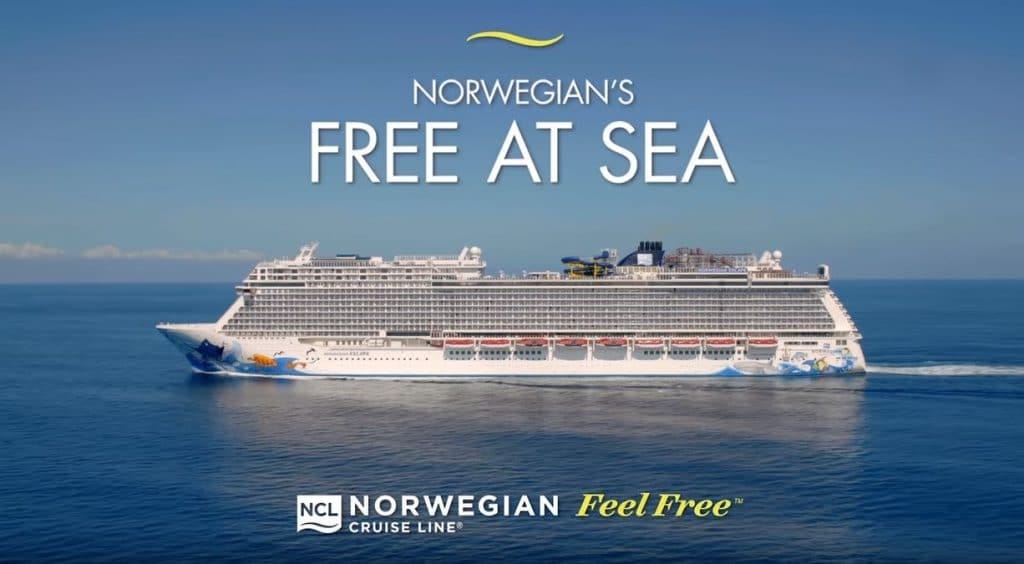
Norwegian is not an all-inclusive cruise line at the base fare level. Understanding the inclusion structure is essential for budgeting accurately.
Included in the standard Norwegian fare:
Accommodation in the booked stateroom
All meals in the main dining room, the buffet, and select complimentary dining venues (The Local pub-style restaurant and the Garden Café buffet on most ships; complimentary dining venues vary by ship)
Entertainment including Broadway-calibre production shows, comedy clubs, and most activity venues
Use of pools, hot tubs, fitness centre, and standard recreational facilities
Youth programmes: Splash Academy for children aged 3 to 12 and Entourage for teens aged 13 to 17
Standard beverages: iced tea, lemonade, filtered water, select juices, milk, drip coffee, and hot tea
Port taxes and fees
Not included in the standard fare, and commonly significant costs:
All alcoholic beverages, sodas, bottled water, and specialty coffees: charged separately unless the Free at Sea package is selected
Wi-Fi: sold by the minute or as a package, charged separately unless included in the Free at Sea package
Gratuities: charged automatically to the account at approximately 20 dollars per guest per day for standard staterooms and 25 dollars per day for suite and Haven guests
Specialty dining: most named restaurants beyond the main dining room and buffet carry a cover charge per person
Shore excursions
Spa treatments
Premium activities such as go-kart racing and virtual reality games
Not included in the standard fare, and commonly significant costs:
All alcoholic beverages, sodas, bottled water, and specialty coffees: charged separately unless the Free at Sea package is selected
Wi-Fi: sold by the minute or as a package, charged separately unless included in the Free at Sea package
Gratuities: charged automatically to the account at approximately 20 dollars per guest per day for standard staterooms and 25 dollars per day for suite and Haven guests
Specialty dining: most named restaurants beyond the main dining room and buffet carry a cover charge per person
Shore excursions
Spa treatments
Premium activities such as go-kart racing and virtual reality games
The Free at Sea programme
Free at Sea is NCL’s bundled-perks promotional programme, which the line offers on most sailings as a way to pre-include the most common add-ons at a discounted rate compared to purchasing them separately. The standard Free at Sea programme includes:
Unlimited open bar (for guests 21 and over): covers premium spirits, cocktails, beer, and wine by the glass (12$ or less).
Specialty dining (number of nights varies by sailing length)
A predetermined amount of minutes of Wi-Fi for all guests in the stateroom based on the length of the sailing (150 minutes per person for a 7 day cruise)
A 50-dollar shore excursion credit per port, applied to the first guest on the reservation
Open bar at Great Stirrup Cay, NCL’s private island in the Bahamas
Free at Sea Plus
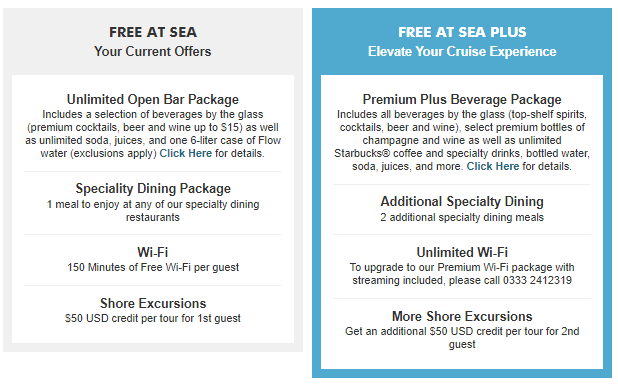
Free at Sea Plus launched for sailings departing from February 1, 2026, at 49.99 dollars per person per day. It layers additional inclusions on top of the standard Free at Sea package and is designed for guests who want a more genuinely all-inclusive experience without the per-drink or per-cup accounting that the standard package still requires in some categories.
Free at Sea Plus adds:
Upgraded open bar with top-shelf spirits not covered under the standard package, including selections such as Patrón Añejo and The Macallan 12 Year Old, up to approximately 50 dollars per drink value
Unlimited Starbucks beverages (on applicable ships)
Bottled water (not included under the standard Free at Sea package)
Unlimited streaming Wi-Fi for one device per guest
A 50 percent discount on specialty dining cover charges for any additional nights beyond the included specialty dining meals
Prepaid service charges (gratuities bundled into the package price, eliminating the separate daily charge)
At 49.99 dollars per person per day, Free at Sea Plus effectively approaches an all-inclusive cost structure for guests who want premium spirits, real Wi-Fi, Starbucks, and no separate gratuity calculation. For a seven-night sailing for two adults, the total cost of Free at Sea Plus versus the standard Free at Sea package (with its mandatory 28.50-dollar gratuity charge) is meaningful, and the value calculation depends heavily on whether the guest would independently purchase the Wi-Fi upgrade, premium spirit access, and daily Starbucks.
The Haven: the ship-within-a-ship
The Haven by Norwegian is NCL’s premium suite tier, present on most modern NCL ships, and represents one of the cruise industry’s most successful executions of the “ship within a ship” concept: a self-contained private zone within the larger vessel with its own pool, sun deck, restaurant, bar, lounge, and 24-hour butler service, physically separated from the rest of the ship and accessible only to Haven guests.
The effect is genuine. Haven guests board through a separate gangway, check in through a private entrance, and move between their suites, the Haven’s private pool deck, and the Haven restaurant without encountering the general ship population unless they choose to venture out. The level of service density in the Haven, with a butler assigned to every suite and a concierge managing activities and reservations, produces an experience that sits between mainstream cruising and the entry level of premium lines.
Haven suite categories vary by ship but include Garden Villas (the largest, often spanning multiple rooms), Penthouse Suites, and Owner’s Suites, down to the entry Haven cabin (a standard-layout stateroom that gains access to the Haven complex). Suites and Haven guests are charged the higher gratuity rate of 25 dollars per person per day. Beverages, specialty dining, and Wi-Fi are not included in Haven fares and are purchased through the standard Free at Sea system unless the relevant packages are added.
Solo studios and the Latitudes solo programme
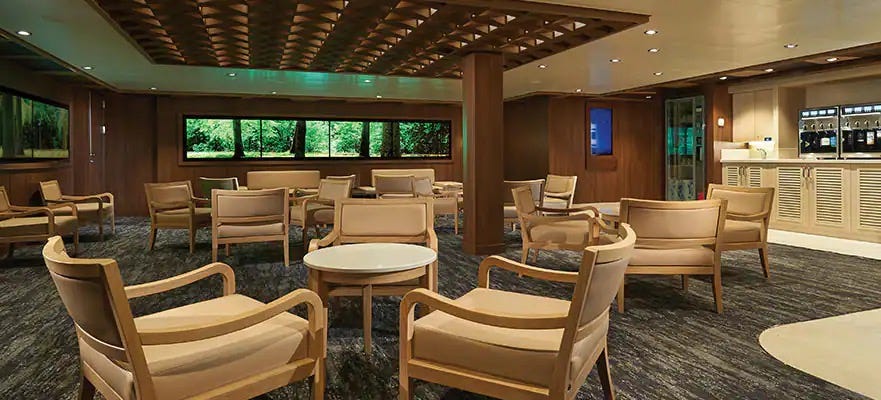
Norwegian pioneered the solo studio cabin, a stateroom category specifically designed for single travellers that eliminates the single supplement, the charge most cruise lines add to fill the revenue gap of a cabin occupied by one person rather than two. NCL’s studio cabins are priced at a rate for one person rather than at double the double-occupancy rate.
Studio cabins are compact, running from approximately 100 to 200 square feet depending on the category (Inside Studio, Virtual Balcony Studio, and Super Studio Ocean View options are available on select ships). The key benefit beyond the price is the Studio Lounge, a private social space accessible only to solo guests, which creates a built-in community for solo travellers and eliminates the social isolation that can be a concern on mainstream ships where programming is oriented around couples and groups.
Norwegian Cruise Line Holdings announced in late 2025 that it plans to reduce the number of single-occupancy cabins across its fleet in future ships, a decision that has drawn criticism from the solo travel community for whom the studio programme was one of NCL’s most distinctive and valued offerings. Solo travellers planning ahead should note that existing ships continue to carry studio cabins through their active service lives.
Great Stirrup Cay and Harvest Caye
Great Stirrup Cay is NCL’s private island in the Bahamas, included as a port of call on most Caribbean and Bahamas itineraries from Florida. In 2025 and 2026, the island is undergoing its most substantial expansion in its history:
A new pier, allowing ships to dock directly rather than requiring tender operations, debuted in late 2025. The Great Tides Waterpark, opening in summer 2026, adds 19 waterslides, a dynamic river, a kids’ splash zone, and cliffside jumps, making it one of the largest waterpark installations on any private island in the Caribbean. A heated pool with swim-up bars is also part of the expansion.
Basic island access, beaches, the existing facilities, and complimentary beverages including water, iced tea, and juice remain included with the cruise fare. The Thrill Waterpark and other premium experiences require separate admission. Alcoholic beverages now require either the separate Great Stirrup Cay island beverage package or the Free at Sea Plus upgrade, following the March 2026 policy change.
Harvest Caye in Belize is NCL’s second private destination, available on select Western Caribbean itineraries, with beaches, a pool, wildlife sanctuary, and water sports. Beverage packages have never been valid at Harvest Caye.
How Norwegian compares to other mainstream and premium lines
Norwegian Cruise Line
Best for: The Freestyle Cruising model with no fixed dining times or dress codes, the widest solo traveller cabin programme in the mainstream market, The Haven ship-within-a-ship suite experience, Pride of America for year-round Hawaii without a foreign port stop, a strong entertainment programme including Broadway-calibre shows, and the broadest itinerary range in the mainstream segment including Alaska, Hawaii, Europe, and the Caribbean.
Royal Caribbean International
Best for: The largest ships in the world (Icon, Star, Legend of the Seas), the widest onboard activity range, Perfect Day at CocoCay where the standard beverage package currently remains valid, and a marginally more family-focused orientation in the megaship design. The Star Class suite experience is broadly comparable to The Haven in concept, with a Royal Genie personal concierge at the top tier.
Carnival Cruise Line
Best for: The lowest headline fares in the mainstream market, a younger and more high-energy social atmosphere, and a strong short-cruise Caribbean product. Less entertainment sophistication than NCL’s Broadway programme and less flexibility in the dining model.
MSC Cruises
Best for: A European-owned alternative with a more international passenger mix, strong Mediterranean itinerary depth, and the MSC Yacht Club as an all-inclusive ship-within-a-ship option. A more formally structured dining environment than NCL’s Freestyle.
Celebrity Cruises
Best for: A meaningful step up in design sophistication, the Always Included fare bundle (beverages, Wi-Fi, and gratuities in the base fare), Daniel Boulud’s Forbes Five-Star restaurant at sea, and an adult-skewing calmer atmosphere. A premium product above NCL’s mainstream positioning.
Princess Cruises
Best for: A modestly quieter mainstream experience with the MedallionClass technology, a strong Alaska and world cruise programme, and the Princess Plus and Premier packages that simplify the extras model. A similar scale to NCL’s mid-tier ships but with less emphasis on thrill-based entertainment.
Who Norwegian is best suited for
Norwegian works best for a specific and very large category of traveller, and Freestyle Cruising is the defining filter.
Guests who want no fixed dining time, no assigned dining companions, and no dress code obligation. The freedom to eat dinner at any point between 5.30 and 10 pm, at any of multiple venues, in whatever clothing is comfortable, remains NCL’s most genuinely distinguishing feature from lines that have formal nights or even semi-formal expectations.
Solo travellers who want to sail without paying a single supplement. The studio cabin programme is the most developed in the mainstream market, and the Studio Lounge creates a genuine social environment for solo guests that no other mainstream line offers with comparable intentionality.
Hawaii travellers who want to visit multiple islands on a single cruise without a foreign port stop, for whom Pride of America is the only practical option in the mainstream cruise market.
Guests who want The Haven experience: the intimacy and service density of a ship-within-a-ship suite at a lower price point than booking a genuinely boutique ship, while still having access to the full entertainment and activity range of a large modern vessel.
Multi-generational families and groups with varied ages and preferences who benefit from the Freestyle format’s ability to let different people eat at different times in different venues and reconnect when it suits rather than on a fixed schedule.
Norwegian is less suited to guests who prioritise a fully all-inclusive base fare without add-on packages, those who want the quietest and most formally refined atmosphere, guests who want the largest ships with the most activity density (Royal Caribbean’s Icon class holds that distinction), or those seeking an expedition or cultural enrichment experience.
Frequently asked questions
What is Freestyle Cruising and does it still matter?
Freestyle Cruising is NCL’s term for the model it introduced around 2000: no fixed dining times, no assigned seating, no formal dress code requirements. In 2026, most mainstream cruise lines have adopted flexible dining in some form, but Norwegian remains the originator and the line for which this flexibility is most structurally embedded across every dining venue and every ship. The absence of any formal night obligation is still meaningful for guests who actively dislike formal dress requirements, and the sheer number of dining venues on modern NCL ships (Norwegian Luna has 17 dining options) makes the flexibility substantively different from competitors who offer two or three flexible options.
Is Norwegian all-inclusive?
No. The base fare covers accommodation, the main dining room, the buffet, select complimentary restaurants, entertainment, pools, and standard non-alcoholic beverages. Alcoholic beverages, specialty dining, Wi-Fi, gratuities, shore excursions, and spa treatments are charged separately. The Free at Sea programme bundles the most common add-ons at a discount, and the mandatory gratuity on the beverage package (approximately 28.50 dollars per person per day) is the most frequently overlooked cost when budgeting from headline fares.
What is The Haven?
The Haven by Norwegian is a physically separate suite complex on most modern NCL ships, with its own pool and sun deck, private restaurant, bar and lounge, and 24-hour butler service, accessible only to Haven guests. It functions as a private boutique hotel within a larger mainstream ship. Entry-level Haven cabin access gives guests the use of the Haven facilities. Penthouse, Owner’s, and Garden Villa suites at the top of the hierarchy represent genuinely spacious multi-room accommodations.
What is the solo studio programme?
NCL introduced studio cabins, staterooms specifically designed and priced for single occupancy without the single supplement most cruise lines charge, making Norwegian the most accessible mainstream cruise line for solo travellers by a significant margin. Studio Cabins run from approximately 100 to 199 square feet and come with access to the exclusive Studio Lounge. Norwegian Cruise Line Holdings announced in late 2025 that future new ships will carry fewer studio cabins, making existing ships increasingly valuable for solo travellers.
What is the Great Stirrup Cay beverage change?
From March 1, 2026, NCL’s standard onboard beverage package is no longer valid at Great Stirrup Cay, the company’s private island in the Bahamas. Guests whose sailing includes a Great Stirrup Cay stop must now purchase a separate island beverage package for alcoholic drinks on the island. Complimentary water, iced tea, and juice remain available at no charge. Free at Sea Plus continues to cover open bar at Great Stirrup Cay. Harvest Caye in Belize has never accepted onboard beverage packages.
What is Pride of America and why is it unique?
Pride of America is the only US-flagged ship in the NCL fleet and the only major cruise ship that can offer year-round seven-night itineraries visiting four Hawaiian islands without any foreign port call. Under the US Passenger Vessel Services Act, only US-flagged vessels may carry passengers between US ports on domestic itineraries. Pride of America’s US registration makes it the only practical option for a cruise entirely within Hawaii for guests who prefer not to stop in a foreign port. It sails from Honolulu visiting Maui, Kauai, and the Big Island every week of the year.
Plan your NCL Cruise with ÆRIA Voyages
Norwegian Cruise Line is one of the most itinerary-flexible mainstream cruise products available, and navigating its add-on structure is the most important planning step before booking. I help clients understand which ships match their departure preferences, whether the Free at Sea package represents genuine value for their travel pattern, and how The Haven compares to a premium-line booking for a similar budget.
If you are curious about pricing, current availability, or whether Norwegian Cruise Line is the right fit for your travel vision, I would be glad to talk it through.
Yvan Junior Blanchette
Travel & Cruise Specialist
ÆRIA Voyages📩 yvanblanchette@aeriavoyages.com
📞 1-888-460-3388
🌐 aeriavoyages.com