

The Infamous Drake Passage: Sail or Fly?
By Yvan junior Blanchette | Travel and Cruise Specialist | ÆRIA Voyages
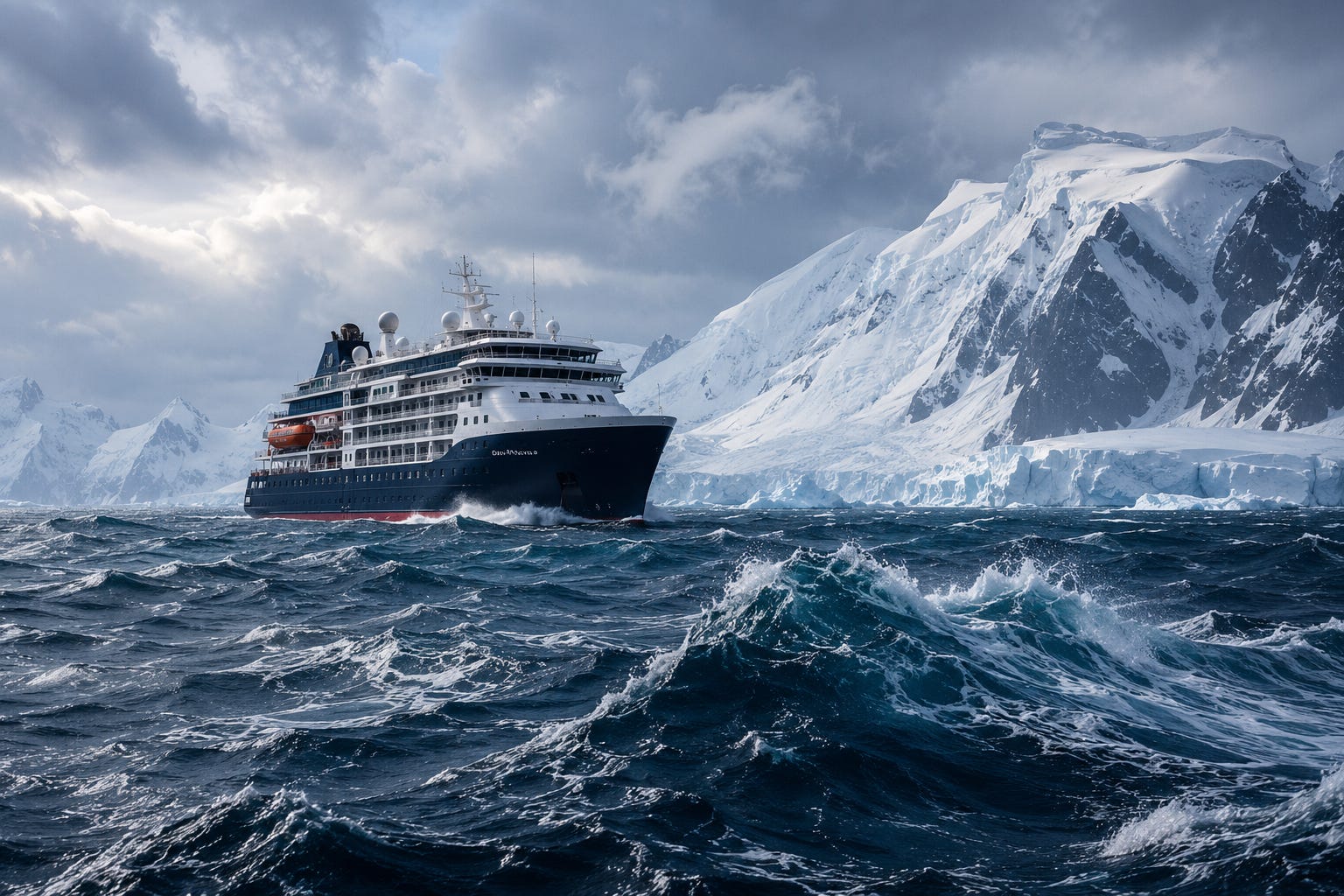
Ask anyone who has been to Antarctica about their trip, and there’s a good chance the conversation starts not with penguins or icebergs, but with the Drake Passage. This 800-kilometer stretch of ocean between Cape Horn and the Antarctic Peninsula has a reputation that precedes it, and for good reason.
It’s where the Atlantic, Pacific, and Southern Oceans collide, funneled through the only gap in the planet where ocean currents circle the globe uninterrupted by land. The result is some of the roughest water on Earth.
For most travelers heading to the White Continent, the Drake is the price of admission. But today, you have a choice: cross it by ship, or skip it entirely and fly. Here’s what you need to know to decide.
What makes the Drake so notorious?
The Antarctic Circumpolar Current pushes an enormous volume of water, far more than any other current on Earth, through a relatively narrow bottleneck. With no landmass to slow the wind, storms in the “Furious Fifties” and “Screaming Sixties” latitudes can whip up swells of 10 meters or more.
Sailors talk about two moods of the passage. The “Drake Lake” is a gentle, almost anticlimactic crossing where the sea barely ripples. The “Drake Shake” is the other version: two days of pitching and rolling, seasickness patches behind every ear, and crew members roping off the outer decks. You won’t know which one you’ll get until you’re in it, and conditions can flip mid-crossing.
Option 1: Sailing the Drake
The classic expedition cruise departs from Ushuaia, Argentina, and takes roughly 48 hours to cross the passage each way. That means four days of your itinerary are spent at sea.
Why people love it. For many, the crossing is the experience. There’s a rite-of-passage quality to it, you earn Antarctica the way explorers of old did. The two days at sea aren’t wasted, either: expedition teams fill them with lectures on glaciology, wildlife, and polar history, and the birdwatching is superb. Albatrosses, petrels, and prions trail the ship for hours.
Crossing the Antarctic Convergence, where the water temperature suddenly drops and the ecosystem changes, is something you feel rather than just read about. And when the first iceberg finally appears on the horizon, the sense of arrival is hard to match.
The downsides. Seasickness is the obvious one. Modern expedition ships have stabilizers, and medication helps most people, but a rough Drake can still put half the passenger list in their cabins. The crossing also eats time: on a 10-day itinerary, you may only get five days in Antarctica itself. And if a storm delays the crossing, that time comes out of your peninsula days.
Cost. Sailing itineraries are generally the more affordable route, with a wide range of ships, cabin categories, and price points.
Option 2: Flying over it
Fly-cruise itineraries, pioneered on routes from Punta Arenas, Chile, replace the crossing with a two-hour flight to King George Island in the South Shetlands, where you board your ship and start exploring almost immediately.
Why people love it. The math is compelling: you trade four days of open ocean for four hours of flying, round trip. That makes a six- or seven-day trip genuinely feasible, perfect if you’re short on vacation time. It’s also the obvious choice if you’re prone to severe motion sickness, have a medical condition that makes rough seas risky, or simply have no interest in testing your sea legs.
The downsides. Flights to King George Island operate under strict weather minimums, and fog or wind can ground planes for a day or more.
Reputable operators build buffer days and contingency plans into their itineraries, but delays are a real possibility. Ironically, the weather can disrupt flyers just as it does sailors.
Fly-cruise trips also tend to cost more per day, and some travelers feel that arriving by plane skips an essential chapter of the story. You also miss the gradual transition, the seabirds, the convergence, the slow buildup of anticipation.
A hybrid option. Several operators offer fly one way, sail the other. You get the full crossing experience once, without doubling your exposure to rough seas, many travelers consider this the best of both worlds.
So, which should you choose?
Sail if: you have 10+ days, you want the full expedition experience, you’re on a tighter budget, or the idea of crossing the world’s wildest ocean excites rather than terrifies you.
Fly if: your time is limited, you suffer badly from motion sickness, or you’d rather spend every possible hour among the icebergs instead of getting to them.
Fly-sail hybrid if: you want the story without the double dose.
Whichever you choose, keep one thing in mind: the Drake Passage is only the beginning. Once you slip into the sheltered channels of the Antarctic Peninsula, with glaciers calving around you and penguins porpoising alongside the zodiacs, the crossing, smooth or savage, becomes just the first chapter of a story you’ll be telling for the rest of your life.
Yvan Junior Blanchette
Travel & Cruise Specialist
ÆRIA Voyages📩 yvanblanchette@aeriavoyages.com
📞 1-888-460-3388
🌐 aeriavoyages.com