

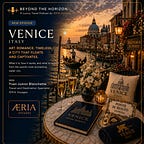
In this episode, we explore Venice, the most improbable city ever built, a place that has no right to exist and yet has existed for over a thousand years, rising from a lagoon on wooden piles driven into the mud of the Adriatic, where there are no cars, no roads, and no straight lines, where every journey is made by foot or by boat, and where the accumulated weight of art, architecture, and history is so dense that it takes several days simply to begin to understand what you are looking at.
We cover everything you need to know before planning a visit, including:
What makes Venice immediately feel unlike any other city in the world, from the silence that replaces traffic the moment you step off the train or the water taxi, to the disorienting beauty of navigating a city whose logic is entirely different from anything you have experienced before, and why the single best thing you can do on your first morning is to put the map away and simply walk
The sestieri worth knowing: San Marco and the Piazza as the ceremonial heart of the city and the place every visitor arrives at first, Dorsoduro for its art institutions, student energy, and the finest evening aperitivo scene in Venice, Cannaregio for the Jewish Ghetto as one of the most historically significant neighborhoods in Europe and the quieter residential character of the northern lagoon edge, San Polo and Santa Croce for the Rialto market and the densest concentration of Gothic architecture in the city, and Castello as the largest and most local sestiere, stretching toward the Arsenal and largely free of tourist crowds
The Piazza San Marco in full: the Basilica di San Marco as the most extraordinary Byzantine building in Western Europe and why arriving before 9am changes the experience entirely, the Palazzo Ducale and the Bridge of Sighs, the Campanile and the view it gives over the lagoon and the terracotta rooftops, and the honest answer to the question of whether the famous cafes on the Piazza are worth the price (once, yes)
The art institutions that make Venice one of the most important cities in the world for anyone who cares about painting: the Gallerie dell’Accademia as the definitive collection of Venetian painting from Bellini through Titian, Tintoretto, and Veronese, the Peggy Guggenheim Collection for the finest museum of modern art in Italy, the Punta della Dogana for contemporary art in a converted customs house at the tip of Dorsoduro, and the Scuola Grande di San Rocco where Tintoretto’s ceiling paintings are among the most ambitious works in the history of art
The Grand Canal and the vaporetto: why taking the Number 1 vaporetto from the train station to San Marco, slowly, is the finest free experience in Venice and the best possible introduction to the city, the Rialto Bridge and what the canal looks like from its top at different times of day, and why a private water taxi from Marco Polo Airport, despite its cost, is the arrival experience that Venice deserves
The food culture that defines the city: cicchetti as the Venetian answer to tapas and the bacaro crawl through the narrow streets of San Polo as one of the great evening rituals of Italian travel, fresh seafood from the Rialto fish market including sarde in saor, baccala mantecato, and risotto di gò, the spritz as the aperitivo of the lagoon, and where to eat well in a city where tourist traps are more concentrated than almost anywhere in Italy
The islands of the lagoon and why they deserve more than an afternoon: Murano for glassblowing in a tradition that has been continuous since 1291, Burano for its painted fishermen’s houses and the best lace workshops in the Veneto, Torcello as the most haunting and ancient island in the lagoon with a cathedral that predates Venice itself, and the Lido for a completely different understanding of what the Venetian lagoon contains
The Biennale and why it matters: the Venice Architecture Biennale and the Venice Art Biennale as the two most important recurring cultural events in the world, what the city looks like during Biennale years, and how to plan a visit around them
The overtourism question addressed directly: what day-tripper crowds actually look like on the Rialto and around San Marco in July and August, why staying overnight transforms the city (when the day visitors leave, Venice becomes a different place entirely), the day visitor entry fee introduced in recent years and its practical implications, and why the city at 6am belongs entirely to those who slept there
When to visit: why November and February offer Venice at its most atmospheric and least crowded, what acqua alta actually means for a visit and how to navigate it, why Carnevale in February is one of the great seasonal experiences in Europe, and why June through August is simultaneously the most popular and the most challenging time to be there
How Venice fits into a broader Italy or Adriatic itinerary, as the northeastern anchor of a rail journey through Verona and Padua, as the starting point for a Dolomites extension by car or bus, or as a cruise departure point for the Adriatic and eastern Mediterranean
Whether you are visiting Italy for the first time or returning to finally give Venice the two or three nights it genuinely requires, this episode makes the case for why no other city on earth offers what Venice offers, and how to experience it with the depth and the timing that makes the difference between a beautiful but overwhelming visit and one that stays with you for the rest of your life.
Resources mentioned in this episode Full article:
Available on the ÆRIA Voyages Blog.
✈️ Find the best flights to Venice
🛜 Stay connected while away with a travel eSim

Plan your itinerary in Italy As a travel advisor, I’m here to turn your ideas into a journey that truly reflects who you are. Don’t hesitate to reach out, I’d be delighted to guide you every step of the way.
📩 yvanblanchette@aeriavoyages.com
📞 1-888-460-3388
Subscribe to Beyond the Horizon for new episodes on cruise lines, destination guides, and travel tips from ÆRIA Voyages.


