

Hurtigruten and HX: What they are, How they work, and What to expect
Cruise guide · Updated 2026 · Norwegian Coastal Express · 34 ports · Northern Lights guarantee · HX Expeditions · Antarctica · Arctic · Hybrid ships · All-inclusive
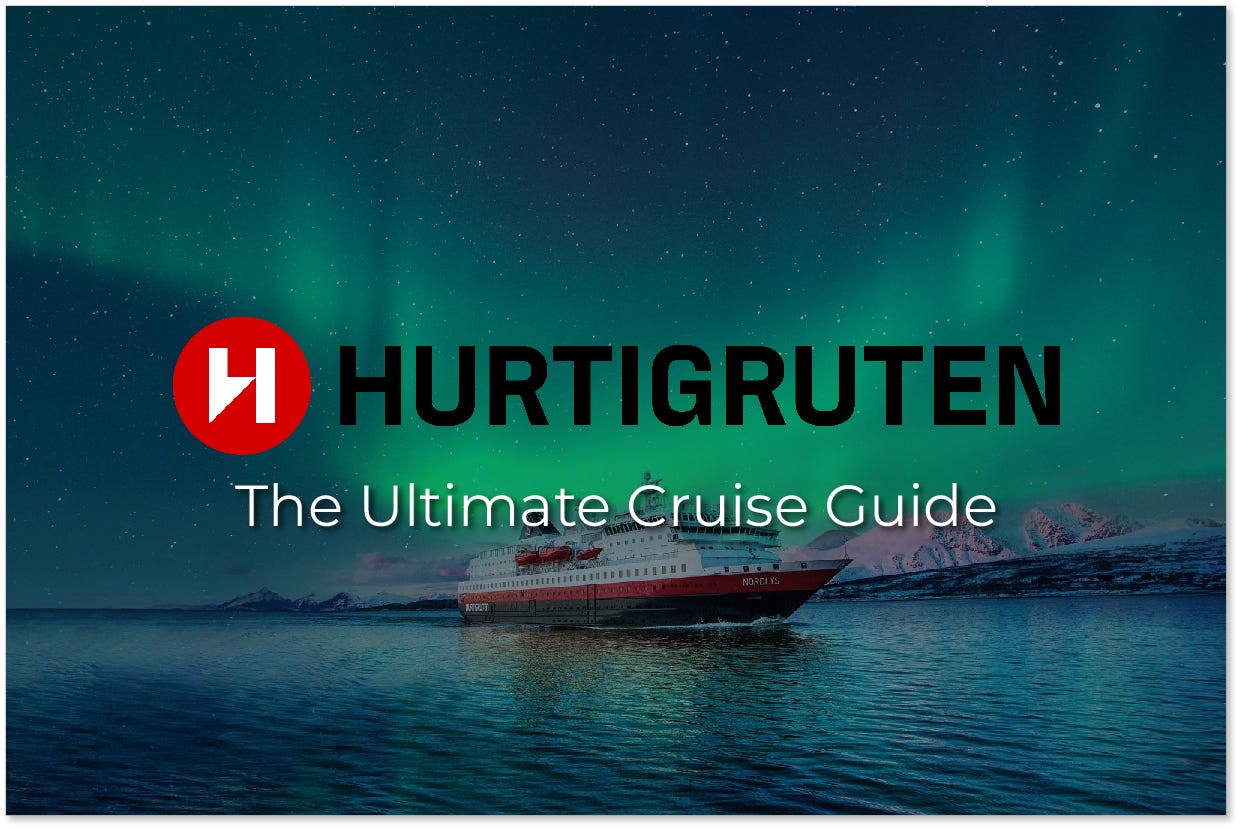
Hurtigruten is one of the most misunderstood names in travel, and in 2026 it is also one of the most important to understand precisely, because what was once a single brand is now two distinct companies with different products, different ships, different ownership structures, and different target travellers.
Hurtigruten, the original Norwegian coastal route operating since 1893, continues to sail the same 34 ports between Bergen and Kirkenes in an unbroken daily service that carries locals, cargo, and visitors through some of the most dramatic coastal scenery on Earth. HX, formerly Hurtigruten Expeditions, is the global polar and remote-destination brand, now independently owned, operating five ships to Antarctica, the Arctic, the Galápagos, Alaska, and beyond on a fully all-inclusive model.
This guide covers both brands: the history of the route, the brand split, the Norwegian coastal voyage in detail, the Signature Line, the Northern Lights guarantee, and the HX expedition fleet and its all-inclusive model. Understanding which product you are booking, and why, is the essential starting point.
Table of Content
🎧LISTEN TO THE BEYOND THE HORIZONS PODCAST
COMING SOON…
A brief history: from 1893 to the brand split
The Hurtigruten route has one of the most specific founding stories in all of travel. In 1893, a Norwegian sea captain named Richard With, sailing aboard the steamship Vesteraalen, completed the first voyage along what would become the Coastal Express route, connecting Bergen in the southwest to Hammerfest in the far north. The name Hurtigruten, meaning literally “the fast route,” described a service designed to link the isolated fishing communities and port towns of the Norwegian coast more reliably than overland transport could in the country’s mountainous terrain.
For the decades that followed, Hurtigruten was not a cruise product. It was a working coastal ferry service subsidised by the Norwegian government to carry passengers, cargo, post, medicine, and essential goods to communities that had no other consistent supply line. Eleven ships call at each of the 34 ports along the route every single day of the year, in both directions, in every season, through Arctic winter storms and summer midnight sun alike. The ships have carried mail, cars, livestock, and locals to villages that would otherwise be cut off. For generations of Norwegians, Hurtigruten was simply how you got from one place to another along the coast.
The leisure travel dimension developed gradually as the route’s scenic character attracted tourists, initially Scandinavian and then international, who wanted to see the fjords, the Northern Lights, the Lofoten Islands, and the North Cape from a ship rather than a tour bus. By the late twentieth century Hurtigruten had become one of the most widely cited “world’s most beautiful voyages,” and the international guest mix on any sailing began to rival the local Norwegian passenger count.
The corporate structure became more complex in the 2010s as the company expanded into expedition cruising beyond Norway, eventually operating in Antarctica, Greenland, Iceland, Alaska, and beyond under the Hurtigruten Expeditions banner. In September 2023, the company completed a formal brand split: the Norwegian coastal operation retained the Hurtigruten name, and the global expedition business was rebranded as HX. In November 2024, both companies were sold separately: HX to a consortium of investors for 140 million euros, Hurtigruten AS to a separate group for 110 million euros. The two brands now operate independently under different ownership while sharing a common history.
Hurtigruten: the Norwegian Coastal Express
The route
The Coastal Express sails from Bergen in the south to Kirkenes in the far northeast of Norway, 2,500 nautical miles through fjords, channels, islands, and open Arctic ocean. The northbound voyage takes seven days and six nights, calling at 34 ports. The southbound voyage takes six days, calling at 33 of the same ports in reverse. The complete roundtrip takes 12 days.
No two ports are the same. The route passes through the UNESCO-listed wharf district of Bryggen in Bergen, the Art Nouveau architecture of Ålesund, the medieval cathedral city of Trondheim, the fishing settlements of Helgeland, the dramatic peaks of the Lofoten Islands, the gateway city of Tromsø, the North Cape, and finally Kirkenes near the Russian border, where the scenery shifts from Atlantic green to Arctic white depending on the season.
Port stays vary enormously, from 15 to 30 minutes at smaller stops to several hours at major cities. The ship docks at each port, disembarks local passengers and cargo, takes on new ones, and continues. Guests who have booked leisure voyages use the longer stops for excursions and independent exploration. Shorter stops are best observed from the deck.
The route operates 365 days a year regardless of weather. In winter, the same passage that is bathed in midnight sun in June crosses the Arctic in polar darkness in January, with temperatures well below freezing and the possibility of the Northern Lights overhead. Both are genuine travel experiences, and the contrast between the summer and winter versions of the same route is one of the most remarkable in ocean travel.
The two voyage types: Original and Signature
Hurtigruten currently offers the coastal route in two formats that differ significantly in what they include and the type of ship that sails them.
The Original Coastal Express is the closest thing to the traditional Hurtigruten experience: a working coastal voyage on ships that still function as a genuine public service, carrying locals alongside leisure travellers. Seven ships sail the Original route. All include breakfast, lunch, and dinner in the main restaurant. Beverages beyond tea, filter coffee, and water are not included. Shore excursions are available at additional cost. The experience is atmospheric, authentic, and unhurried, but not a curated luxury product. The ship you board, which depends on your departure date, is assigned rather than chosen, though MS Vesterålen, the smallest and most classic ship in the fleet at 274 guests, is particularly loved by guests who want the most intimate coastal experience.
The Signature Line is a newer and more structured product operating on selected ships including MS Trollfjord, MS Finnmarken (now MS Otto Sverdrup after a name change in 2025), and from May 2026, MS Midnatsol. Signature voyages are more inclusive: food and drink in at least two onboard restaurants, a six-person Coastal Experience Team providing lectures, port talks, and guided excursions, and a programme of themed onboard activities. The North Cape Line (sailing from Bergen or Hamburg to the North Cape) and the Svalbard Line (sailing from Bergen to Longyearbyen) operate under the Signature format. MS Midnatsol joins the Signature fleet in May 2026, sailing both the Svalbard Line and the North Cape Line from Hamburg.
The Northern Lights guarantee
Hurtigruten’s most discussed selling point for winter voyages is the Northern Lights Promise, and understanding its terms precisely matters before booking around it.
The guarantee applies to all voyages of 11 days or more along the Norwegian coast, on Original and Signature sailings, departing between September 20 and March 31. If the Northern Lights do not occur within sight of the ship and are not recorded by the deck officers and announced to passengers, Hurtigruten will provide a complimentary six-day southbound coastal voyage on a future departure.
What the guarantee does not promise is when or how dramatically the lights will appear. A brief display of a few minutes counts as a sighting and fulfils the guarantee. The Northern Lights are a meteorological and astronomical phenomenon that cannot be scheduled. The value of the guarantee is that it reduces the financial risk of booking a long winter voyage specifically for the aurora, not that it guarantees a spectacular display. For many guests, the chance of a free return voyage is itself a meaningful incentive.
The fleet in 2026
Hurtigruten AS operates ten ships on the Norwegian coastal route. All ships share the essential character of the Coastal Express: a Norwegian registered working vessel that happens to offer very fine scenery along the way, rather than a purpose-built cruise ship that happens to call at Norwegian ports. The ships range in size from MS Vesterålen at 274 guests to the larger modern ships accommodating up to 1,000 passengers.
Each ship is named for a Norwegian place or concept connected to the Arctic and coastal tradition. MS Polarlys (polar light), MS Nordkapp (North Cape), MS Nordnorge (North Norway), MS Richard With (the founder), MS Vesterålen (the island group where the first voyage originated), and MS Midnatsol (midnight sun) are among the current fleet. All share the same essential route and the same soul.
Cabin categories across the fleet span four levels: inside cabins without a window, standard outside cabins with a sea view window, and suites with larger dimensions and superior positioning. The cabins are functional and comfortable rather than lavishly appointed, consistent with the hybrid nature of the product as both a working ferry and a leisure vessel.
What is included and what is not
Original Coastal Express:
Breakfast, lunch, and dinner in the main restaurant Torget
Tea, filter coffee, and water throughout the day
Use of all public spaces on board
The scenery, which is always included
Not included: all other beverages, shore excursions, Wi-Fi (available for purchase), and single supplements which apply.
Signature Line:
All meals in at least two onboard restaurants including the main dining room and the premium Kysten restaurant
A selection of beverages included (the extent varies by voyage; full details confirmed at booking)
The six-person Coastal Experience Team, port talks, and lectures
Wi-Fi access on Signature voyages
Not included on Signature: some premium beverages, private excursions, and single supplements.
HX Expeditions: the global expedition brand
What HX is and how it differs from Hurtigruten
HX, which stands for Hurtigruten Expeditions, was rebranded from Hurtigruten Expeditions in September 2023 and formally sold to a separate investor consortium in November 2024. It shares Hurtigruten’s history and Norwegian identity but is now a completely distinct company with its own management, fleet, and product positioning.
HX operates five expedition ships to some of the world’s most remote destinations, including Antarctica, the Arctic, the Galápagos Islands, Alaska, Iceland, Greenland, and the Northwest Passage. Since November 2024, HX has operated as a fully all-inclusive expedition brand, making it one of the most genuinely comprehensive expedition cruise products in the market.
For travellers researching the Hurtigruten name and wondering about Antarctica or Greenland voyages, the answer as of 2026 is that those voyages sail under the HX brand. For travellers interested specifically in the Norwegian coast, they sail under the Hurtigruten brand. The two are now different companies, booked separately, with different ships, different inclusions models, and different price points.
The HX fleet in 2026
HX operates five ships, ranging from the flagship hybrid vessels to the intimate Galápagos charter.
MS Fridtjof Nansen entered service in 2020 and, together with her sister ship MS Roald Amundsen, represents the technological core of the HX operation. Both are the world’s first battery-hybrid-powered expedition cruise ships, combining hybrid-electric propulsion systems with highly efficient engines, a heat recovery system, and an innovative hull design that reduces fuel consumption. Each carries approximately 490 guests, which is large for a polar expedition ship and produces a different social atmosphere from the intimate vessels of Seabourn or Viking Expeditions. Both ships feature panoramic saunas, outdoor hot tubs, infinity pools, and an onboard Science Centre. Named after the Norwegian explorer, scientist, and Nobel Peace Prize laureate Fridtjof Nansen, she explores Antarctica, Greenland, Iceland, and the Northwest Passage.
MS Roald Amundsen entered service in 2019 as the first of the two hybrid flagships, named for the Norwegian polar explorer who was the first person to reach the South Pole. She is identical in specification to Fridtjof Nansen and operates a similar global itinerary range.
MS Fram is a smaller and more manoeuvrable vessel carrying approximately 318 guests, named for the famous Norwegian polar ship that carried both Nansen and Amundsen on their expeditions. She was recently upgraded with new cabins and a state-of-the-art Science Centre. Fram is particularly well-suited to the most demanding polar landings and the deepest reaches of the Antarctic Peninsula where larger ships cannot operate as flexibly.
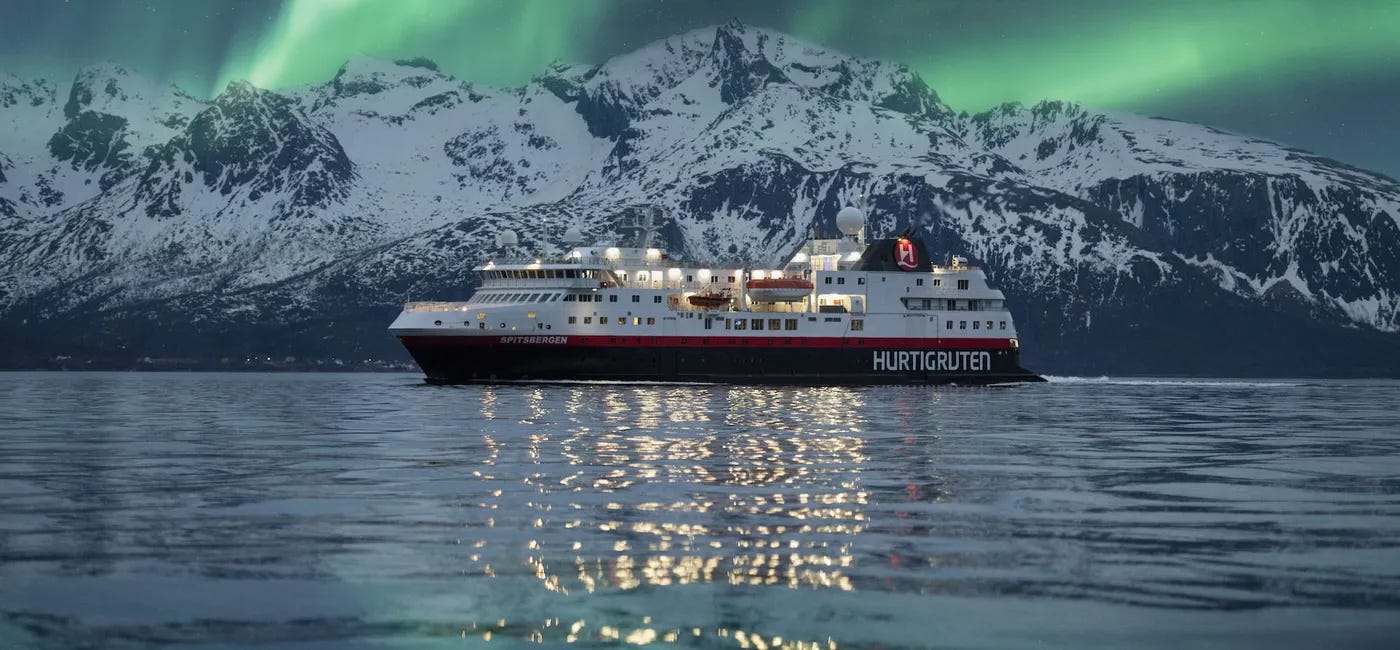
MS Spitsbergen carries approximately 200 guests and operates primarily in Svalbard, Greenland, Iceland, and Arctic Norway, where her smaller size gives access to landing sites and anchorages unavailable to the larger ships.
MV Santa Cruz II is a charter vessel of approximately 90 guests operating exclusively in the Galápagos Islands, providing HX’s dedicated Galápagos programme.
What HX includes: the all-inclusive model since November 2024
Since November 2024, HX has offered a fully all-inclusive expedition product. This is one of the most comprehensive inclusions models in the expedition segment and represents a significant departure from the partial-inclusion model the brand operated under previously.
Included in every HX fare:
All meals on board across all dining venues, full board
All alcoholic and non-alcoholic beverages throughout the day and evening: house wine, beer, and spirits available at all times, not just with meals
All daily guided expedition activities: Zodiac landings, small-boat cruising, guided hikes, and wildlife encounters
A premium expedition jacket to keep, a reusable water bottle, and loan of waterproof boots and trekking poles for use during the voyage
A complimentary digital photo album from the onboard professional photographer
Gratuities for all crew
Starlink Wi-Fi where geography allows
Port taxes and fees
Professional lectures and Science Centre programmes on every voyage
Access to the onboard Science Centre for guest participation in research projects
Not included: optional premium excursions beyond the daily programme, spa treatments, and retail purchases.
The inclusion of the expedition jacket and photography is particularly distinctive: few expedition lines routinely provide a custom jacket to keep as part of the standard fare, and the professional photography inclusion eliminates the largest incidental purchase most expedition guests make.
The Science Centre: HX’s defining onboard feature
Every HX ship carries an onboard Science Centre, a dedicated research and education facility staffed by the ship’s scientific team and open to guest participation. This is not a passive lecture hall. Guests can contribute to real scientific observation projects, including wildlife surveys, oceanographic measurements, water sampling, and species documentation that contribute to ongoing polar research programmes. The data collected on HX voyages has been used in published academic research.
The Science Centre is the clearest expression of HX’s philosophy that expedition travel should produce genuine outcomes beyond personal experience. It separates the brand most clearly from expedition competitors that offer lectures and naturalist guides but no framework for guest participation in science.
The HX itinerary range in 2026
The HX programme covers more than 80 itineraries across five continents and some of the most remote marine environments accessible to any passenger vessel.
Antarctica is the anchor of the HX season, with Fridtjof Nansen and Roald Amundsen operating the flagship 12-day Antarctic Peninsula expedition from Ushuaia and a range of longer itineraries including South Georgia and the Falkland Islands. The 490-guest capacity of the flagships means that IAATO landing group regulations require rotation across five groups rather than the two or three typical on smaller vessels. This is the most commonly cited limitation by guests comparing HX to smaller expedition lines.
Arctic Norway and Svalbard are covered by MS Spitsbergen and, in the summer, by the flagships. The 2026 programme includes dedicated Northern Lights expedition voyages in winter and Svalbard wildlife expeditions in summer.
Greenland and Iceland sailings run in the shoulder seasons with fly-cruise options including a partnership with Air Greenland for direct flights to remote departure points.
Alaska’s Inside Passage is part of the 2026 programme with nine and twelve-night itineraries introduced for the season.
The Northwest Passage voyages are among the most ambitious in the fleet, sailing the legendary Arctic route that defeated generations of explorers, offered only in the narrow summer window when ice conditions permit.
The Galápagos Islands are served exclusively by the Santa Cruz II charter on dedicated eight-night Eastern, Western, and Northern circuit itineraries.
New for 2026: a seven-night Ultimate Norway Arctic Expedition under the Northern Lights, a special Ultimate Norway at Christmas voyage, and new sailings departing from Dover, UK, and Hamburg, Germany.
How Hurtigruten and HX compare to other lines
Hurtigruten (Coastal Express)
Best for: The world’s most celebrated coastal voyage, sailing the same route that has connected Bergen and Kirkenes since 1893, through fjords and Arctic landscapes with working-port authenticity. Not a curated luxury cruise. A journey of genuine character where the route and the scenery are the product.
HX Expeditions
Best for: Value-accessible all-inclusive polar expedition with the world’s first hybrid-powered expedition ships, a fully all-inclusive model since November 2024 including premium spirits and an expedition jacket to keep, and a Science Centre for guest participation in genuine research. Ships carry 200 to 490 guests, larger than most ultra-luxury competitors, which produces lower pricing at a cost to landing group intimacy.
Viking Expeditions (Octantis and Polaris)
Best for: The most acclaimed expedition design at 378 guests per ship, voted number one by Condé Nast and Travel + Leisure, with a submarine on Octantis and library curated by Cambridge University’s Scott Polar Research Institute. Gratuities are now charged separately. A higher price point than HX with a more intimate group experience.
Seabourn Expedition
Best for: Ultra-luxury fully all-inclusive polar expedition, two submarines on Venture and Pursuit, Thomas Keller dining, ships carrying 264 guests. The most refined onboard experience in polar cruising at the highest price point.
Scenic (Discovery Yachts)
Best for: The most technologically ambitious ultra-luxury expedition, 228 guests per ship, two helicopters and a submarine per ship (at additional cost), fully all-inclusive including premium spirits. A significantly higher price point than HX.
Silversea
Best for: The broadest polar destination range globally, the most ice-capable vessel at sea (Silver Endeavour), fully all-inclusive, ships from 100 to 334 guests in the expedition fleet. The deepest polar and remote-destination coverage in the ultra-luxury segment.
Who Hurtigruten is best suited for
The Norwegian Coastal Express is best suited for:
Travellers who want to experience Norway as Norwegians experience it, aboard a working ship that serves real communities rather than a ship designed entirely for leisure guests
Guests whose primary interest is the scenery: the fjords, the Lofoten Islands, the Trollfjord, the North Cape, and the Arctic tundra experienced from the deck of a ship that stops at every inhabited port along the way
Northern Lights hunters who want a structured voyage with the Northern Lights Promise and the understanding that the guarantee provides a fallback, not a performance
History and culture travellers who find the authenticity of a 130-year-old public service route more compelling than a purpose-built cruise itinerary
Guests who want a relatively accessible price point for a genuinely extraordinary journey
Who HX is best suited for
HX is best suited for:
First-time expedition cruisers who want a comprehensive all-inclusive model at a price point below ultra-luxury, with expert guidance, Zodiac landings, and the Science Centre experience without the commitment of Seabourn or Silversea pricing
Active travellers who want daily guided activities, hiking, and wildlife encounters as the core of the voyage, with a fully all-inclusive beverage and dining model around them
Solo travellers: HX actively caters to solo guests, releasing cabins with no single supplement on selected sailings and maintaining a solo supplement well below the industry norm on others
Guests whose primary interest is Antarctica at the most accessible price point among polar expedition operators, with the hybrid ships, the all-inclusive model, and the scientific engagement of the Science Centre
Travellers interested in the Galápagos Islands through the dedicated Santa Cruz II charter programme
Frequently asked questions
Are Hurtigruten and HX the same company?
No, as of November 2024 they are two completely separate companies under different ownership. Hurtigruten AS operates the Norwegian Coastal Express and was sold for 110 million euros. HX was sold for 140 million euros to a separate investor consortium. Both share the history and Norwegian identity of the original Hurtigruten brand but operate independently with different fleets, different products, and different booking systems.
What is the Northern Lights Promise?
Hurtigruten guarantees that guests on voyages of 11 or more days, departing between September 20 and March 31 on the Norwegian Coastal Express, will receive a complimentary six-day return voyage if the Northern Lights are not sighted from the ship and recorded by the deck officers. A sighting of any duration counts as fulfilling the guarantee. The guarantee applies to Original and Signature voyages and reduces the financial risk of booking a winter voyage specifically for the aurora.
Is HX fully all-inclusive?
Yes, since November 2024. HX includes all meals, all beverages including premium spirits throughout the day and evening, all daily expedition activities and Zodiac landings, a professional expedition jacket to keep, a reusable water bottle, loan of waterproof boots and trekking poles, a complimentary professional photo album, gratuities, and Wi-Fi where available. Spa treatments, optional premium excursions, and retail purchases are charged separately.
How large are the HX ships and does that affect the expedition experience?
The two flagship hybrid ships, MS Fridtjof Nansen and MS Roald Amundsen, each carry approximately 490 guests. This is the largest capacity in the premium expedition segment and means that IAATO regulations require landing groups to rotate in five shifts rather than the two or three on smaller vessels. The practical effect is that each individual’s shore time at any given landing is shorter than on a 200 to 378-guest competitor. HX compensates with significantly more departures per season, broader itinerary choice, and a lower entry price point. MS Fram at 318 guests and MS Spitsbergen at 200 guests offer more intimate experiences in their respective deployment areas.
What makes the HX Science Centre different from a lecture programme?
The Science Centre on every HX ship is a dedicated research facility where guests can participate in actual data collection and scientific observation, including wildlife surveys, oceanographic sampling, and species documentation. The data gathered on HX voyages is contributed to active polar research programmes and has been incorporated into published academic work. This is distinct from a passive lecture series where guests listen to experts. HX guest participation produces real scientific outcomes.
What is the difference between an Original and a Signature coastal voyage?
Original voyages are the most authentic Hurtigruten experience, sailing on traditional working coastal ships with meals included but beverages charged separately, no structured shore programme, and the same ships that carry local Norwegians between ports. Signature voyages operate on selected modern ships with a more inclusive fare that covers food and drink in at least two restaurants, a six-person Coastal Experience Team providing talks and guided activities, and a more curated guest experience overall. Signature sailings include the Svalbard Line to Longyearbyen and the North Cape Line from Hamburg.
Plan your Hurtigruten or HX Cruise with ÆRIA Voyages
Every voyage on both the Hurtigruten coastal route and the HX expedition programme is different depending on season, direction, ship, and destination. I help clients navigate those choices: from understanding whether the Northern Lights Promise makes a November or February departure more appropriate, to comparing HX’s all-inclusive model against Viking Expeditions or Seabourn for an Antarctica voyage, to advising on which HX ship best suits a solo traveller booking the Galápagos.
If you are curious about pricing, current availability, or whether Hurtigruten or HX is the right fit for your travel vision, I would be glad to talk it through.
Yvan Junior Blanchette
Travel & Cruise Specialist
ÆRIA Voyages📩 yvanblanchette@aeriavoyages.com
📞 1-888-460-3388
🌐 aeriavoyages.com