

Lindblad Expeditions / National Geographic: What it is, How it works, and What to expect
Cruise guide · Updated 2026 · Premium expedition · American · NatGeo partnership · X-Bow polar ships · Certified Photo Instructor on every departure
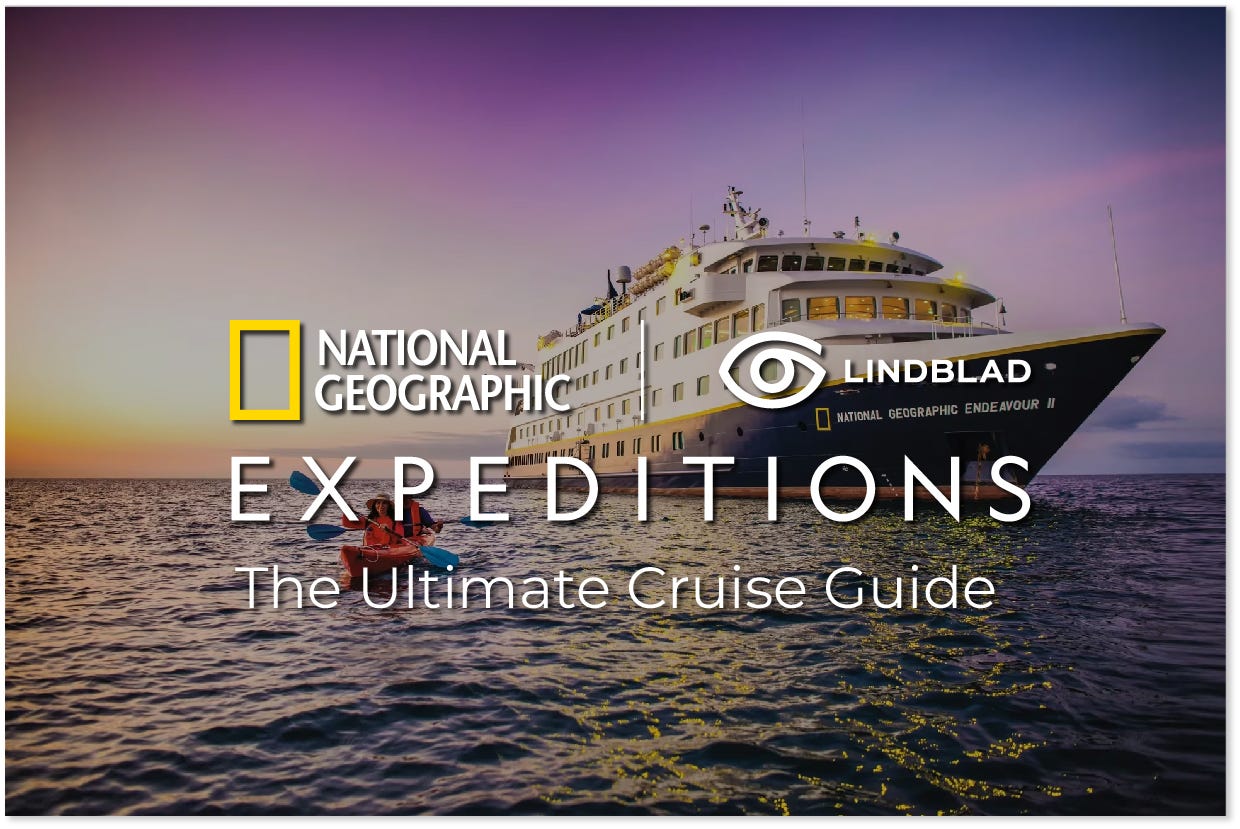
Lindblad Expeditions did not enter the expedition cruise market. It created it. On January 23, 1966, Lars-Eric Lindblad led the first tourist expedition to Antarctica, chartering an Argentine naval supply ship to carry 57 passengers to the Antarctic Peninsula from Ushuaia. The following year, he brought the first tourists to the Galápagos Islands. Both voyages are now understood as the founding events of modern expedition cruising.
In 2026, on the 60th anniversary of that first Antarctic voyage, the company he started, now operating as National Geographic-Lindblad Expeditions, runs a fleet of 24 ships, maintains a partnership with the National Geographic Society extended through 2040, and continues to hold every ship in the fleet to a maximum capacity of 148 guests.
This guide covers the Lindblad family history and the founding of expedition travel, how the National Geographic partnership works in practice, the fleet by programme area, what is and is not included, the photo programme and the OM System gear locker, the undersea specialist programme, the Galápagos fleet, the two X-Bow polar ships, new platforms in 2026, the conservation programmes, and how Lindblad compares to the expedition competition.
Table of Content
🎧 LISTEN TO THE BEYOND THE HORIZON PODCAST
EPISODE COMING SOON…
The Lindblad family and the founding of expedition travel
Lars-Eric Lindblad was born in Sweden and founded Lindblad Travel in Westport, Connecticut, in 1958. His philosophy was simple and radical for the time: that educated people who saw extraordinary places with their own eyes would become the most potent force for their preservation. He charted itineraries to places that had no tourist infrastructure and, in most cases, no previous civilian visitors.
In January 1966, Lindblad Travel chartered the Argentine naval supply ship Lapataia and carried 57 passengers from Ushuaia to the Antarctic Peninsula, the first commercial tourist expedition to Antarctica in history. In 1967, he organised the first tourist expedition to the Galápagos Islands. These two voyages, separated by one year, established the entire model of expedition cruising: small groups, expert naturalists, remote destinations, active shore engagement rather than passive observation from deck. Lars-Eric Lindblad is now universally regarded as the father of ecotourism.
In 1979, his son Sven-Olof Lindblad founded Special Expeditions as a subsidiary of Lindblad Travel, concentrating specifically on marine-based adventures and taking the expedition philosophy into small-ship ocean operations. Special Expeditions decoupled from Lindblad Travel in 1982 and was renamed Lindblad Expeditions in 2000. Sven-Olof expanded the company’s conservation commitments, introduced kayaking in polar regions and the Galápagos, and established the undersea programme that has become one of the most distinctive features of the fleet.
In October 2004, Lindblad Expeditions entered its defining partnership with the National Geographic Society, integrating National Geographic photographers, scientists, and editorial expertise into its expedition programme and renaming all fleet vessels with the National Geographic prefix. The partnership was renewed in November 2023 for a further seventeen years, extending through 2040. In August 2024, the company formally rebranded as National Geographic-Lindblad Expeditions, placing the National Geographic name first to reflect the partnership’s centrality to the product.
Sven-Olof Lindblad stepped down as CEO on January 1, 2025, appointing Natalya Leahy as CEO while himself becoming Co-Chair of the Board. The company remains listed on the NASDAQ exchange under the ticker LIND and is headquartered in New York City.
On January 23, 2026, National Geographic-Lindblad Expeditions celebrated the 60th anniversary of civilian polar travel, marking the exact date of Lars-Eric Lindblad’s 1966 departure to Antarctica.
The National Geographic partnership: what it means in practice
The partnership with the National Geographic Society is not a licensing arrangement or a branding agreement. It is a working relationship that places National Geographic scientists, photographers, editors, and explorers aboard ships and within the expedition programme, and that extends National Geographic’s century-long editorial and scientific authority into the guest experience.
In practical terms, the partnership delivers four things that are specific to National Geographic-Lindblad Expeditions and unavailable on any other expedition line:
A National Geographic Certified Photo Instructor (CPI) on every single departure. Every voyage across the National Geographic fleet includes a CPI, an individual who has completed a rigorous certification programme designed jointly by Lindblad and National Geographic. CPIs are naturalists and photographers simultaneously: they provide instruction, help guests understand their cameras in the specific conditions of the destination, and lead photography-focused activities during landings and Zodiac excursions.
A National Geographic Photographer on select ships. On National Geographic Endurance, National Geographic Explorer, National Geographic Orion, and National Geographic Resolution, a veteran National Geographic Photographer joins the expedition team on departures. These are working photographers who have spent decades contributing to National Geographic Magazine and other editorial platforms, and they sail to make images, share their working methods, and engage with guests as professional colleagues in the field.
The OM System Photo Gear Locker. In partnership with OM System (formerly Olympus), every National Geographic-Lindblad ship (except those in the Galápagos fleet) provides a gear locker of the latest OM System cameras, lenses, and accessories for guests to borrow at no charge throughout the voyage. This allows guests without professional-grade equipment to use it in environments where it matters most, and those who want to test a system before purchasing to do so in field conditions.
The National Geographic Explorers-in-Training programme. Designed for families with children, the programme uses certified field educators to teach children to observe, document, and think about nature and culture in the manner of a National Geographic explorer. Children participate through photography, drawing, video, journaling, and field identification activities calibrated to their age and skill level.
The Lindblad Expeditions-National Geographic Fund. Every voyage contributes to this conservation fund, which supports the Galápagos Conservation Fund (established by Lindblad), OPUS (Operation to Prevent Unwanted Species, a programme that screens food imports to the Galápagos to prevent invasive species introduction), killer whale tagging in Antarctica, coastal and marine habitat conservation, and National Geographic Society research and student scholarship programmes.
The fleet: 24 ships across seven programme areas
No National Geographic-Lindblad ship carries more than 148 guests. This ceiling is a founding principle, not an operational constraint, and it has been maintained across every ship in the company’s history including the newest and most advanced polar vessels.
The fleet divides into six programme areas in 2026, each with ships purpose-matched to the destination.
The polar flagships: National Geographic Endurance and National Geographic Resolution
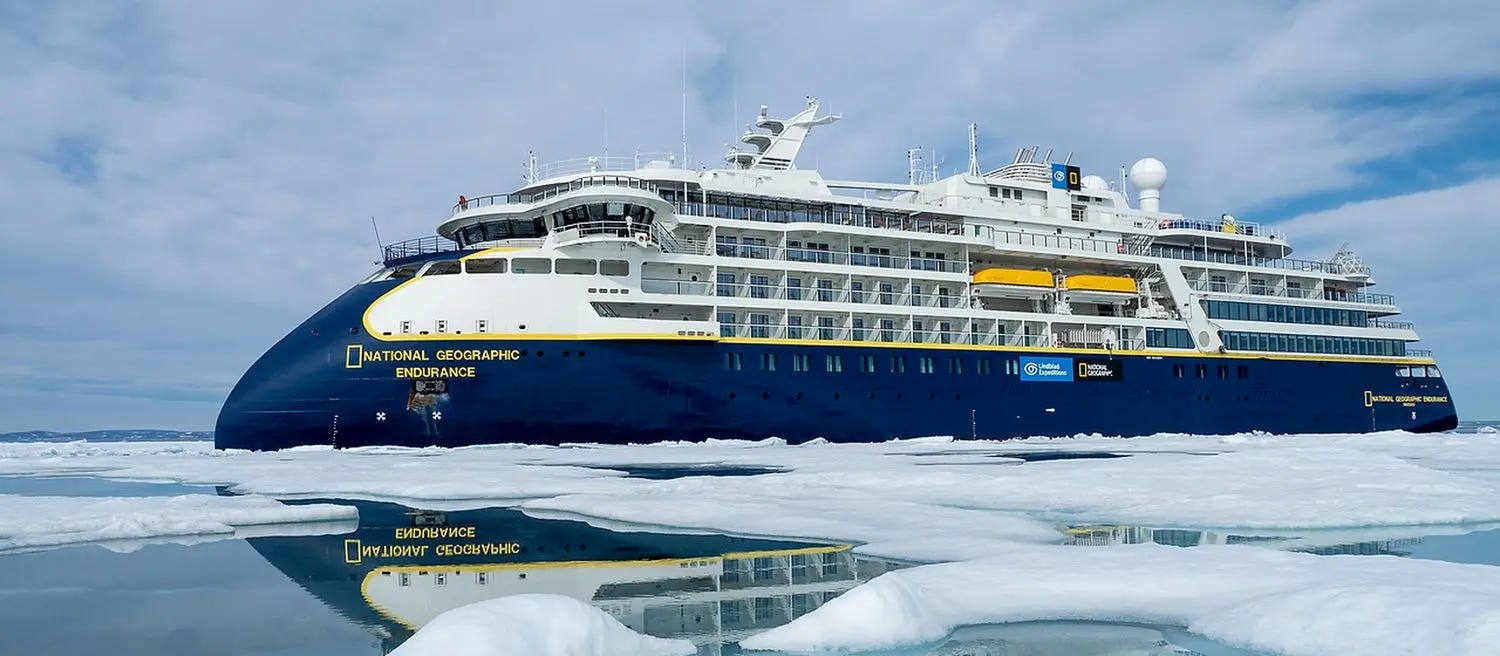
These two ships are the most technically sophisticated in the fleet and the only ones purpose-built from a clean design for polar operations. Both were built at Ulstein Verft in Ulsteinvik, Norway: National Geographic Endurance was delivered in 2020 and National Geographic Resolution in 2021. Both are Polar Class 5, Category A vessels, the highest ice classification that allows year-round operations in all polar regions. Both use the patented Ulstein X-Bow, a design in which the hull profile is inverted at the bow, the nose of the ship projecting forward and downward rather than rising to a conventional point. The X-Bow slices through waves rather than riding over them, eliminating the pitching motion that causes discomfort and seasickness in heavy seas and significantly reducing bow spray on deck.
National Geographic Endurance carries 138 guests in seven categories of sea-view accommodation, with dedicated solo cabins among the options. National Geographic Resolution carries 126 guests in 69 cabins, all with large windows or balconies. Both ships feature an expedition command centre in every cabin with tablets and USB charging; a sauna, infinity-edge hot tubs, and fitness centre; a library; and panoramic observation spaces designed for wildlife viewing in conditions where guests cannot or should not be on deck.
Both ships carry a National Geographic Photographer on board in addition to the Certified Photo Instructor, and both deploy the OM System Photo Gear Locker. Both operate in Antarctica in the southern hemisphere summer, the Arctic and Greenland in the northern, and extend into the British Isles, Patagonia, and other remote-access destinations seasonally. Their Polar Class 5 rating allows them to begin polar seasons up to two weeks earlier than ice-classed but non-Polar-Class vessels, extending access to early-season wildlife breeding activity.
National Geographic Explorer and National Geographic Orion
National Geographic Explorer joined the Lindblad fleet in 2008 after a full rebuild. She is a fully stabilised, ice-reinforced vessel carrying approximately 148 guests, with a long history of Arctic and Antarctic operations. A National Geographic Photographer sails aboard Explorer on every departure. She operates primarily in the Arctic, Antarctica, the British Isles, Canada, Patagonia, and the Azores.
National Geographic Orion operates in Antarctica, the South Pacific including Australia and Pacific Islands, the Mediterranean including partnership voyages with Food and Wine magazine, and the European Arctic. A National Geographic Photographer sails aboard Orion on every departure.
The Alaska fleet: National Geographic Quest, National Geographic Venture, National Geographic Sea Bird, National Geographic Sea Lion
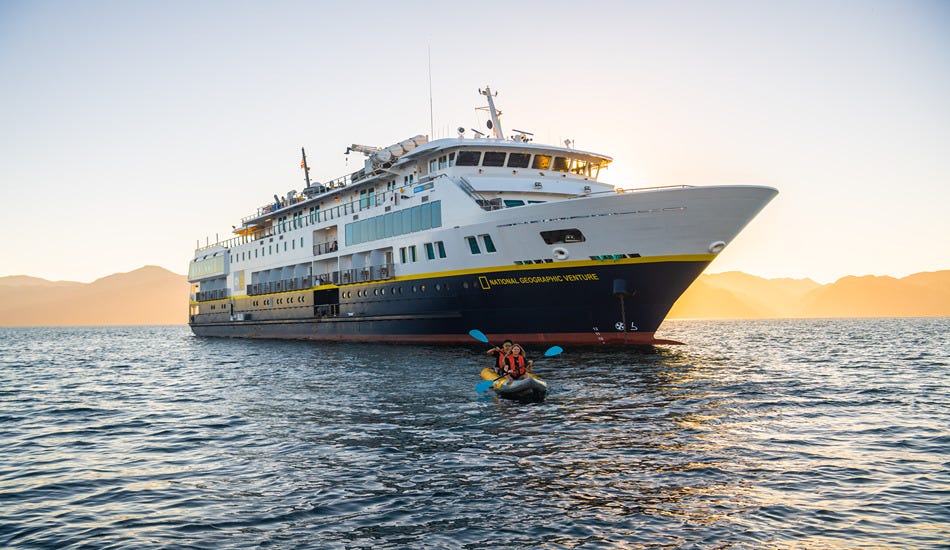
National Geographic Quest and National Geographic Venture were built specifically for Lindblad in 2017 and 2018, the first purpose-built Lindblad vessels in decades before the Endurance and Resolution. Both are United States-flagged, carrying 100 guests in 50 cabins each. They sail Alaska, Baja California, and the Pacific Coast. National Geographic Sea Bird and National Geographic Sea Lion are smaller vessels carrying approximately 62 guests each, also United States-flagged, sailing Alaska and Baja.
The United States flag registration on the Alaska fleet is operationally significant: it allows the ships to operate coastal itineraries entirely within United States waters under the Passenger Vessel Services Act, providing access to remote Alaskan anchorages and communities unavailable to foreign-flagged vessels on domestic US routes.
The Galápagos fleet
The Galápagos programme is the longest-running continuous expedition programme in the history of expedition travel, dating to Lars-Eric Lindblad’s 1967 inaugural voyage. In 2026, the fleet in the Galápagos consists of four vessels:
National Geographic Endeavour II is the primary year-round Galápagos vessel, joined by National Geographic Islander II (a gracious expedition vessel with a one-to-one guest-to-crew ratio that evokes a private yacht atmosphere). National Geographic Gemini (formerly Celebrity Xpedition, acquired in 2025) and National Geographic Delfina (a luxury catamaran, formerly Celebrity Xploration, acquired in 2025) joined the Galápagos fleet in the first quarter of 2025, doubling Lindblad’s capacity in the archipelago. The Galápagos fleet supports the OPUS invasive species prevention programme and the Galápagos Conservation Fund as standard operational commitments.
New platforms in 2026
Three new programme areas debut in 2026, extending Lindblad’s reach into waterways where it has not previously operated:
Aqua Blu is a specialised expedition yacht deploying in Indonesia in 2026, equipped for both undersea and on-shore adventures in the rich biodiversity of the Indonesian archipelago including Raja Ampat. Aqua Blu is a long-established vessel in the luxury liveaboard diving world, repurposed and equipped to the Lindblad expedition standard.
Charaidew II is a luxury river vessel operating on the Brahmaputra River in the Indian state of Assam, debuting in 2026. Assam is one of the world’s most biodiverse regions, home to one-horned rhinoceros, Bengal tigers, elephants, and an extraordinary concentration of bird species. The Brahmaputra programme is conducted in partnership with local conservation organisations.
Connect is a purpose-built river ship designed for European inland waterways, operating the Rhine River programme in 2026 in partnership with Transcend Cruises under a multi-year charter agreement extending through at least 2028. Lindblad’s expedition leaders, field staff, and National Geographic experts travel aboard Connect, providing the same enrichment programme format as the ocean fleet on European river voyages.
The chartered river fleet also includes Delfin II and Delfin III on the Peruvian Upper Amazon, The Jahan on the Mekong River, Lord of the Glens in the Scottish Highlands, Oberoi Philae and Sun Goddess on the Nile in Egypt, and Sea Cloud II sailing European waters.
What is and is not included
National Geographic-Lindblad Expeditions operates a comprehensive all-inclusive model that covers the substantial majority of the on-voyage experience. The specific inclusions vary slightly between the owned National Geographic fleet and the chartered vessels.
Included on all National Geographic fleet voyages:
All meals, with open-seating dining featuring gourmet menus with healthy options and regional ingredients
Unlimited complimentary beer, wine, cocktails, and spirits throughout the voyage at all bars
Coffee station and snacks available at all times in the lounge
Complimentary sodas and beverages in cabin refrigerators
Starlink-enabled Wi-Fi on all National Geographic fleet ships
All shore excursions and Zodiac landings
All park and site entrance fees, special access permits, and port taxes
Certified Photo Instructor on every departure
Access to the OM System Photo Gear Locker (all National Geographic fleet ships except Galápagos)
Undersea specialist with ROV on most departures
National Geographic Photographer aboard Endurance, Resolution, Explorer, and Orion
National Geographic Explorers-in-Training family programme
Gratuities for crew aboard Endurance, Resolution, Explorer, and Orion (gratuities are additional on Quest, Venture, Sea Bird, Sea Lion, and Galápagos fleet)
Use of kayaks, paddleboards, and other watersports equipment where deployed
Snorkelling equipment
Expedition parka on polar voyages
On select Antarctica and Arctic departures, additionally included:
Pre-voyage hotel night and charter flights on qualifying itineraries (when indicated as included in the specific voyage)
Not included:
Airfare (except when specifically stated as included for qualifying itineraries)
Pre and post-expedition hotel nights and private transfers, unless specifically indicated
Gratuities on Quest, Venture, Sea Bird, Sea Lion, and the Galápagos fleet (charged separately)
Premium wine and spirits upgrades beyond the inclusive selection
Travel protection plans, passport and visa fees
The gratuity structure is the most important nuance in the Lindblad inclusions model: crew gratuities are included on the four largest and newest polar ships but are an additional charge on the Alaska fleet and the Galápagos vessels. Guests should confirm the gratuity policy for their specific ship when budgeting.
The undersea specialist programme
The undersea specialist is a role Sven-Olof Lindblad introduced to expedition travel and that remains unique to the National Geographic-Lindblad product. On most departures across the fleet, an undersea specialist dives or deploys a remotely operated vehicle (ROV) beneath the ship during the day, capturing footage of the marine environment beneath the expedition. During the nightly recap in the lounge, the specialist presents and interprets the footage, revealing the ecosystem at depths and in conditions guests cannot access directly.
In Antarctica, where the water temperature and ice conditions prevent most guests from diving, the undersea footage is frequently the only view of what exists beneath the keel: under ice formations, in kelp forests, among leopard seals. In the Galápagos and in tropical destinations, the footage extends the surface wildlife viewing into the marine environment, connecting what guests see from the Zodiacs with what lives beneath. The ROV footage has on multiple occasions captured species and behaviours that scientists have documented as genuinely rare or previously unrecorded.
Stateroom categories
Accommodation across the National Geographic fleet spans from practical to genuinely comfortable, with the standard reflecting the expedition rather than resort philosophy: the cabins are designed to rest in between activities, with the lounge, decks, and Zodiacs as the primary living spaces.
On National Geographic Endurance, seven categories run from the Fore Deck Stateroom with forward-facing porthole windows to Category 7 Suites with separate sleeping and living areas. The Fore Deck cabins include a generous window seat positioned to watch the polar landscape approach while the ship navigates under the X-Bow. All cabins face outside and have large windows or balconies except where hull geometry prevents it. An expedition command centre with tablet and USB charging is standard across all categories on Endurance and Resolution.
On National Geographic Explorer and Orion, cabins range from standard outside staterooms to suites with private balconies. Categories 6 and 7 on Explorer and Orion include complimentary laundry as part of the suite amenities programme.
On National Geographic Quest and Venture, the 100-guest Alaska ships, 50 cabins span from entry-level outside staterooms to the Category 5 suite with complimentary laundry included. The suite amenities programme provides complimentary laundry at specific suite categories on all major fleet ships.
On the Galápagos fleet, National Geographic Gemini offers the widest variety including larger suites, balcony cabins, and a mix of double, solo, and triple occupancy options. National Geographic Islander II has a one-to-one guest-to-crew ratio and the most yacht-like atmosphere in the Galápagos programme.
How Lindblad compares to the expedition competition
National Geographic-Lindblad Expeditions
Best for: The deepest and most systematic photography programme in the expedition cruise market, with a Certified Photo Instructor on every departure, a National Geographic Photographer on select ships, and the OM System gear locker for borrowing professional equipment at no charge. The founding heritage of expedition travel, including the original Galápagos and Antarctic civilian programmes. A genuinely science-connected undersea programme with ROV footage. No ship over 148 guests. New 2026 programmes in Indonesia (Aqua Blu), India’s Brahmaputra (Charaidew II), and European rivers (Connect). National Geographic Society partnership through 2040.
Swan Hellenic
Best for: The deepest cultural and humanities expert programme in the expedition segment, with twelve named experts per ship drawn from archaeology, anthropology, and history. Shore excursions included. More comprehensively all-inclusive than Lindblad on most ships. Less photography-focused; more humanities-focused.
Silversea Expeditions
Best for: Ultra-luxury all-inclusive at a higher price tier, the most ice-capable passenger vessel in service (Silver Endeavour), the S.A.L.T. culinary programme, and the broadest polar destination access. A significantly more formally luxurious product than Lindblad’s adventure-first design ethos.
HX Expeditions
Best for: The most expedition departures globally, the Science Centre for guest research participation, the world’s first hybrid-electric expedition ships, and an all-inclusive model including beverages since November 2024. Ships at 200 to 490 guests, a larger scale than Lindblad.
Atlas Ocean Voyages
Best for: Fully all-inclusive including spirits, charter flights, and hotel on Antarctic voyages, at 198 guests per ship. Comparable scale to Lindblad’s polar ships but without the photography specialisation or the National Geographic scientific connection.
PONANT
Best for: French ultra-luxury, the Blue Eye underwater lounge, the world’s only luxury icebreaker (Le Commandant Charcot), and the only polar luxury operator capable of reaching the Geographic North Pole. A significantly higher price point and a more formally elegant atmosphere.
Who Lindblad is best suited for
National Geographic-Lindblad Expeditions is unusually well-suited to a specific and identifiable profile of guest, and the photography programme is the most distinctive filter.
Photographers at every level, from those who have never owned a camera to professional amateurs, who want structured instruction from a National Geographic-certified instructor in environments that provide some of the most extraordinary photographic opportunities on earth. The OM System gear locker extends this to guests who want to use professional equipment without owning it.
Guests who relate to the National Geographic brand as a source of authority and aspiration, and who want their expedition experience connected to the science, journalism, and exploration that brand represents. Sailing aboard a ship with a National Geographic Photographer is a meaningfully different experience from sailing with a ship that carries a photography enthusiast.
Families with children who want a programme specifically designed for young explorers, with certified field educators and the Explorers-in-Training framework that gives children an active role in the expedition.
Galápagos travellers who want the operator with the deepest historic relationship with the archipelago, the most developed conservation commitment, and the broadest vessel choice including the new catamaran National Geographic Delfina.
Alaska travellers who want a United States-flagged small-ship programme with access to remote coastal communities and national park areas that foreign-flagged ships cannot reach on domestic itineraries.
Expedition travellers who value the undersea dimension of their voyage as much as the above-water experience, and want nightly video interpretation of what lives beneath the ship’s keel.
Lindblad is less suited to guests who prioritise the most formally luxurious accommodation standard in the market (Silversea or PONANT), those whose primary interest is polar extremes beyond Polar Class 5 (Le Commandant Charcot for North Pole access), or guests who want the most comprehensively all-inclusive model including shore excursions at every port and all gratuities bundled, without exception (Swan Hellenic or Regent Seven Seas).
Frequently asked questions
What is the relationship between Lindblad and National Geographic?
National Geographic-Lindblad Expeditions operates under a formal partnership established in October 2004 and extended in November 2023 through 2040. Under the partnership, all fleet vessels carry the National Geographic name, every departure includes a National Geographic-certified photo instructor, select ships carry a National Geographic Photographer, and guests interact with the National Geographic Society’s scientific and editorial network. The Lindblad Expeditions-National Geographic Fund jointly supports conservation and research. It is an operational partnership rather than a branding licence, and it shapes the content of every voyage.
Is Lindblad fully all-inclusive?
On the four primary polar ships (Endurance, Resolution, Explorer, and Orion), the fare is comprehensively all-inclusive including all meals, unlimited beer, wine, cocktails, and spirits, Wi-Fi, shore excursions, park fees, and crew gratuities. On the Alaska fleet (Quest, Venture, Sea Bird, Sea Lion) and the Galápagos vessels, gratuities are an additional charge. Airfare is not included except on itineraries where it is specifically stated as included.
What is the X-Bow and why does it matter?
The Ulstein X-Bow is a patented hull design used on National Geographic Endurance and National Geographic Resolution in which the bow profile is inverted: the hull nose projects forward and downward into the water rather than rising to a conventional point above the waterline. This allows the ship to slice through waves rather than riding over them, dramatically reducing the pitching motion and bow slamming that cause seasickness and discomfort in heavy seas. In the Drake Passage and other polar waters, the X-Bow produces a measurably smoother passage than conventionally-bowed vessels of comparable size, and the Polar Class 5 rating allows operations up to two weeks earlier in the polar season than ice-class but non-polar-class vessels.
What is the OM System Photo Gear Locker?
In partnership with OM System (the professional camera brand formerly marketed as Olympus), Lindblad provides a locker of OM System cameras, lenses, and accessories aboard every National Geographic fleet ship (except the Galápagos vessels). Guests may borrow this equipment for free throughout the voyage. The programme is designed to let guests without professional cameras use high-quality equipment in the field, and to let those considering a purchase test the system in demanding real-world conditions.
What is OPUS?
OPUS stands for Operation to Prevent Unwanted Species. It is a conservation programme Lindblad operates specifically in the Galápagos to prevent the introduction of invasive species through food imports to the islands, one of the primary ecological threats to the unique species of the archipelago. All food brought aboard Galápagos ships by Lindblad is screened under OPUS protocols. The programme was developed in partnership with the Galápagos National Park and is one of the practical conservation commitments that distinguishes Lindblad’s relationship with the Galápagos from operators who visit without comparable operational commitments.
Who founded Lindblad Expeditions and what is its heritage?
Lars-Eric Lindblad founded Lindblad Travel in Connecticut in 1958 and led the first tourist expedition to Antarctica on January 23, 1966, and the first tourist expedition to the Galápagos Islands in 1967. He is universally regarded as the father of ecotourism. His son Sven-Olof Lindblad founded Special Expeditions as a marine-focused subsidiary in 1979, which became Lindblad Expeditions in 2000 and National Geographic-Lindblad Expeditions in 2024. Sven-Olof stepped down as CEO on January 1, 2025, with Natalya Leahy appointed as CEO. The 60th anniversary of Lars-Eric’s first Antarctic voyage was commemorated on January 23, 2026.
Plan your Lindblad Expedition Cruise with ÆRIA Voyages
Every National Geographic-Lindblad voyage is different depending on the ship, the destination, and the specific experts sailing that departure. I help clients navigate those choices: from selecting between National Geographic Endurance and Explorer for a first Antarctic voyage, to advising on the Galápagos fleet and which vessel best fits a particular travel style, to understanding whether Lindblad or Swan Hellenic is the better match for a specific expedition interest.
If you are curious about pricing, current availability, or whether National Geographic-Lindblad Expeditions is the right fit for your travel vision, I would be glad to talk it through.
Yvan Junior Blanchette
Travel & Cruise Specialist
ÆRIA Voyages📩 yvanblanchette@aeriavoyages.com
📞 1-888-460-3388
🌐 aeriavoyages.com