

MSC Cruises: What it is, How it works, and What to expect
Cruise guide · Updated 2026 · Mainstream · Italian heritage · Privately owned · Mediterranean depth · MSC Yacht Club · Ocean Cay · World Class ships · Bella / Fantastica / Aurea experience
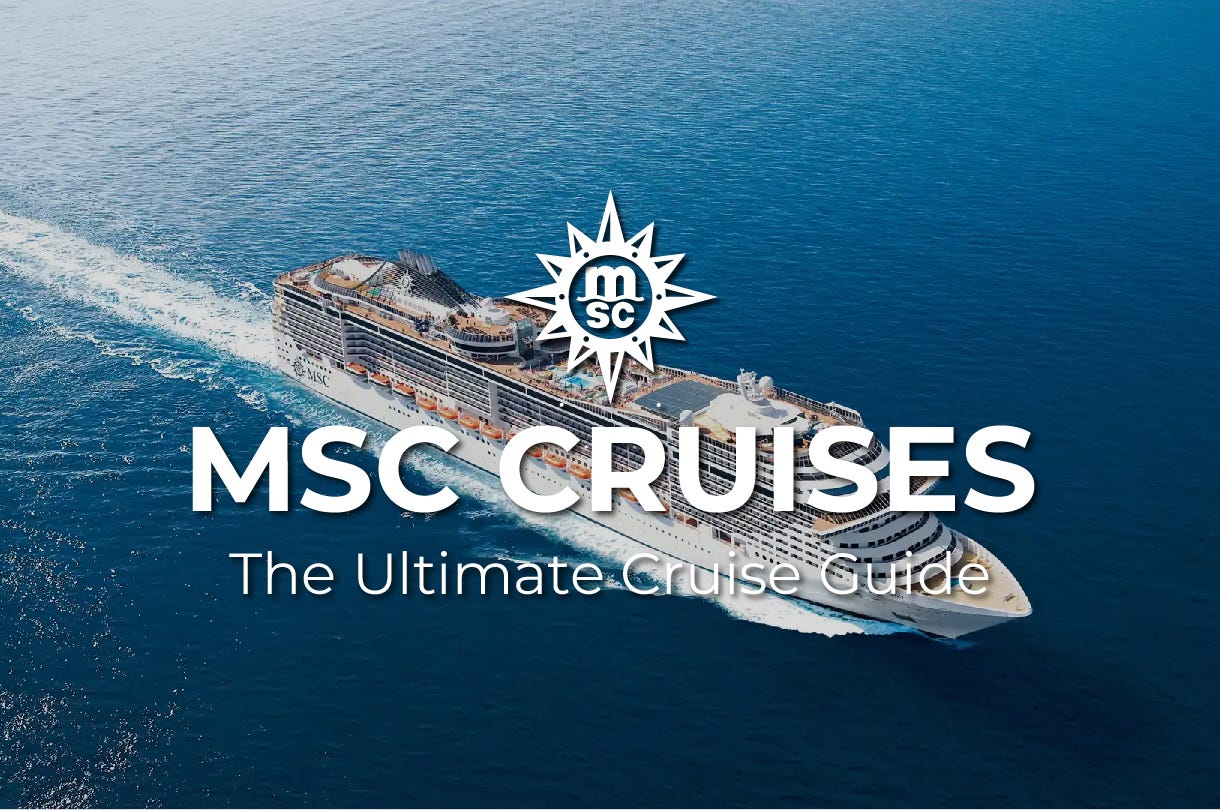
MSC Cruises is the world’s largest privately held cruise company and the only major cruise line not answerable to public shareholders. The Aponte family, Gianluigi and his wife Rafaela as founders, their son Diego as President and CEO, and daughter Alexa as CFO, has grown what began as a shipping operation in Naples in 1988 into the third-largest cruise company in the world by passengers, behind only Carnival Corporation and Royal Caribbean Group.
The private ownership structure shapes the company in ways that are genuinely felt aboard: decisions are made on a generational horizon rather than a quarterly earnings cycle, the Mediterranean itinerary programme is the deepest of any mainstream line because MSC is fundamentally European in its identity and market base, and the fleet is expanding faster than any comparable cruise company.
This guide covers MSC’s founding and private ownership, the ship classes in 2026 including the World Class expansion, the Bella/Fantastica/Aurea experience tier system, what is and is not included, the MSC Yacht Club ship-within-a-ship, Ocean Cay MSC Marine Reserve, the Mediterranean programme advantage, and how MSC compares to the mainstream competition.
Table of Content
🎧 LISTEN TO THE BEYOND TH HORIZON PODCAST
EPISODE COMING SOON…
A brief history of MSC Cruises
Gianluigi Aponte was born in Sorrento, Italy, and has roots in Neapolitan maritime commerce extending back centuries. In 1970 he and his wife Rafaela founded the Mediterranean Shipping Company in Brussels, building it into what is now the world’s largest container shipping operator, running over 800 vessels and carrying cargo globally. The family’s entry into the cruise business came in 1988 when Gianluigi Aponte purchased the Achille Lauro from Flotta Lauro Line and acquired two liners from Lauro Lines, initially naming the cruise operation StarLauro Cruises before rebranding as MSC Cruises. The name MSC, drawn from Mediterranean Shipping Company, reflects the cruise line’s origins within the broader shipping group.
MSC remained a relatively small Mediterranean operator through the 1990s, growing its fleet gradually through secondhand acquisitions and operating primarily in the European market. The transformation into a global cruise company began in earnest in the mid-2000s, when MSC began ordering its first purpose-built new ships and accelerating its fleet expansion. Since 2014, Diego Aponte has served as President and CEO, presiding over the most rapid fleet expansion in the company’s history.
MSC is headquartered in Geneva, Switzerland, with operations offices in Naples, Genoa, and Venice, reflecting its Italian maritime identity within a European corporate structure. It holds approximately ten percent of all cruise passengers globally in 2025, and its fleet is growing faster than any comparable line: four more World Class ships are confirmed for delivery through 2031 under a new €3.5 billion agreement with Chantiers de l’Atlantique, the French shipyard that builds the World Class vessels.
MSC also owns Explora Journeys, its separately branded ultra-luxury small-ship line launched in 2023, which operates as a distinct brand with its own fleet and identity. Explora Journeys is covered in its own guide.
The ship classes in 2026
MSC operates 22 ships in 2026, spanning seven generations of design from the oldest Lirica-class vessels built in the early 2000s to the newest World Class ships. The experience on board varies significantly between generations, and the choice of ship matters as much as the itinerary.
World Class: the current flagship generation
Three ships in service in 2026: MSC World Europa (2022), MSC World America (April 2025), and MSC World Asia (2026). MSC World Atlantic follows in 2027, with four more World Class ships confirmed through 2031.
At 215,863 gross tons and carrying 6,762 passengers at full capacity with 2,126 crew, the World Class ships are the seventh-largest cruise ships in the world, exceeded only by Royal Caribbean’s Icon and Oasis class vessels. They are powered by LNG, the cleanest available fuel for ocean vessels, and designed explicitly as what MSC calls “floating destinations”: ships with enough districts, venues, and activities that the vessel itself functions as the primary holiday rather than merely the transport between ports.
MSC World Europa homeports in the Arabian Gulf. MSC World America sails from Miami on Caribbean itineraries. MSC World Asia, delivered in 2026 with Asian-inspired design touches, is deployed in Asian markets. Each World Class ship features: a Cliffhanger, a cantilevered infinity pool suspended over the ocean on the upper deck; the largest waterpark in the MSC fleet; seven swimming pools including one with a retractable sliding roof; 13 dining venues; 19 cabin categories including seven new design types not seen on earlier MSC ships; and a full Yacht Club complex.
Meraviglia and Meraviglia Plus class: the Mediterranean design generation
Six ships: MSC Meraviglia (2017), MSC Bellissima (2019), MSC Grandiosa (2019), MSC Virtuosa (2021), MSC Seashore (which shares some features), and MSC Euribia (2023). At approximately 181,000 to 215,863 gross tons, this generation introduced the LED promenade, a two-deck-high interior boulevard covered by an LED sky ceiling displaying changing sky scenes, weather, and entertainment, which has become one of MSC’s most recognisable architectural signatures. These ships are Mediterranean-optimised in layout: generous outdoor spaces, multiple pool areas, and itinerary-focused port-intensive schedules in Europe.
MSC Euribia, the most recently delivered Meraviglia Plus vessel, is LNG-powered and is the most environmentally advanced in this class. MSC Grandiosa expanded to Port Canaveral in 2026 as the first Meraviglia Plus class vessel based in the United States.
Seaside and Seaside EVO class: the outdoor-forward warm-weather ships
Four ships: MSC Seaside (2017), MSC Seaview (2018), MSC Seashore (2021), and MSC Seascape (2022). At approximately 153,000 to 170,000 gross tons, the Seaside class was designed specifically for warm-weather Caribbean and Mediterranean operations, with a significantly wider outdoor promenade wrapping the full circumference of the ship on Deck 8, providing unusually direct contact with the sea at all times. The aft of the ship cascades from the upper decks down to a Miami Beach-style pool terrace close to the waterline. The Seaside and Seaside EVO ships have more outdoor deck space per guest than any other MSC class and are the best match for guests who want a sun-focused, pool-deck-oriented Caribbean experience.
MSC Seashore and MSC Seascape carry up to 5,632 guests and are among the most popular vessels on the US market, sailing from Port Canaveral and Galveston respectively.
Fantasia class: the proven large-ship generation
Four ships: MSC Fantasia (2008), MSC Splendida (2009), MSC Divina (2012), and MSC Preziosa (2013). At approximately 137,000 to 140,000 gross tons carrying 4,345 to 4,363 guests, the Fantasia class ships are the oldest large-format MSC vessels and the ones most likely to be deployed on longer world cruise sectors and less common itineraries. MSC Divina is US-based in Miami. These ships carry the Yacht Club complex but lack some of the entertainment and activity features of the newer generations.
Musica class and Lirica class: the heritage fleet
Eight ships spanning from MSC Lirica (2003) through MSC Musica (2006), MSC Orchestra (2007), MSC Poesia (2008), and MSC Magnifica (2010), carrying approximately 2,000 to 3,000 guests each. These ships are significantly smaller and simpler than the modern MSC fleet, with fewer dining venues, no major waterparks, and a more traditionally European cruise atmosphere. They provide access to smaller Mediterranean ports that the megaships cannot enter, and their itineraries are often the most port-intensive and culturally focused in the MSC programme. They represent the best option for guests whose priority is the Mediterranean destination rather than the onboard experience.
MSC fleet at a glance (2026)
World Class: MSC World Europa (2022), MSC World America (2025), MSC World Asia (2026), 215,863 GT, 6,762 guests, LNG
Meraviglia / Meraviglia Plus: 6 ships, 181,000 to 215,863 GT, LED promenade
Seaside / Seaside EVO: 4 ships, 153,000 to 170,000 GT, outdoor promenade design
Fantasia class: 4 ships, 137,000 to 140,000 GT, 4,300 to 4,363 guests
Musica class: 4 ships, approximately 90,000 GT, 3,000 guests
Lirica class: 4 ships, approximately 65,000 GT, 2,000 guests
The experiences: Bella, Fantastica, Aurea, and Yacht Club
MSC structures its pricing around four named “experience” tiers that modify the inclusions and cabin location for every booking. Understanding these tiers is essential because the same stateroom category (such as balcony cabin) carries significantly different perks and locations depending on which experience tier is selected.
Bella is the entry experience, offering the base cabin with no specific location guarantee. Bella cabins are often assigned to less desirable positions on the ship, including lower decks, cabins over machinery or nightlife venues, or those with obscured views. Bella includes the standard fare inclusions only, with no preference on dining time assignment.
Fantastica upgrades the cabin to a better location on the ship, guarantees preferred dining time (early or late seating) in the main restaurant, and adds complimentary continental breakfast room service. Fantastica is the tier most commonly recommended for guests who want a predictable cabin quality without the full Aurea premium. Fantastica is available across all standard cabin types from interior to suite.
Aurea is the top non-Yacht-Club experience tier, providing the best available cabin locations for balconies and suites, access to My Choice flexible dining in a dedicated section (comparable to NCL’s Freestyle model), priority boarding, discounted access to the thermal spa facilities, and a complimentary massage. Aurea is designed primarily for guests who value flexibility in dining timing and spa access.
MSC Yacht Club is a separate category entirely and is discussed in detail in the next section.
The experience tier system means that MSC pricing must be evaluated with the tier selected, not only the cabin category. A Bella balcony cabin and a Fantastica balcony cabin in the same room type will produce genuinely different experiences, and the price difference between them typically represents reasonable value for the location guarantee alone.
MSC Yacht Club: the ship-within-a-ship
The MSC Yacht Club was introduced in 2008 and has been expanded and refined across the fleet since then. It is present on most modern MSC ships and operates as a physically private zone within the larger vessel, accessed by keycard only, with its own pool and sun deck, restaurant (the MSC Yacht Club Restaurant with panoramic views), Top Sail Lounge open 24 hours with a complimentary bar and live music in the evenings, and 24-hour butler service.
The Yacht Club is the only MSC experience that operates as genuinely all-inclusive. Its inclusions are:
All meals at the Yacht Club Restaurant and priority reservations with butler escort at specialty restaurants throughout the ship
The Premium Extra beverage package, covering all beverages priced up to 16 US dollars, including premium spirits, wines, and cocktails, at all bars, the buffet, the main restaurant, and specialty restaurants
Unlimited Wi-Fi for two devices per cabin
Access to the thermal spa suite
Priority boarding and debarkation through a dedicated gangway
24-hour butler service including unpacking and repacking assistance
Exclusive access to Ocean House Beach on Ocean Cay MSC Marine Reserve, the private island
The Yacht Club complex on the World Class ships has been significantly expanded compared to earlier fleet generations, with a larger dedicated pool deck, more suite categories, and a higher overall standard of public space design within the private zone. On the World Class ships, the Yacht Club carries a broader suite hierarchy including garden-view and sea-view terrace suites alongside the standard balcony categories.
Yacht Club guests on Ocean Cay have access to Ocean House Beach, a private beachfront area with a bar offering butler service, an exclusive restaurant, and cabana rentals. The rest of the island is accessible to all MSC guests, with beaches, restaurants, and activities provided as part of the cruise fare.
What is and is not included
For guests not in the Yacht Club, MSC’s base fare covers a defined set of services with additional costs accruing across the voyage.
Included in the standard MSC fare (all experience tiers):
Accommodation in the booked stateroom
All meals in the main dining rooms and the buffet
Entertainment including Broadway and Vegas-style production shows by Carousel Productions at Sea, casino access, the LED promenade and most onboard activities
Use of pools, hot tubs, fitness centre, sports deck, and standard recreational facilities
Youth programmes: MSC Kids Club for children and MSC Teens for teenagers
Basic beach access, beaches, and complimentary food at Ocean Cay MSC Marine Reserve when the itinerary includes a stop
Port taxes and fees
Not included (and commonly significant costs):
Alcoholic beverages, specialty coffees, and sodas: charged separately unless a beverage package is purchased. MSC’s beverage packages start at the Easy Package (beers and non-alcoholic drinks), through the Classic (standard spirits and wines), to the Premium and Premium Extra (broadest range including premium brands). Only the Yacht Club includes beverages
Wi-Fi: sold separately by package, not included in Bella or Fantastica. Aurea does not include Wi-Fi. Only Yacht Club includes Wi-Fi for two devices
Gratuities: charged automatically to the account, typically 15 to 18 dollars per guest per day depending on the region and experience tier
Specialty dining: cover charges apply at most named restaurants beyond the main dining room
Shore excursions
Spa treatments (thermal suite access is discounted for Aurea guests; Yacht Club includes thermal suite)
Ocean Cay MSC Marine Reserve
Ocean Cay MSC Marine Reserve is MSC’s private island in the Bahamas, included as a stop on most Caribbean and Bahamas itineraries sailing from US ports. Unlike some competitors’ private islands, Ocean Cay is explicitly framed around ecological restoration: the island was a former industrial site that MSC has rehabilitated into a functioning marine reserve, with reef restoration, light pollution reduction to protect sea turtle nesting, and conservation programming as stated operational commitments.
Eight beaches are accessible to all MSC guests as part of the cruise fare, along with restaurants and basic beach amenities. MSC Yacht Club guests have exclusive access to Ocean House Beach, the private beachfront zone with its own bar and restaurant. MSC allows overnight stays at Ocean Cay on select sailings, a feature that gives guests an evening on the island that most private island experiences do not offer.
The Mediterranean program: MSC’s advantage
The single most significant advantage MSC holds over its American-owned mainstream competitors is the depth and authenticity of its Mediterranean itinerary programme. MSC is fundamentally a European company with a European customer base, and the Mediterranean is its home market in a way that no American-owned line can replicate.
In practical terms, this produces: itineraries that include smaller Mediterranean ports that large-capacity American ships either do not visit or treat as secondary stops; overnight stays in Mediterranean cities that allow genuine evening exploration; port-intensive schedules that prioritise shore time over sea days; and itineraries that extend throughout the year rather than seasonal deployments.
The Musica and Lirica class ships are the most port-intensive of the fleet, their smaller size enabling access to harbours that the World Class ships cannot physically enter. For a guest whose primary goal is the Mediterranean experience, the smaller MSC ships on port-intensive itineraries produce a genuinely different product from the same company’s megaships on a Caribbean circuit.
In summer 2026, nine MSC ships operate the European programme, covering the Western Mediterranean, Eastern Mediterranean including the Greek islands, Northern Europe and the Norwegian fjords, the Baltic, and the British Isles.
How MSC compares to other mainstream lines
MSC Cruises
Best for: The deepest Mediterranean itinerary programme of any mainstream line, a more internationally mixed passenger demographic than American-owned lines (MSC’s European and Latin American guest base produces a socially different atmosphere from Carnival, NCL, or Royal Caribbean), the MSC Yacht Club as an all-inclusive ship-within-a-ship at competitive pricing, Ocean Cay with genuine conservation framing and overnight stays, and a private ownership structure that produces a distinctly European product philosophy.
Royal Caribbean International
Best for: The largest ships in the world (Icon class at 250,000 GT versus World Class at 215,863 GT), the widest onboard activity range, Perfect Day at CocoCay where the standard beverage package currently remains valid, and a more consistently family-entertainment-focused approach across the fleet.
Norwegian Cruise Line
Best for: Freestyle Cruising flexibility with no fixed dining times across the entire fleet, the solo studio cabin programme, The Haven ship-within-a-ship, and Pride of America for Hawaii. NCL’s flexibility model is more consistently applied fleet-wide than MSC’s tiered experience system.
Carnival Cruise Line
Best for: The lowest headline fares in the mainstream market, a younger and more high-energy social atmosphere, and short-cruise Caribbean product. A simpler booking model with fewer experience tiers to navigate than MSC.
Celebrity Cruises
Best for: A premium product above the mainstream tier, the Always Included fare bundle (beverages, Wi-Fi, and gratuities in the base fare), and an adult-skewing design-forward atmosphere. A meaningful price step up from MSC but with a more predictable all-in cost.
Who MSC is best suited for
MSC works best for a specific profile of guest, and the company’s European origins do more filtering work than any product feature.
Travellers who want a more internationally diverse passenger mix than American-owned mainstream lines typically provide. MSC’s European, South American, and Middle Eastern guest base creates a social atmosphere aboard that is genuinely multicultural in a way Royal Caribbean, Norwegian, and Carnival rarely achieve.
Mediterranean specialists for whom the depth of port coverage, the overnight stays in European cities, and the smaller-ship access to secondary ports represent the primary cruise value.
Guests who want the Yacht Club all-inclusive experience at a price point that undercuts the ultra-luxury lines while delivering comparable service within the private zone.
Families who want European-style formal evenings as part of the onboard culture alongside the activity programming. MSC retains Gala nights with formal dress expectations on most ships, a feature that has largely disappeared from American mainstream lines.
Guests sailing from European ports who want a departure experience and cultural atmosphere aligned with the continent they are exploring, rather than a primarily American product deployed to Europe seasonally.
MSC is less suited to guests who want Freestyle dining flexibility without navigating experience tiers, those who want the most comprehensive private island amenities in the Caribbean market (CocoCay’s waterpark and sheer scale exceeds Ocean Cay), those who want the largest and most activity-dense ships afloat, or those who find the tier system confusing relative to simpler mainstream fare structures.
Frequently asked questions
Who owns MSC Cruises?
MSC Cruises is privately owned by the Aponte family, whose maritime heritage in Naples dates to the seventeenth century. Gianluigi Aponte is the founder and Chairman; his son Diego Aponte has served as President and CEO since 2014; and his daughter Alexa Aponte Vago serves as CFO. As the world’s largest privately held cruise company, MSC is not listed on any stock exchange and does not have public shareholders. The family also owns the Mediterranean Shipping Company, the world’s largest container shipping operator with over 800 vessels.
What is the difference between Bella, Fantastica, and Aurea?
Bella is the entry tier with no cabin location guarantee. Fantastica upgrades cabin location and adds preferred main dining time and complimentary continental breakfast room service. Aurea provides the best cabin locations, My Choice flexible dining in a dedicated section, priority boarding, discounted spa access, and a complimentary massage. Yacht Club is a separate and fully all-inclusive tier. The experience tier determines the cabin location on the ship, not only the perks: a Bella balcony cabin and a Fantastica balcony cabin in the same room type will be in materially different physical positions on the ship.
Is MSC Yacht Club all-inclusive?
Yes. MSC Yacht Club includes all meals at the Yacht Club Restaurant and priority reservations at specialty restaurants, the Premium Extra beverage package covering all drinks up to 16 US dollars, Wi-Fi for two devices, thermal spa suite access, 24-hour butler service, priority boarding and debarkation, and exclusive Ocean House Beach access on Ocean Cay.
What is Ocean Cay MSC Marine Reserve?
Ocean Cay is MSC’s private island in the Bahamas, built on a former industrial site that MSC has rehabilitated as a functioning marine reserve with reef restoration and sea turtle nesting protection programmes. Eight beaches are accessible to all MSC guests with the cruise fare. MSC Yacht Club guests access the exclusive Ocean House Beach with butler service. Overnight stays at Ocean Cay are available on select sailings, one of very few private island programmes to offer evening access.
What is the MSC World Class and why does it matter?
The World Class is MSC’s current flagship generation at 215,863 gross tons, making them the seventh-largest cruise ships in the world. They are LNG-powered and designed as multi-district floating destinations with seven pools, the largest MSC waterpark, and 13 dining venues. MSC World Europa (2022) sails the Arabian Gulf. MSC World America (2025) sails from Miami. MSC World Asia (2026) deploys in Asian markets. MSC World Atlantic follows in 2027, with four more confirmed through 2031. Their scale and feature density represent MSC’s direct response to Royal Caribbean’s Icon and Oasis class ships.
How does MSC’s Mediterranean programme compare to other mainstream lines?
MSC is the only mainstream cruise line with genuine European market dominance and a year-round Mediterranean programme built for European guests rather than deployed seasonally from an American base. In summer 2026, nine MSC ships operate the European programme, visiting ports throughout the Western and Eastern Mediterranean, Greek islands, Northern Europe, fjords, and the British Isles. The Musica and Lirica class ships, at approximately 65,000 to 90,000 gross tons, access smaller Mediterranean harbours that the World Class and Meraviglia ships cannot enter, providing itinerary depth unavailable on any comparable American-owned line.
Plan your next MSC Cruise with ÆRIA Voyages
Every MSC voyage differs substantially based on ship generation, experience tier, and destination region. I help clients navigate those choices: from selecting the right ship class and experience tier for their priorities, to comparing the Yacht Club value proposition against premium alternatives, to advising on whether an MSC Mediterranean itinerary on a smaller ship or a World Class Caribbean sailing better matches their travel vision.
If you are curious about pricing, current availability, or whether MSC Cruises is the right fit for your travel vision, I would be glad to talk it through.
Yvan Junior Blanchette
Travel & Cruise Specialist
ÆRIA Voyages📩 yvanblanchette@aeriavoyages.com
📞 1-888-460-3388
🌐 aeriavoyages.com