

Rocky Mountaineer: What It Is, How It Works, and What to Expect
Guide · Updated 2026 · Luxury rail · Canadian Rockies · Daylight-only · GoldLeaf and SilverLeaf · Armstrong Collective
Rocky Mountaineer has won the World’s Leading Travel Experience by Train award eight times. It operates in daylight only, so guests never miss a single kilometre of the Canadian Rockies rolling past their glass-dome windows. It has carried travellers from more than 100 countries since its inaugural journey on May 27, 1990. And in 2026, one of its most beloved routes may be operating for the very last time.
The Rainforest to Gold Rush route, running from North Vancouver through Whistler and Quesnel to Jasper since 2006, faces closure after this season because CN Railway intends to discontinue operations on a portion of the rail line it uses. If you have ever considered this route, 2026 is the year to take it.
This guide covers Rocky Mountaineer’s origins as a Via Rail service and the 1990 private sector sale to Peter Armstrong, the Armstrong Collective parent company, all four Canadian routes with what each one covers and why you would choose it, the two service levels (GoldLeaf and SilverLeaf) and what distinguishes them physically and experientially.
It also covers what is and is not included, the new Passage to the Peaks route exclusive to June and July 2026, the Rainforest to Gold Rush situation explained fully, the Circle Journey option, how Rocky Mountaineer connects to Canyon Spirit in the American Southwest, and how to build a complete Canadian Rockies itinerary around the train.
Table of Content
How Rocky Mountaineer fits into a Canadian Rockies itinerary
The Rainforest to Gold Rush closing: what you need to know right now
🎧 LISTEN TO THE BEYOND THE HORIZON PODCAST

A brief history of Rocky Mountaineer
The Rocky Mountaineer concept was created by Harry Holmes, a railroad engineer, and Pat Crowley, a tourism entrepreneur, both from Jasper, Alberta. Together they developed a business plan in the mid-1980s for a daylight-only sightseeing train through the Canadian Rockies and presented it to Via Rail before Expo 86 in Vancouver. Via Rail launched the service on May 22, 1988, as a once-weekly daylight train between Vancouver, Calgary, and Jasper, pulled by a Canadian National steam locomotive.
As a purely tourist sightseeing service, Via Rail concluded the operation was not a core part of its mandate. In November 1989, the government directed Via Rail to organise a private sector sale of the route, equipment, and book of business. The process attracted twenty initial bidders, eventually narrowing to three: Westours Holland America (a subsidiary of Carnival Cruise Line), a group of Via Rail executives, and Vancouver businessman Peter R.B. Armstrong’s Armstrong Hospitality Group Ltd.
In March 1990, Armstrong Hospitality Group acquired the route, twelve coaches, two baggage cars, and all branding for an undisclosed sum through a subsidiary called Mountain Vistas Railtour Services Ltd. The inaugural private sector journey departed on May 27, 1990. Peter Armstrong grew the operation over the following three decades into what became one of the most recognised luxury rail brands in the world. Rocky Mountaineer has since won thirteen World Travel Awards, including the World’s Leading Travel Experience by Train eight times.
Armstrong Collective is the parent company today, operating under CEO Tristan Armstrong. It owns both Rocky Mountaineer in Canada and Canyon Spirit, the American Southwest rail experience that debuted under the Rockies to the Red Rocks name before rebranding as Canyon Spirit for the 2026 season. Rocky Mountaineer operates exclusively in Canada; Canyon Spirit operates exclusively in the United States.
Rocky Mountaineer is based in Vancouver, British Columbia. Its trains operate from April through October. No service runs in winter.
The fundamental design: why daylight-only matters
Rocky Mountaineer’s most consequential design decision is also its simplest: it travels by daylight only. Every segment of every route is timed so that passengers are awake and seated in glass-dome coaches while the landscape rolls past. At the end of each travel day, the train stops for the night and passengers sleep in a partner hotel in the intermediate city. The train does not have sleeping cars because the darkness of a sleeping car is precisely what Rocky Mountaineer was designed to eliminate.
This design has practical consequences that are worth understanding before booking. The train does not connect cities quickly. A flight from Vancouver to Calgary takes approximately one hour. Rocky Mountaineer takes two days. Travellers who book Rocky Mountaineer are not booking transportation. They are booking the experience of being on the train while the Canadian Rockies reveal themselves through glass-dome windows at the pace of the landscape rather than the pace of air travel.
The GoldLeaf coaches are bi-level with seating on the upper dome level and dining on the lower level. The SilverLeaf coaches are single-level with dome windows. Both provide panoramic glass above the standard sightline, allowing passengers to see not just the landscape at eye level but the peaks and ridgelines rising above the train. The specific section of track through the Fraser Canyon, the Spiral Tunnels above Field, and the passage beside the Illecillewaet Glacier all produce views that are legitimately unavailable from any road, any aircraft approach angle, or any other form of surface transport.
The two service levels
GoldLeaf Service
GoldLeaf is Rocky Mountaineer’s premium service tier and the one most frequently described in the context of bucket-list rail travel. The GoldLeaf coaches are custom-designed bi-level glass-dome cars built to a specification unique to Rocky Mountaineer. The upper level is a seated observation deck with full-length dome windows and reclining seats that rotate 180 degrees, allowing groups of four to face each other for conversation or all face the same direction for viewing. The lower level is a dedicated dining room where hot meals prepared in the onboard kitchen are served to guests at reserved tables throughout the travel day.
The rotation mechanism on GoldLeaf seats is a practical feature rather than a novelty: couples and families who want to share a meal or conversation without raising their voices across the aisle simply turn their seats to face each other. This configuration is not available on any standard rail service and produces a social dynamic on the train that guests consistently describe as one of the highlights of the experience.
GoldLeaf service is available on all three Canadian signature routes: First Passage to the West, Journey through the Clouds, and Rainforest to Gold Rush. It is not available on Canyon Spirit (the American Southwest route) because the taller bi-level coaches exceed the loading gauge of the American trackage used.
GoldLeaf inclusions:
Seated dome-level observation with rotating and reclining seats
Full hot meals served in the lower-level dining room: breakfast and lunch on each travel day, plus complimentary snacks and refreshments throughout the day
A wide selection of wines, beers, spirits, and non-alcoholic beverages
Onboard Host service with commentary on the landscape, history, and wildlife visible from the train
Outdoor viewing platform at the rear of designated cars
All gratuities for onboard staff
SilverLeaf Service
SilverLeaf is the standard service level and the one that delivers the core Rocky Mountaineer experience at a lower price point. SilverLeaf coaches are single-level glass-dome cars with oversized panoramic windows and reclining seats. The seated dome view in SilverLeaf is genuinely comparable to GoldLeaf for the purpose of landscape viewing. The primary differences are in dining and seating configuration rather than view quality.
In SilverLeaf, breakfast and lunch are served at the seat by onboard Hosts rather than in a dedicated dining room. The food quality is high but the menu is less elaborate than GoldLeaf. Seating does not rotate. The social configuration of SilverLeaf is more like a conventional premium rail carriage: generous space, excellent views, attentive service, but without the convertible seating and dining room that give GoldLeaf its specific character.
SilverLeaf inclusions:
Single-level dome observation with oversized windows and reclining seats
Breakfast and lunch served at the seat on each travel day, plus snacks and refreshments throughout the day
A selection of non-alcoholic beverages, with alcoholic beverages available for purchase
Onboard Host service with commentary on the landscape, history, and wildlife
SilverLeaf is the right choice for travellers who want the Rocky Mountaineer experience at a more accessible price, who travel solo and value the ease of seat-service dining over a dining room requiring a companion, or who are prioritising the route and the scenery over the premium onboard social experience.
The routes in 2026
Rocky Mountaineer operates four routes in 2026: three signature Canadian routes and one new limited-availability route. The American Southwest route, formerly Rockies to the Red Rocks, became Canyon Spirit in 2026 and is now its own separate brand.
First Passage to the West
The most popular Rocky Mountaineer route and the one most directly connected to Canadian railway history. First Passage to the West runs between Vancouver and Banff (or Lake Louise) with an overnight stop in Kamloops, following the route of the Canadian Pacific Railway’s original transcontinental line. The route passes through the Fraser Canyon, across the Columbia River at Revelstoke, through the Spiral Tunnels near Field (an engineering marvel in which the train loops through two complete circles inside the mountain to gain elevation), past Craigellachie where the last spike of the CPR was driven in 1885, through Kicking Horse Canyon, and into the Rocky Mountains.
The Fraser Canyon section is the most dramatic urban-to-wilderness transition on any Canadian rail route: within two hours of leaving Vancouver, passengers are in a steep-walled canyon with the river hundreds of metres below. Hell’s Gate, where 750 million litres of water crash through a 33-metre-wide gorge every minute, is visible from the train. This section of track is one of the reasons for which the daylight-only design was specifically chosen.
First Passage to the West operates both directions (Vancouver to Banff/Lake Louise and reverse) from April through October, twice a week per direction.
Journey through the Clouds
Journey through the Clouds connects Vancouver and Jasper with an overnight stop in Kamloops, following a route distinct from First Passage to the West through the mountain sections. Where First Passage crosses the Kicking Horse Pass into Alberta, Journey through the Clouds takes the Yellowhead Pass route, a different crossing point through the Rockies that reveals different landscapes including Pyramid Falls (visible only from the train and not from any road), Moose Lake, and the approach to Mount Robson, at 3,954 metres the highest peak in the Canadian Rockies. Mount Robson is so large it generates its own weather system and is cloud-covered on most days. Seeing it clearly is considered by regular Rocky Mountaineer guests a notable piece of luck.
Journey through the Clouds operates both directions, April through October, twice a week per direction.
Rainforest to Gold Rush
This may be the final season for this route. Read this section carefully before booking.
The Rainforest to Gold Rush route connects North Vancouver and Jasper over two and a half days with overnight stops in Whistler and Quesnel, following a route through BC’s coastal rainforest, the rugged Fraser Canyon, and the Cariboo gold rush region before climbing into the Rocky Mountains through the Rocky Mountain Trench.
The route was introduced in 2006 and has operated on trackage owned by Canadian National Railway between Squamish and the 100 Mile House area of British Columbia. CN intends to discontinue operations on this portion of the line as part of its network plan. Rocky Mountaineer announced on March 30, 2026, that 2026 will be the last year the Rainforest to Gold Rush route operates unless a long-term track operator can be found to maintain the rail line. The company will not operate the route in 2027 and has not included it in the 2028 schedule.
Tristan Armstrong, CEO of Armstrong Collective, has stated the company would be happy to return to the route if a long-term operator is found, but that outcome is not guaranteed and is not within Rocky Mountaineer’s control.
The practical meaning for travellers is straightforward: if the Rainforest to Gold Rush route has been on your list, 2026 is almost certainly your last opportunity to take it. The route covers terrain and passes through communities including Whistler and Quesnel that no other Rocky Mountaineer route visits. Its highlights include the Cheakamus Canyon outside Whistler, the Painted Chasm near Clinton, the Deep Creek Bridge, the Cottonwood River Bridge, and the wildlife-rich forested corridors of northern British Columbia where black bears, grizzly bears, bald eagles, and osprey are regularly sighted from the train.
Rainforest to Gold Rush operates both directions (North Vancouver to Jasper and reverse), April through October, with the three-day format including two overnight stops.
Passage to the Peaks (New for 2026, limited availability)
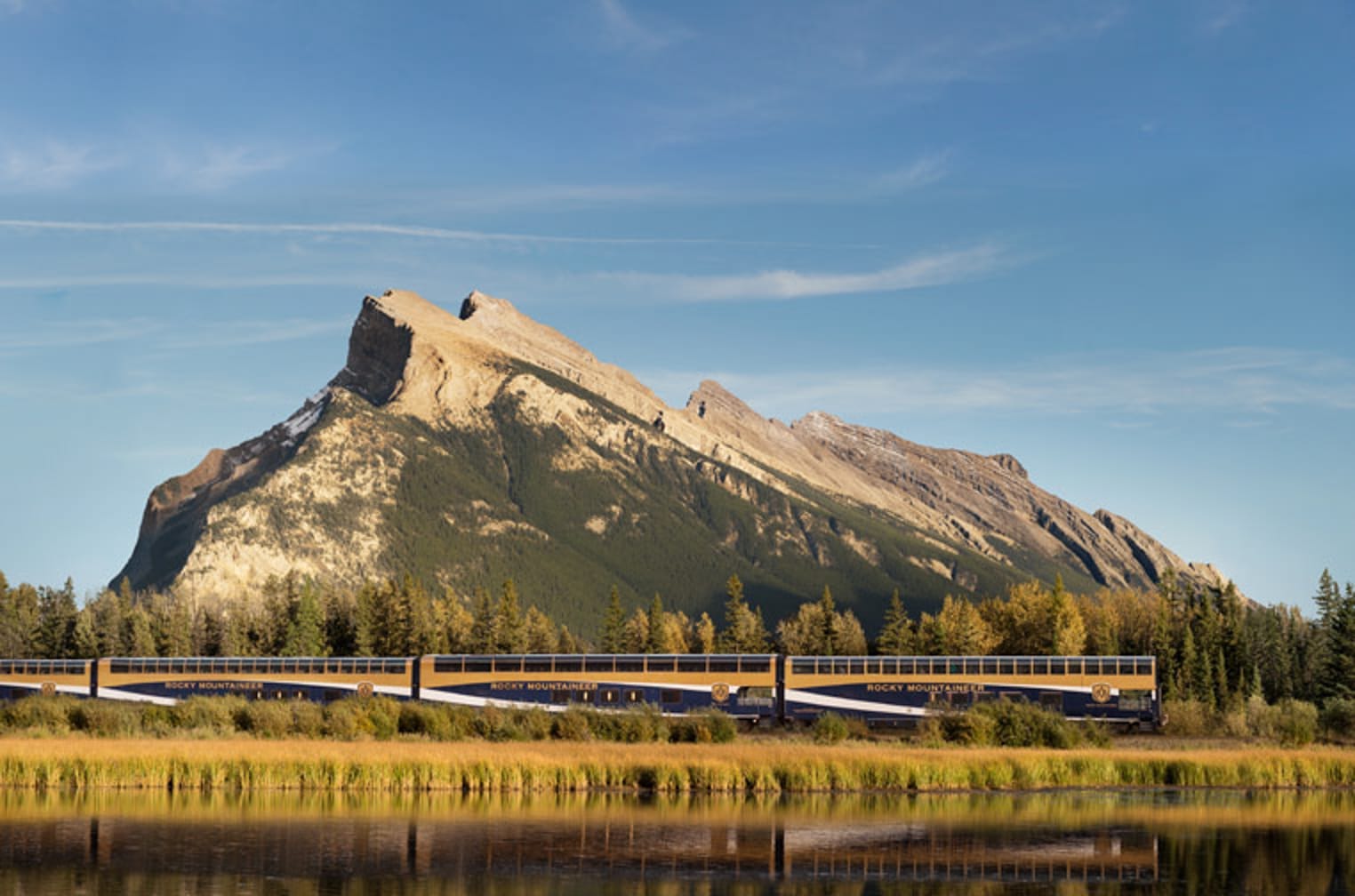
Passage to the Peaks is a new route introduced exclusively for June and July 2026. It is the only Rocky Mountaineer journey that both begins and ends in the Canadian Rockies, running between Banff or Lake Louise and Jasper with an overnight stop in Kamloops. This is also the first route that does not start or end in Vancouver.
The practical purpose of Passage to the Peaks is to allow travellers who are already in the Rockies, staying in Banff or Lake Louise, to experience Rocky Mountaineer without returning to Vancouver. It also enables Circle Journey combinations (see below) that previously required returning to Vancouver as the connecting point. Highlights include the Continental Divide crossing, the Spiral Tunnels, Stoney Creek Bridge, and the approach to Mount Robson.
Passage to the Peaks operates on a limited schedule: selected departures in June and July 2026 only, twice a week per direction.
Circle Journeys: combining routes into a longer experience
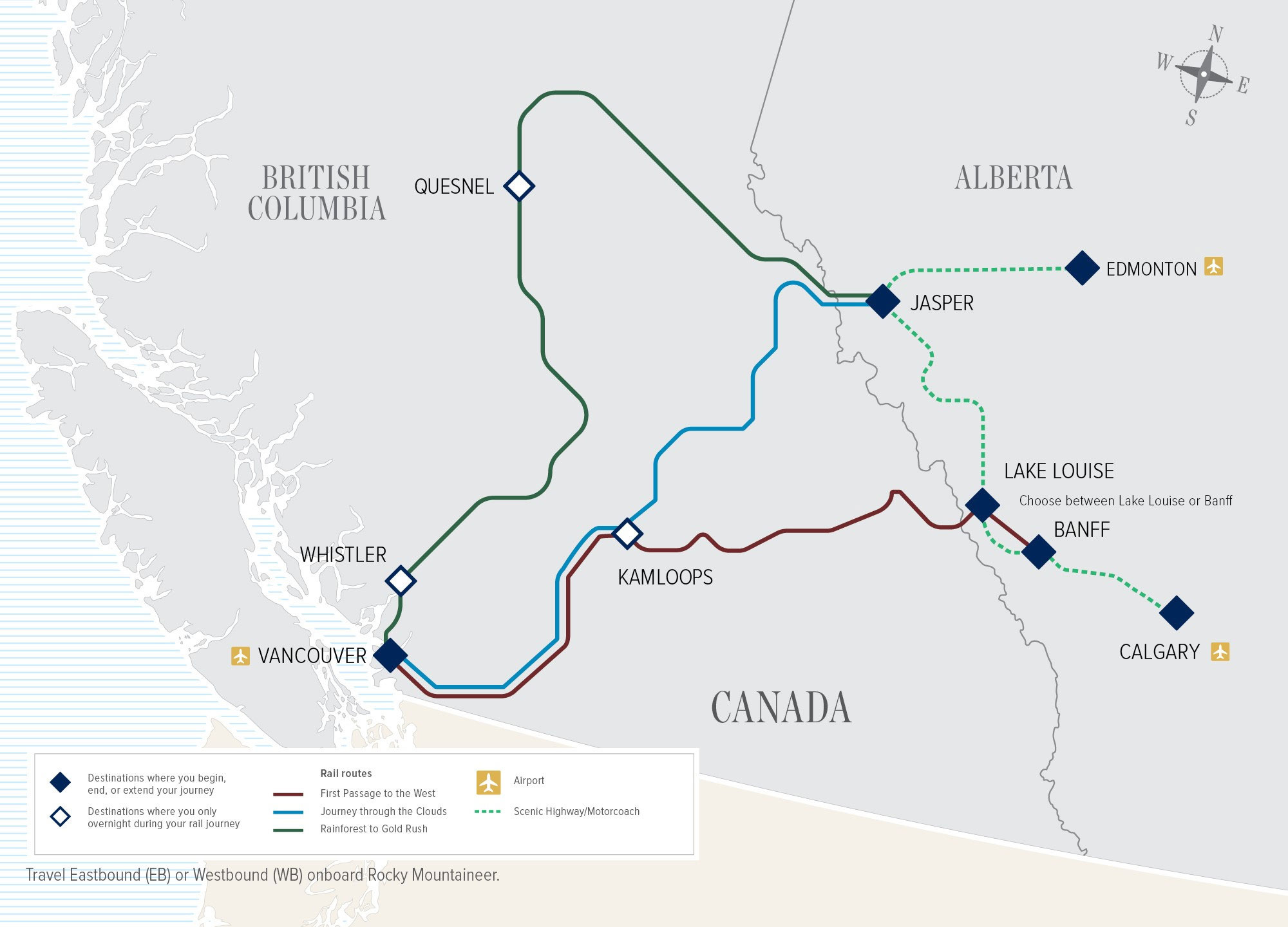
Rocky Mountaineer offers Circle Journeys as a way to experience two different routes in sequence without returning to Vancouver between them. The most popular Circle Journey combines First Passage to the West (Vancouver to Banff) with Journey through the Clouds (Jasper to Vancouver), with a connecting road or rail segment between Banff and Jasper through the Icefields Parkway.
This four-day rail experience (two days in each direction on different routes) passes through the Rockies twice from different approaches, seeing different mountain passes, different river corridors, and different wildlife territory. The Banff to Jasper connection along the Icefields Parkway, one of the most celebrated scenic drives in North America, provides the overland link between the two train segments and can be completed by rental car, private transfer, or guided sightseeing.
Rocky Mountaineer promotes double savings promotions for Circle Journey bookings, and the combination is the most frequently recommended itinerary for guests who want the fullest possible Rocky Mountaineer experience.
What is and is not included
Included in GoldLeaf service:
All onboard meals: hot breakfast and hot lunch served in the lower-level dining room on each travel day
Complimentary snacks and sweet and savoury refreshments throughout the day
A full selection of alcoholic and non-alcoholic beverages throughout the day
Dedicated Host service with onboard commentary
Outdoor observation platform access on designated cars
Luggage transfer to the overnight hotel in Kamloops, Quesnel, or Whistler between train days
Motorcoach transfer between the train station and the overnight hotel
One night of hotel accommodation in the intermediate overnight city (Kamloops, Quesnel, or Whistler) per the route
Gratuities for all onboard staff
Included in SilverLeaf service:
All onboard meals: breakfast and lunch served at the seat on each travel day
Snacks and non-alcoholic refreshments throughout the day
Alcoholic beverages available for purchase
Dedicated Host service with onboard commentary
Luggage transfer to the overnight hotel
Motorcoach transfer between train station and hotel
One night of hotel accommodation in the intermediate overnight city per the route
Gratuities for onboard staff
Not included in either service level:
Hotel accommodation in Vancouver, Banff, Lake Louise, or Jasper at the start and end of the journey (booked separately or through Rocky Mountaineer packages)
Transfers to and from Vancouver’s Rocky Mountaineer Station at the start and end of the journey
International and domestic flights
Travel insurance
Activities and excursions at destination cities
Rocky Mountaineer’s onboard service is all-inclusive for the time on the train. The gaps are at the journey endpoints, where guests book their own hotel stays in the departure and arrival cities or purchase Rocky Mountaineer’s complete vacation packages, which include those hotels, transfers, and often multi-day Banff or Jasper programmes.
How Rocky Mountaineer fits into a Canadian Rockies itinerary
Rocky Mountaineer works best as the centrepiece of a broader Canadian Rockies trip rather than a standalone product. The most logical itinerary structure builds several days in Vancouver before the train, the train journey itself over two days, and several days in Banff and Jasper after.
Vancouver is a destination city in its own right: Stanley Park, Granville Island, Gastown, the Capilano Suspension Bridge, the Seawall, and day trips to Whistler, the Gulf Islands, or Victoria make a three to four-night Vancouver stay natural and rewarding before the train journey begins.
Kamloops, the mandatory overnight stop on First Passage and Journey through the Clouds, is a small Interior BC city that is not a major tourist destination but offers comfortable partner hotels and a genuine sense of the BC Interior landscape. Most guests treat it as a pleasant interlude rather than a destination, which is appropriate.
Banff is one of the most visited mountain towns in North America, with year-round tourism, the Fairmont Banff Springs, Lake Louise (a 45-minute drive), the Banff Gondola, and the surrounding national park with hiking, skiing, and wildlife viewing available across every season. Three to five nights in Banff allows genuine exploration of the national park rather than only the town.
The Icefields Parkway between Banff and Jasper, at 232 kilometres, is one of the most celebrated scenic drives on the planet. For travellers combining First Passage to the West and Journey through the Clouds in a Circle Journey, the Icefields Parkway is the overland connector and warrants a full day of travel with stops at the Columbia Icefield, Athabasca Glacier, Peyto Lake, and the Bow Lake area.
Jasper is quieter and less commercially developed than Banff, with a more genuinely wilderness character. Jasper National Park at 11,000 square kilometres is larger than Banff National Park. Wildlife encounters including elk, black bears, and occasionally grizzly bears in the valley are more frequent near the townsite than at almost any comparable destination in North America.
How Rocky Mountaineer compares to other rail experiences
Rocky Mountaineer (Canada)
Best for: The Canadian Rockies experience that no road, no hiking trail, and no aircraft approach replicates: the Fraser Canyon, the Spiral Tunnels, the Yellowhead Pass, Mount Robson, and the approach to Banff and Jasper through landscapes that history designated as the route of the transcontinental railway for reasons that remain visually obvious from the train window. Thirteen World Travel Awards. The world’s most awarded luxury train experience.
Canyon Spirit (American Southwest)
Best for: The same formula applied to the American Southwest: daylight-only, glass-dome, seat-delivered cuisine, Host-led storytelling, but through the red rock canyons of Colorado and Utah between Denver, Moab, and Salt Lake City. Operated by the same Armstrong Collective parent company. SilverLeaf-equivalent Signature experience onboard, with Premier upgrade for lounge car access.
VIA Rail Canada (The Canadian)
Best for: The classic transcontinental crossing from Toronto to Vancouver in three to four days and nights, with sleeping car accommodation available at various grades from economy to the newest Prestige sleeper. A different type of experience from Rocky Mountaineer: overnight transcontinental travel in sleeping cars versus daylight luxury observation rail. Significantly lower price point.
Belmond Royal Scotsman
Best for: The most intimate luxury train in Europe, with sleeping suites, formal dining cars, and journeys through the Scottish Highlands of up to seven nights. A higher price point than Rocky Mountaineer, a more formal atmosphere, and a different cultural landscape.
Glacier Express (Switzerland)
Best for: The eight-hour panoramic rail journey between Zermatt and St. Moritz through 291 bridges and 91 tunnels in the Swiss Alps, a half-day experience rather than a multi-day journey, without sleeping accommodation or the daylight-only model.
Who Rocky Mountaineer is best suited for
Rocky Mountaineer works best for a clearly defined profile of traveller, and the daylight-only model is the most effective filter.
Travellers for whom the experience of being on the train in the landscape is the purpose of the trip, not a means of getting from one city to another. The guests who are most satisfied with Rocky Mountaineer are those who chose it specifically for the journey rather than for the speed or convenience of the transport.
Canadian travellers, particularly those from eastern Canada, for whom the Canadian Rockies represent a bucket-list destination that the train makes more accessible than the self-drive circuit. The train removes all navigation and logistics and places the landscape in front of you for two full days.
International travellers combining Rocky Mountaineer with a broader Canada trip: Vancouver plus the Rockies plus perhaps the Okanagan or Victoria. Rocky Mountaineer is the centrepiece of the most popular Canada itinerary structure in the market.
Couples celebrating anniversaries, milestone birthdays, or significant occasions for whom the GoldLeaf dining room and the rotating seats and the glass-dome views in the Canadian Rockies provide a context that few other travel experiences can match.
Travellers who want to experience Rainforest to Gold Rush specifically: if this route is on your list at all, 2026 is your year.
Rocky Mountaineer alumni who want Canyon Spirit for a companion American Southwest experience. The same company, the same formula, a different and equally spectacular geography.
Rocky Mountaineer is less suited to travellers who want efficient point-to-point transportation, those who want sleeping car accommodation for overnight travel (VIA Rail’s Canadian serves this better), budget-conscious travellers for whom the price represents a significant portion of the total trip cost, or those for whom the Canadian Rockies landscape is not itself a primary motivation.
The Rainforest to Gold Rush closing: what you need to know right now
This section warrants its own heading because the information is time-sensitive and many travellers who read about Rocky Mountaineer will not have seen the March 2026 announcement.
Rocky Mountaineer announced on March 30, 2026, that the Rainforest to Gold Rush route may operate for the final time this season. CN Railway, which owns the trackage between Squamish and 100 Mile House that this route uses, has announced its intention to discontinue operations on this section of the line as part of its network restructuring. Rocky Mountaineer has no control over CN’s network decisions.
The route will not operate in 2027. It has not been included in the 2028 schedule. The CEO of Armstrong Collective, Tristan Armstrong, has stated the company would return to the route if a long-term operator is found to maintain the rail line, but no such arrangement is in place and the prospects are uncertain.
What this means for travellers is clear: the Rainforest to Gold Rush route visits Whistler, travels through the Cariboo region of northern British Columbia, passes through landscapes including Cheakamus Canyon and the Painted Chasm, and provides wildlife viewing opportunities (black bear, grizzly bear, bald eagle, osprey) that the other Rocky Mountaineer routes do not offer. It is the most geographically diverse route in the Canadian portfolio and the only one that takes three days rather than two. It has operated since 2006 and has been many guests’ favourite of the three Canadian routes.
The 2026 season may be the last opportunity to take it. I can confirm availability and assist with booking for any remaining 2026 departures.
Frequently asked questions
How is Rocky Mountaineer different from a regular train?
Rocky Mountaineer is not a transportation service. It is a luxury sightseeing experience that uses trains as its vehicle. The daylight-only model means every moment of travel is a viewing opportunity. The GoldLeaf and SilverLeaf coaches are purpose-built with glass-dome windows above the standard sightline. Meals are served by dedicated Hosts at the seat or in a dining room. There are no sleeping cars because the train stops overnight in partner hotels. A flight covers the same distance in under two hours; Rocky Mountaineer takes two to three days by design.
What is the difference between GoldLeaf and SilverLeaf?
GoldLeaf is a bi-level glass-dome coach in which the upper level is a seated observation deck with rotating and reclining seats, and the lower level is a dedicated dining room serving hot meals at reserved tables. Seating rotates 180 degrees, allowing groups of four to face each other. All beverages including alcohol are included. SilverLeaf is a single-level glass-dome coach in which meals are served at the seat and seating does not rotate. Both offer the same panoramic views. The choice depends on the value placed on the dining room format, the rotating seat configuration, and the premium beverages versus the lower price of SilverLeaf.
Is the overnight hotel in Kamloops included?
Yes. The hotel stay in Kamloops (on First Passage to the West and Journey through the Clouds), or in Whistler and Quesnel (on Rainforest to Gold Rush), or in Kamloops again (on Passage to the Peaks) is included in the Rocky Mountaineer fare along with the motorcoach transfer between the train station and the hotel and luggage delivery. Hotels in Vancouver or Banff or Jasper at the journey start and end are not included and are booked separately or through Rocky Mountaineer’s complete vacation packages.
What is the Rainforest to Gold Rush situation in 2026?
The Rainforest to Gold Rush route, which has operated since 2006 between North Vancouver and Jasper via Whistler and Quesnel, faces closure after the 2026 season. CN Railway has announced it will discontinue operations on the portion of its rail line that this route depends on. Rocky Mountaineer has confirmed the route will not run in 2027 and is not in the 2028 schedule. If you want to take this route, 2026 is almost certainly your last opportunity. Contact me directly for current availability on remaining 2026 departures.
What is Passage to the Peaks?
Passage to the Peaks is a new route introduced for a limited window in June and July 2026 only. It is the only Rocky Mountaineer journey that begins and ends in the Canadian Rockies, running between Banff or Lake Louise and Jasper with an overnight stop in Kamloops. It allows guests who are already staying in the Rockies to experience Rocky Mountaineer without returning to Vancouver, and enables Circle Journey combinations between Banff and Jasper that were not previously available.
What is a Circle Journey?
A Circle Journey combines two Rocky Mountaineer routes into a single extended itinerary. The most popular combination is First Passage to the West from Vancouver to Banff, followed by a road transfer along the Icefields Parkway to Jasper, followed by Journey through the Clouds from Jasper back to Vancouver. This four-day rail experience passes through the Rockies twice from different directions, covering two distinct mountain crossing routes. Rocky Mountaineer offers promotional savings for Circle Journey bookings.
Plan a Rocky Mountaineer Trip with ÆRIA Voyages
Rocky Mountaineer is one of the most personally significant travel experiences I help clients plan, and the Rainforest to Gold Rush closure makes 2026 a genuinely important year for anyone who has put it off. I help clients select the right route, the right service level, the right direction, and the right surrounding itinerary in Vancouver, Banff, and Jasper to build a Canadian Rockies trip that the train anchors rather than simply passes through.
If you are curious about pricing, current availability, or particularly about any remaining Rainforest to Gold Rush departures in 2026, I would be glad to talk it through.
Yvan Junior Blanchette
Travel & Cruise Specialist
ÆRIA Voyages📩 yvanblanchette@aeriavoyages.com
📞 1-888-460-3388
🌐 aeriavoyages.com