

The Ultimate Quebec City Travel Guide: What to know, where to go, and how to make the most of your visit
Updated 2026 | Québec | First-time visitors | In-depth travel
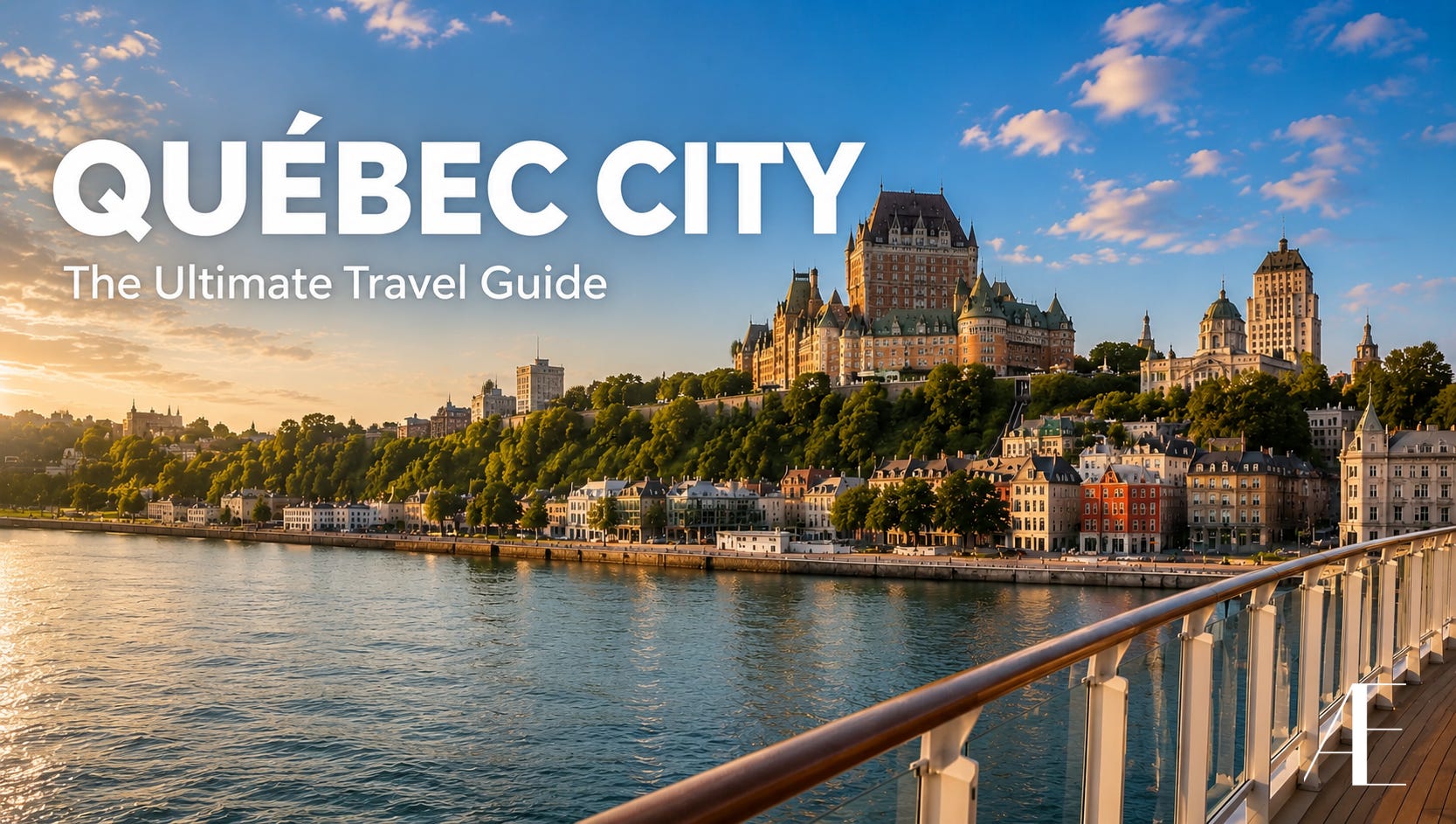
Québec City is not quite like anywhere else in North America. It is the only fortified city north of Mexico, a UNESCO World Heritage Site where 400 years of French history are still visible at street level, and a place that produces, in summer and winter alike, a quality of life that visitors from across the continent routinely describe as the closest thing to Europe they have ever found without crossing the Atlantic. And all of it is contained in a city of fewer than half a million people, compact enough to walk across in an afternoon, rich enough to hold your attention for a week.
The French language is the first thing you notice. Then the stone walls, the pitched copper roofs, the St. Lawrence River sprawling below. Then the smell of maple syrup drifting out of a shop on Rue du Petit-Champlain, and the Château Frontenac looming above everything like something out of a dream.
This guide covers everything you need to plan a serious visit: the neighbourhoods, the landmarks that genuinely earn their reputations, the restaurants that have earned Michelin recognition, where to sleep at every budget level, and how to think about the seasons. Québec City rewards preparation. This is that preparation.
Table of Contents
Why Québec City is worth it
There is a version of Québec City that shows up on Christmas cards: snow on the cobblestones, the Château Frontenac glowing against a winter sky, horse-drawn carriages navigating the narrow streets of the Old Town. That version is real, and it is genuinely beautiful. But it is only one version of a city that has been building on itself for four centuries, and stopping at the postcard image means missing what makes Québec City one of the most compelling destinations in the country.
The city sits on a promontory above the St. Lawrence River, and the geography is everything. Upper Town and Lower Town are separated by a cliff, connected by a funicular and by staircases steep enough to slow even the most impatient walker. The division gives Québec City a physical drama that few North American cities possess: you are always either climbing toward the old fortifications or descending toward the river, and the views in both directions are extraordinary.
What makes Québec City more than a beautiful backdrop is the specificity of its culture. This is the heartland of French Canada, and the French fact here is not merely linguistic: it shapes what people eat, how they celebrate, what they build, what they argue about. The Carnaval de Québec, held each February, is not a tourism exercise. It is something the city actually does, with a seriousness of purpose that surprises visitors who expect a staged event. The same is true of the food scene, which has grown into one of the most distinctive in the country. As of May 2026, Québec City is home to the only two-Michelin-starred restaurant in the province, along with six additional starred restaurants, a cluster of exceptional bistros, and a commitment to local terroir, Île d’Orléans produce, and boreal ingredients that sets the cooking here apart from anything you will find in a more cosmopolitan city.
For travellers based in eastern Canada or the northeastern United States, Québec City is one of the great underutilised long-weekend destinations. For international visitors making a first trip to Canada, it belongs on the itinerary alongside Toronto and Montréal, and it will likely be the city they remember most clearly.
The neighbourhoods to know
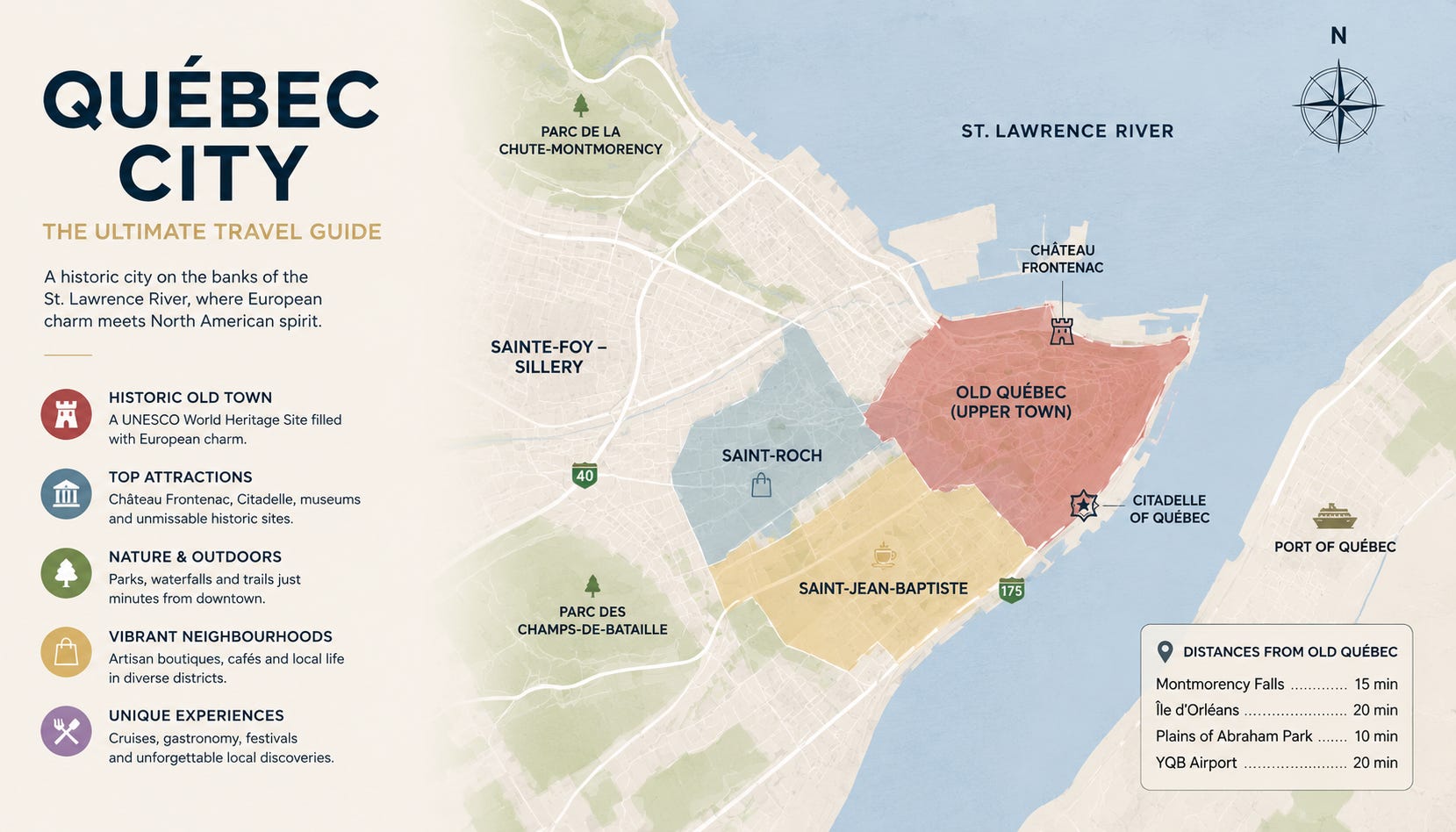
Québec City organises itself around the distinction between Upper Town and Lower Town, with the old fortification walls running through the middle. Understanding this structure makes the city immediately navigable.
Vieux-Québec Haute-Ville (Upper Old Town)
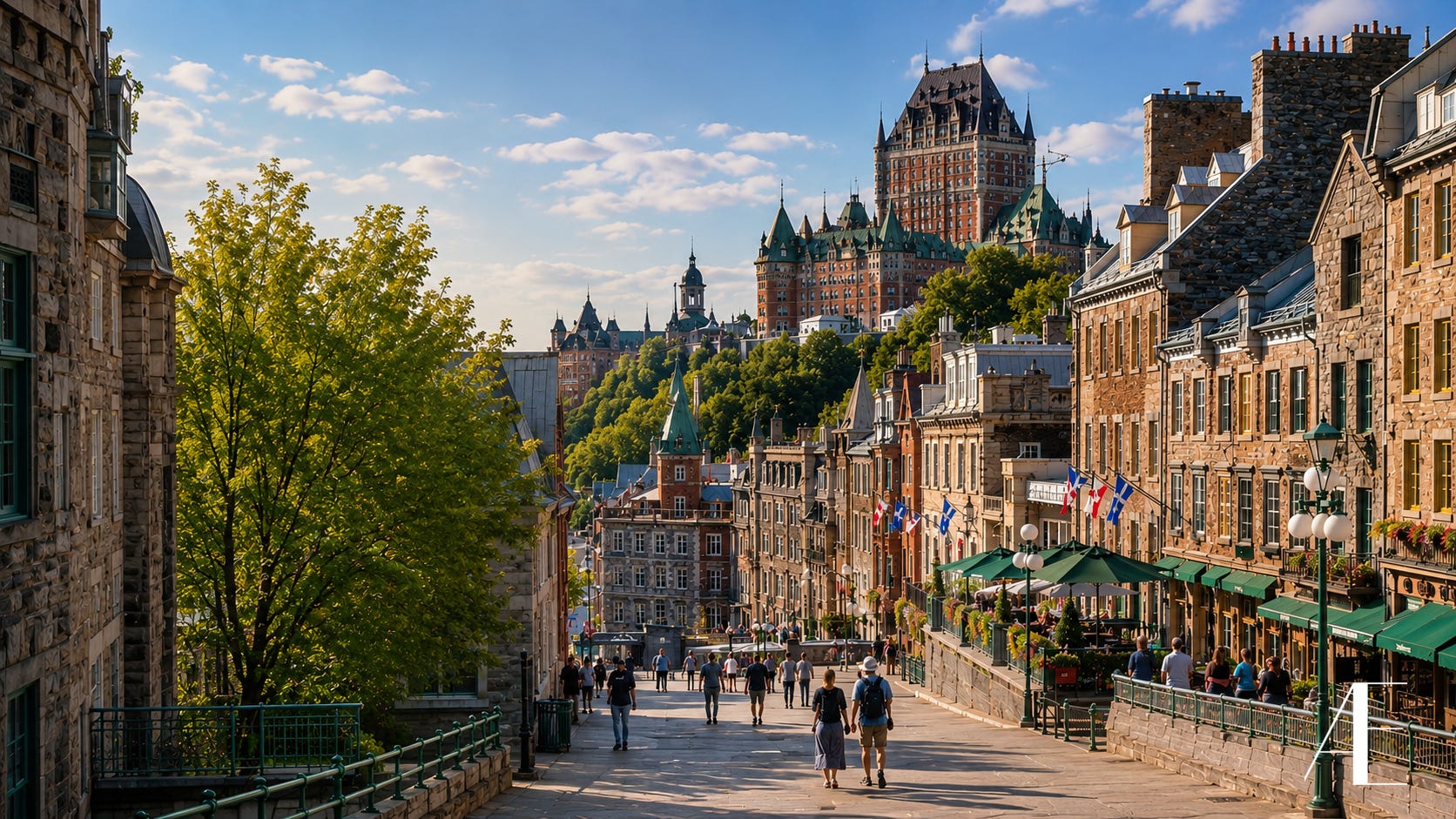
The walled heart of the city, centred on the Château Frontenac, Dufferin Terrace, and the streets that radiate outward from Place d’Armes. This is where the concentration of churches, museums, historic buildings, and tourist infrastructure is highest. It is also, inevitably, where the crowds are most present in summer and during the Carnaval. The Upper Town is not to be avoided; it is to be understood as a starting point rather than a destination in itself. Walk every street in it at least once. The ramparts, which you can follow on foot for most of their length, offer some of the finest urban walking in Canada.
Vieux-Québec Basse-Ville (Lower Old Town)
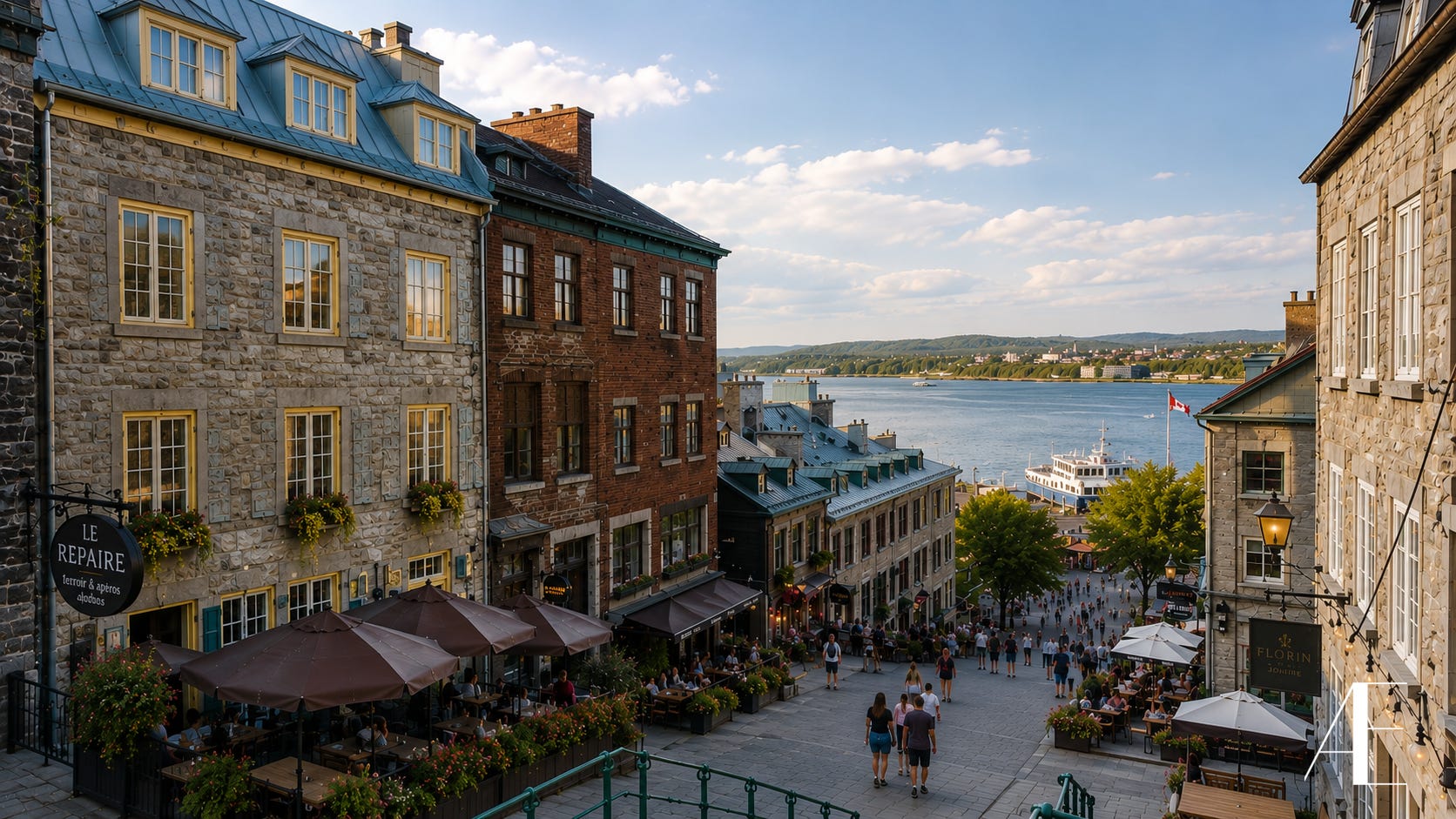
Below the cliff, reached by the funicular or the Escalier Casse-Cou (Breakneck Stairs), the Lower Town has a different scale and texture from the Upper. Place Royale, where Samuel de Champlain founded the city in 1608, anchors the lower quarter. The Quartier du Petit-Champlain runs south from Place Royale along the river: one of the oldest commercial streets in North America, lined with artisan boutiques, restaurants, and galeries that manage, against the odds, to retain genuine charm even when busy. The Old Port and the Museum of Civilization are both here.
Saint-Jean-Baptiste
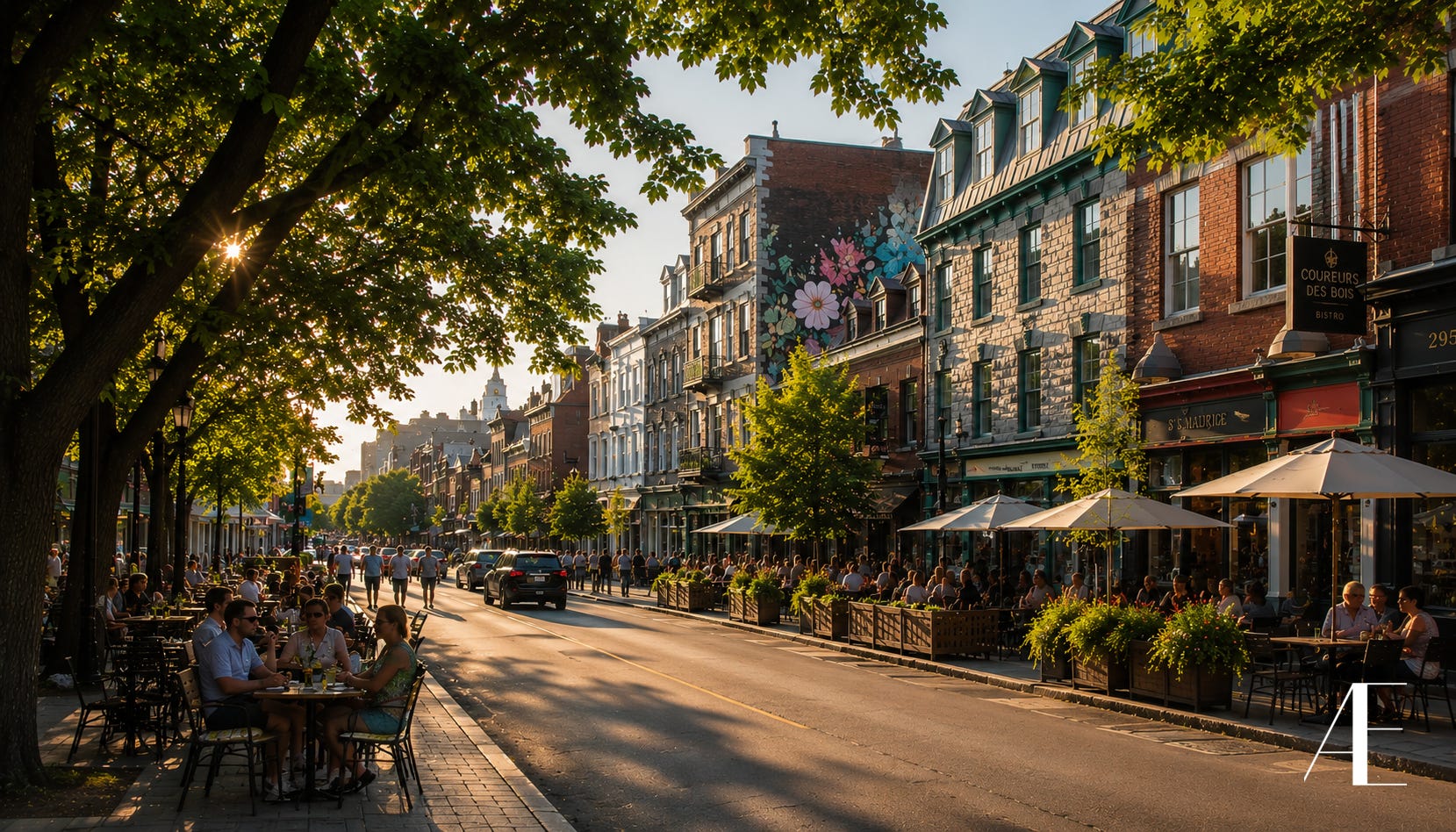
Just outside the fortification walls to the west of Upper Town, Saint-Jean-Baptiste is the bohemian neighbourhood that Québec City residents actually live in. Rue Saint-Jean is the main artery: a street of independent cafés, restaurants of real quality, butchers, booksellers, and bars that stay open late. The neighbourhood has a festive, slightly irreverent character that balances the formal history of the walled city. It is where you should go when you want to eat and drink among Québécois rather than with other tourists.
Grande Allée and Montcalm
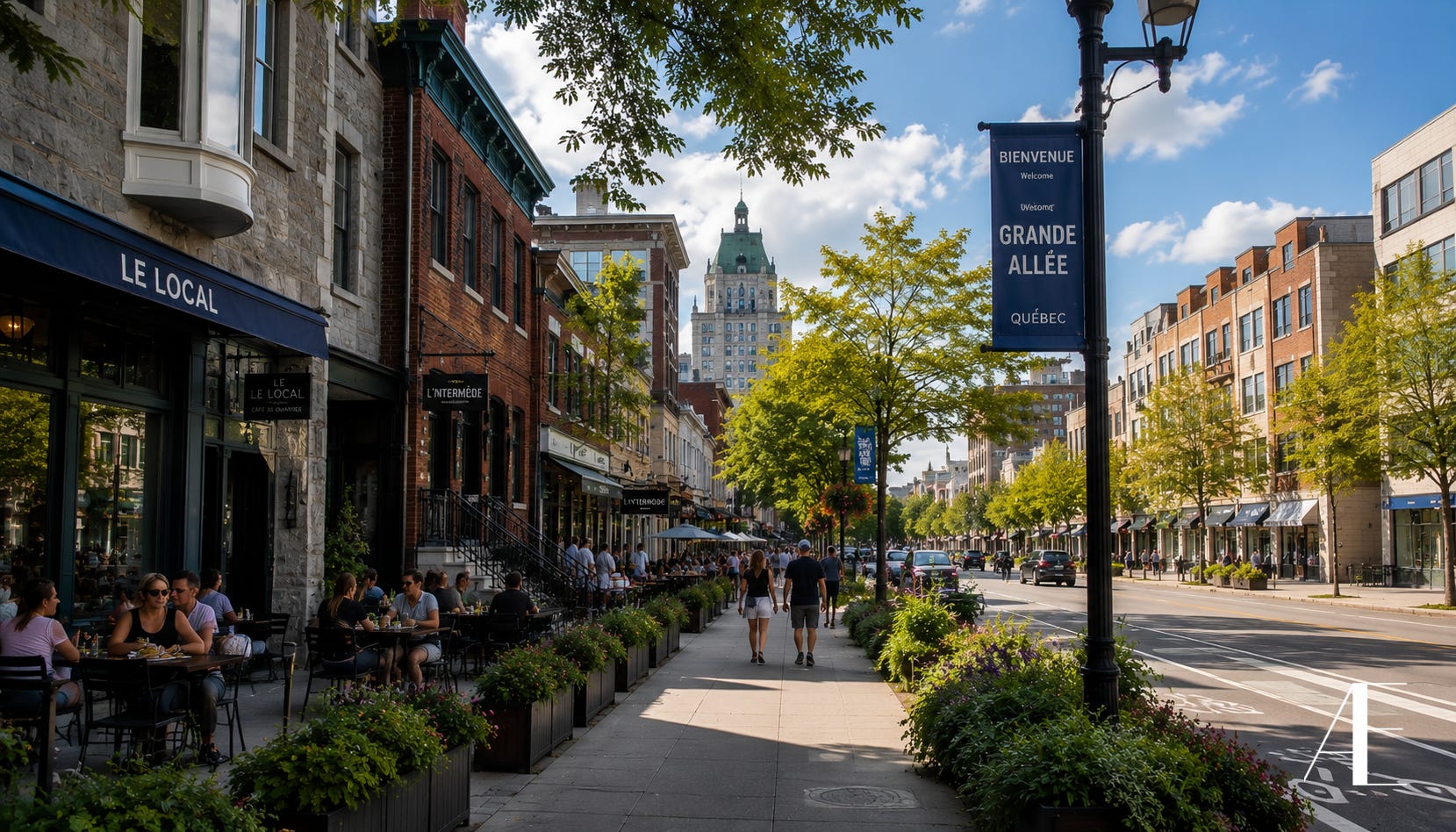
The Parisian-flavoured boulevard that extends west from the walls, Grande Allée is Québec City’s summer terrace culture at its most concentrated. The outdoor restaurant terraces here are packed from May through September. Parliament Hill sits at the eastern end, and Battlefields Park, which encompasses the Plains of Abraham, runs parallel to the south. The Montcalm neighbourhood beyond Grande Allée is quieter, residential, and home to the National Museum of Fine Arts of Québec, which is consistently undervisited relative to its quality.
Saint-Roch
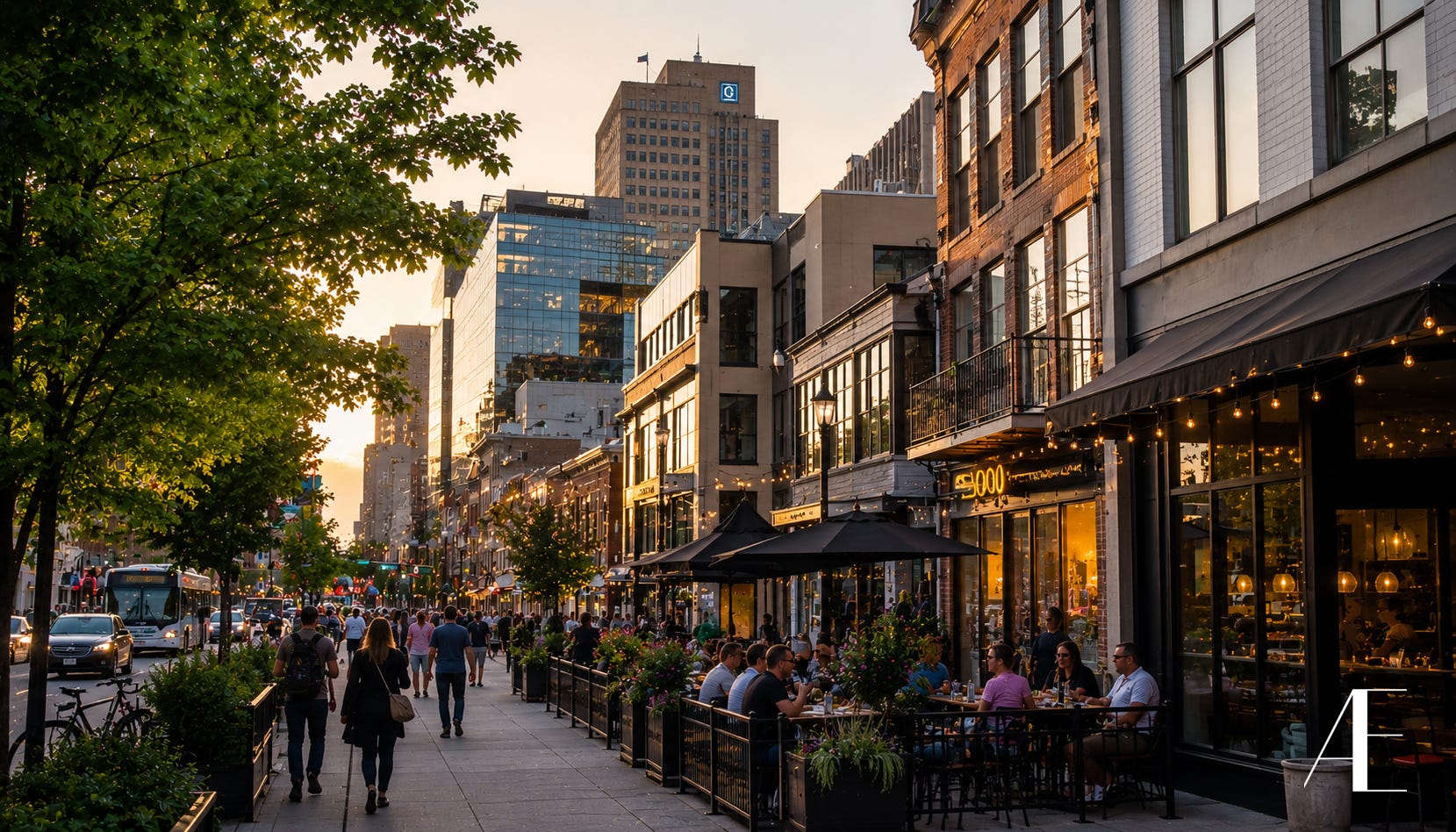
The Lower Town neighbourhood that underwent the most dramatic transformation of any quarter in the city over the past two decades. Once a declining industrial district, Saint-Roch is now where Québec City’s creative class eats, works, and socialises. The restaurant scene here is sharp and unpretentious: small rooms, serious cooking, natural wine, and prices that the Upper Town cannot match. If you are spending more than three days in the city, Saint-Roch deserves an evening.
Saint-Sauveur (Saint-Sô)
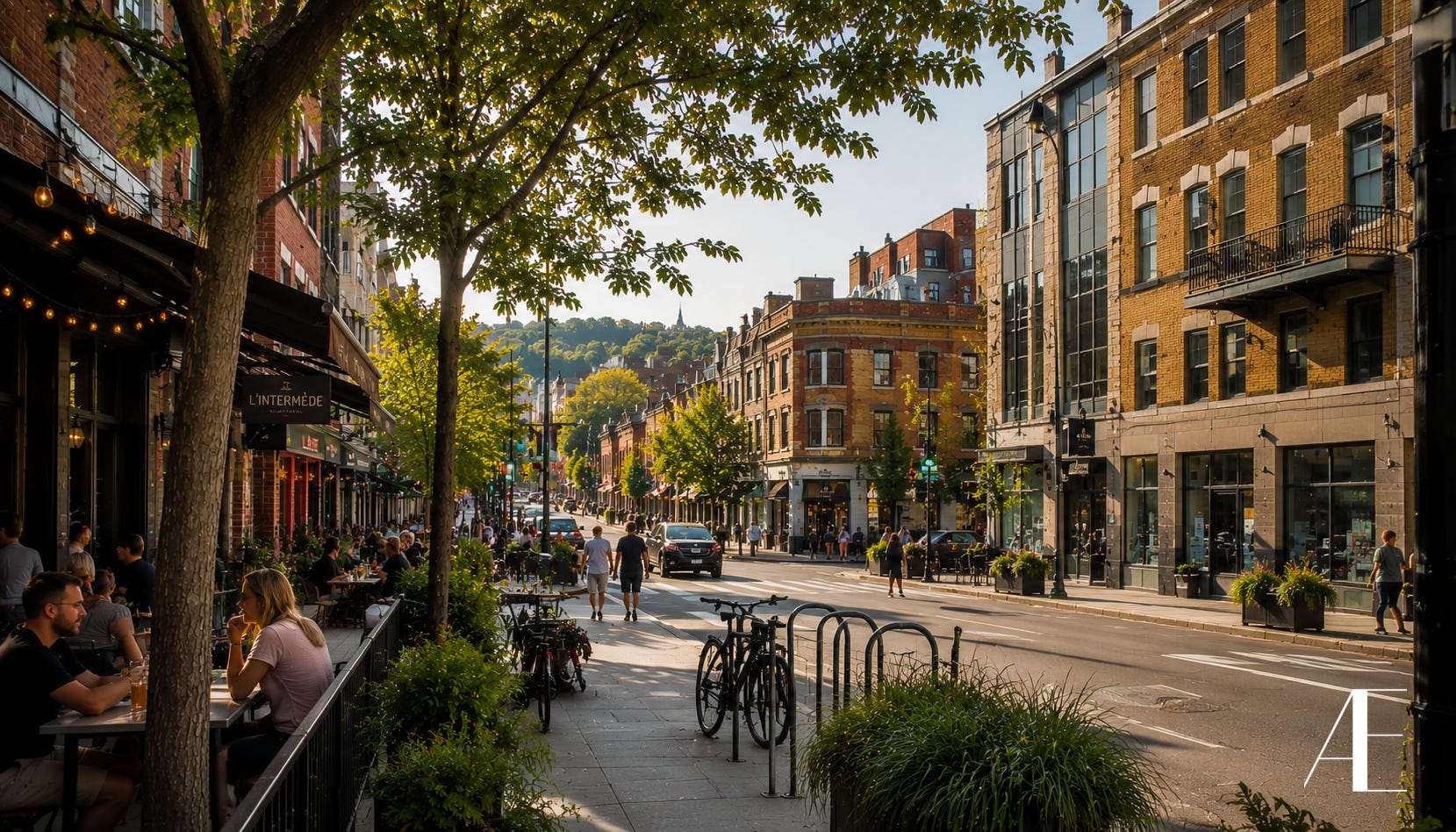
Immediately west of Saint-Roch, Saint-Sauveur has followed a similar trajectory: working-class origins, gradual influx of young families and creative professionals, neighbourhood restaurants of genuine character, and a community spirit that feels earned rather than marketed. Less visited than Saint-Roch, it is the neighbourhood for anyone who wants to see what Québec City looks like when it is not performing for visitors.
Things you should not miss
Québec City accumulates experiences faster than any reasonable itinerary can absorb them, and the city layers its pleasures differently by season. Spring brings the sugar shacks of the surrounding countryside, where maple sap is boiled down and served on snow in a tradition Québécois take seriously as a rite of the season.
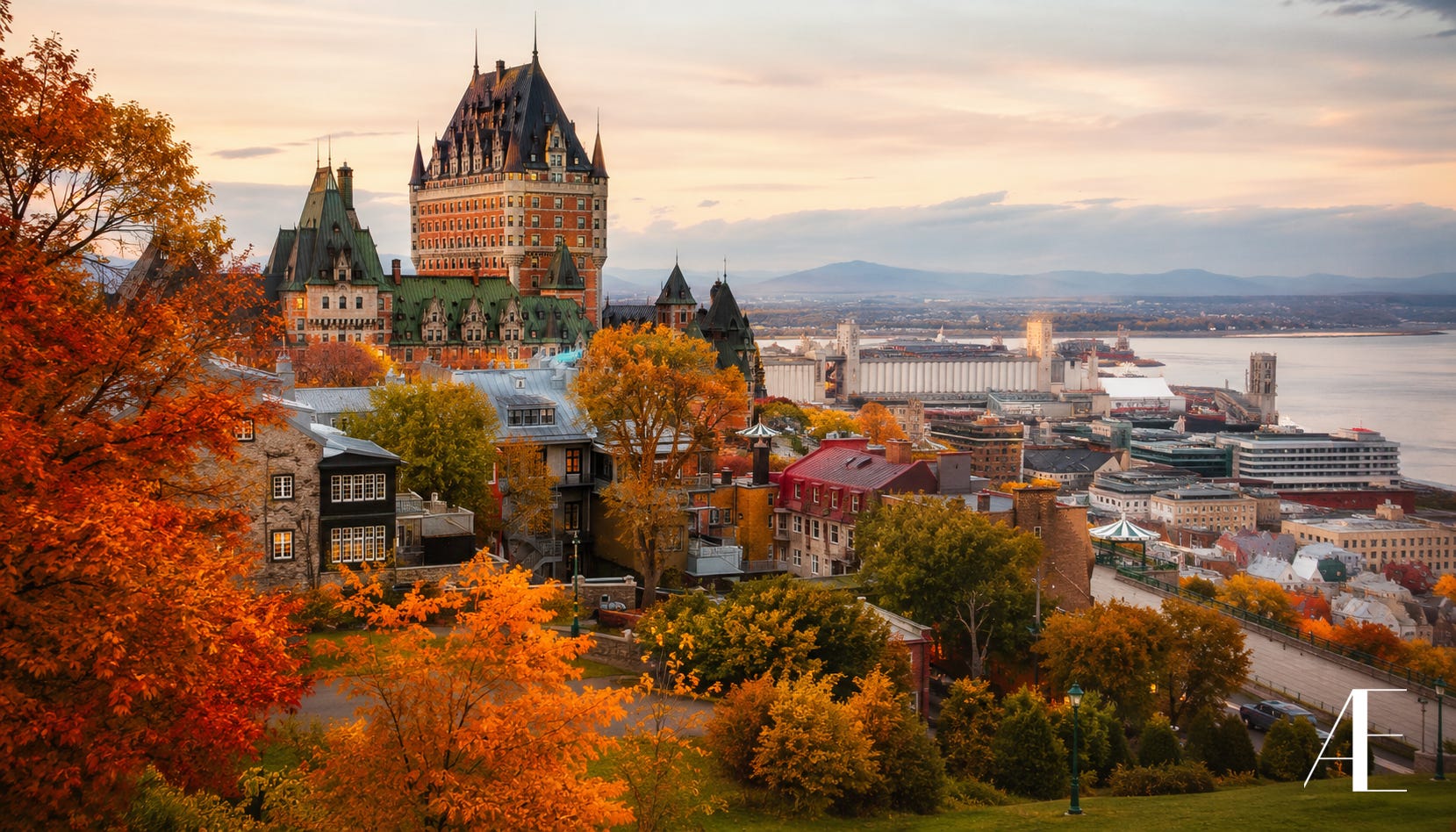
Autumn is the kind of walking weather this city was made for: brisk air, copper light on the river, and foliage in the valleys around Jacques-Cartier National Park that justifies a detour. Winter doubles down rather than quieting things, with the Carnaval, the toboggan slides, and a particular silence on the cobblestones after a fresh snowfall. What follows belongs on every visit, whatever the season.
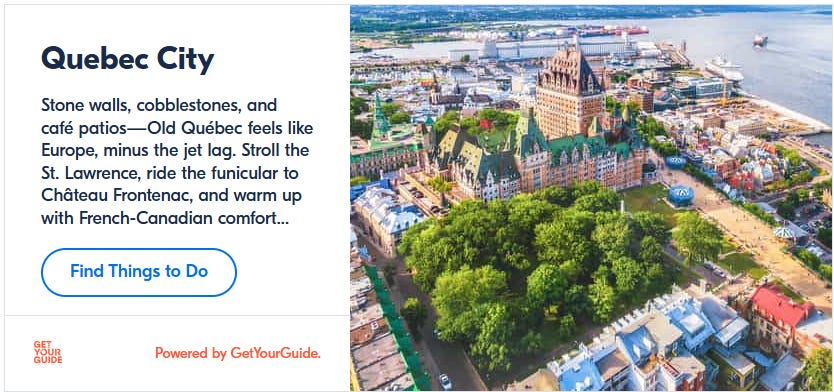
The Château Frontenac and Dufferin Terrace

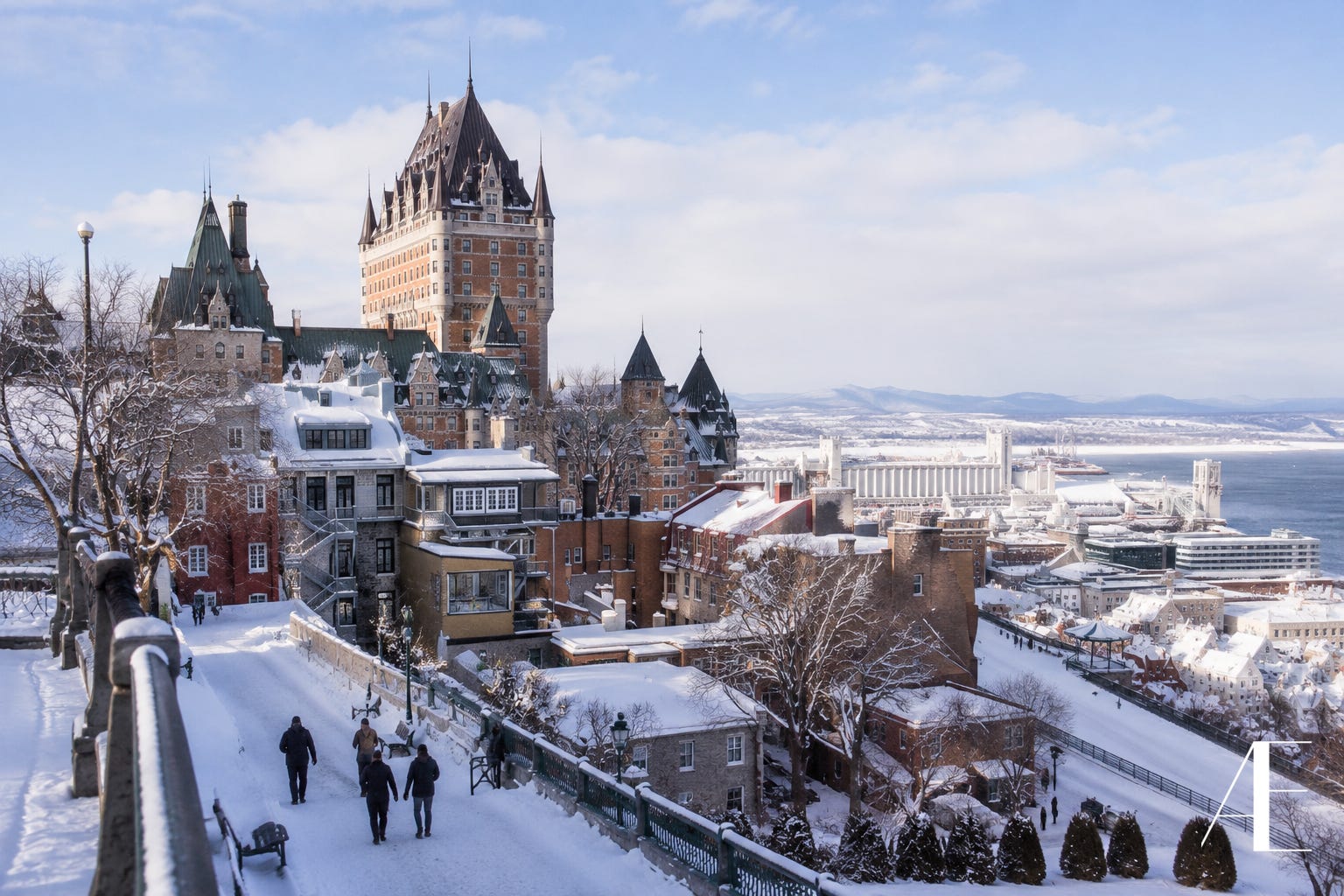
The Château Frontenac is not merely an iconic hotel: it is, in a real sense, the defining image of French Canada. Designed by Bruce Price for the Canadian Pacific Railway and opened in 1893, it towers over the Upper Town from the Cap Diamant, visible from the river, from the south shore at Lévis, and from virtually every elevated point in the city. You do not need to stay here to engage with it. The hotel lobby is open to visitors, and the interior’s grand corridors and public spaces carry a genuine weight of history. But the more essential experience is the Dufferin Terrace itself: the 671-metre boardwalk that runs along the cliff edge beside the château, offering unobstructed views of the river, the lower town, and the opposite shore. In summer, street performers and artists occupy the terrace from afternoon into the evening. In winter, the historic toboggan slide at the terrace’s northern end has operated since the 1880s, and the queue to use it is one of the more joyful spectacles in the country.
The Citadelle de Québec

The star-shaped fortification that anchors the southern end of the ramparts was built by the British between 1820 and 1850, though it sits on the site of earlier French defences. It remains an active Canadian Forces base and the official residence of the Governor General in Québec.
The Changing of the Guard ceremony, held daily at 10 a.m. from late June through early September, is a genuine spectacle rather than a tourist set-piece, and the regimental museum inside the walls houses artifacts that illuminate both the military history of the continent and the particular story of the Royal 22e Régiment, the famous “Van Doos” who have served here for over a century. The view from the Citadelle’s ramparts over the river and the city is the finest single view in Québec City.
Place Royale and the Quartier du Petit-Champlain

Place Royale is the site of the first permanent French settlement in North America, and the square itself, surrounded by 17th-century stone buildings and anchored by the Church of Notre-Dame-des-Victoires (one of the oldest stone churches on the continent, dating to 1688), earns its claim as the birthplace of French America. It is not a recreation: these buildings are genuinely old, carefully restored rather than rebuilt. The adjacent Quartier du Petit-Champlain, which descends toward the river along Rue du Petit-Champlain, is sometimes dismissed as too commercial for serious visitors. That assessment is too quick. The street is narrow, the architecture is authentic, and the mix of artisan shops, good restaurants, and galleries retains a texture that mass tourism has not entirely flattened. Go on a weekday morning in shoulder season and it is genuinely beautiful.
The Plains of Abraham
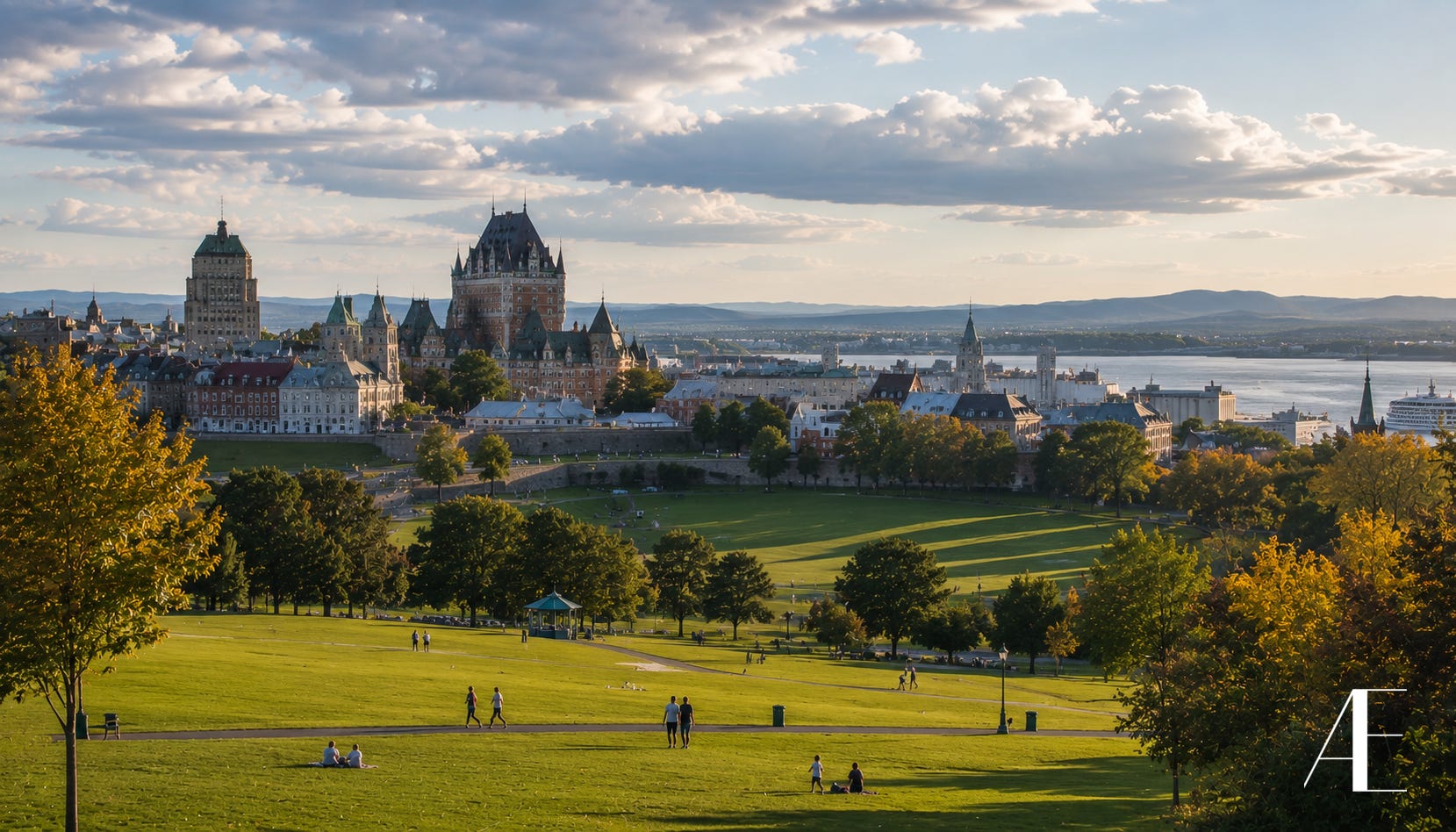
The grassy plateau above the city where, in 1759, the British forces under General Wolfe defeated the French under the Marquis de Montcalm in a battle that lasted less than twenty minutes but determined the future of North America. Both commanders died of their wounds. The site is now part of Battlefields Park, 103 hectares of urban green space that Québec City residents use year-round for walking, cycling, jogging, and picnicking.
The historical weight is always present but not oppressive: the Plains of Abraham Museum, housed in a former military building nearby, offers the most rigorous account of the battle and its aftermath available anywhere. In summer, the park hosts major outdoor concerts. In winter, it becomes a cross-country skiing and snowshoeing venue.
Montmorency Falls

Fifteen minutes east of the Old Town, the Montmorency River drops 83 metres into the St. Lawrence: taller than Niagara Falls by nearly 30 metres, though far narrower. The falls can be approached from above by cable car or from below via a staircase of 487 steps. A suspension bridge crosses the gorge at the top. In summer, a zipline operates across the face of the falls. In winter, the frozen spray builds up into a cone of ice at the base, called the sugarloaf, which ice climbers scale and visitors photograph with the same enthusiasm.
The Manoir Montmorency, the elegant Victorian house at the summit, houses a café and an exhibition on the falls’ history. Note that a major redevelopment of the upper sector is underway and due for completion in summer 2026, which will improve access considerably. Verify current conditions before visiting.
The Musée national des beaux-arts du Québec (MNBAQ)

The National Museum of Fine Arts of Québec is routinely overlooked by visitors focused on the Old Town, which is a genuine mistake. The museum’s permanent collection, spread across three pavilions in Battlefields Park, covers Québec art from the 17th century to the present with a depth and curatorial intelligence that is not matched by any other institution in the province outside Montréal. The Inuit and First Nations collection is particularly strong. The building itself is worth the visit: the newest pavilion, designed by Atelier 21 with a glass corridor linking it to a repurposed prison, is among the most thoughtful pieces of museum architecture in the country.
The Musée de la civilisation
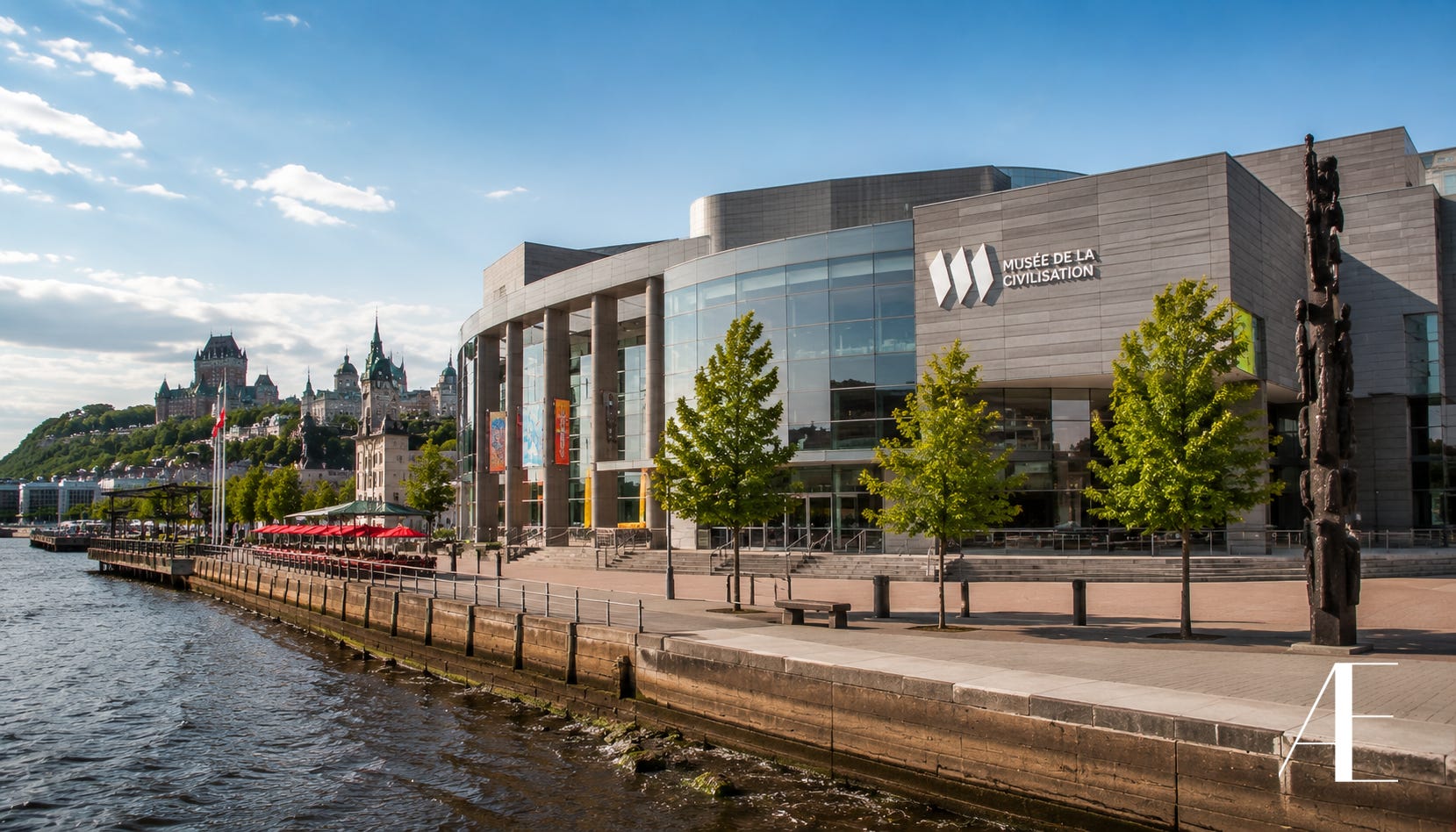
The Museum of Civilization in the Lower Town, designed by Moshe Safdie and opened in 1988, is one of the finest museums in Canada and chronically underrated internationally.
Its permanent exhibition on Québec society, Nous, les autres (Us and the Others), traces the history and identity of Québec from its indigenous origins through French settlement, the British conquest, industrialisation, and into the present, with an editorial intelligence and a willingness to engage with complexity that is rare in public institutions. The building itself, integrated into the historic streetscape of Place Royale with exposed archaeological fragments visible through glass floors, is architectural brilliance.
Day trips from Québec City
Île d’Orléans
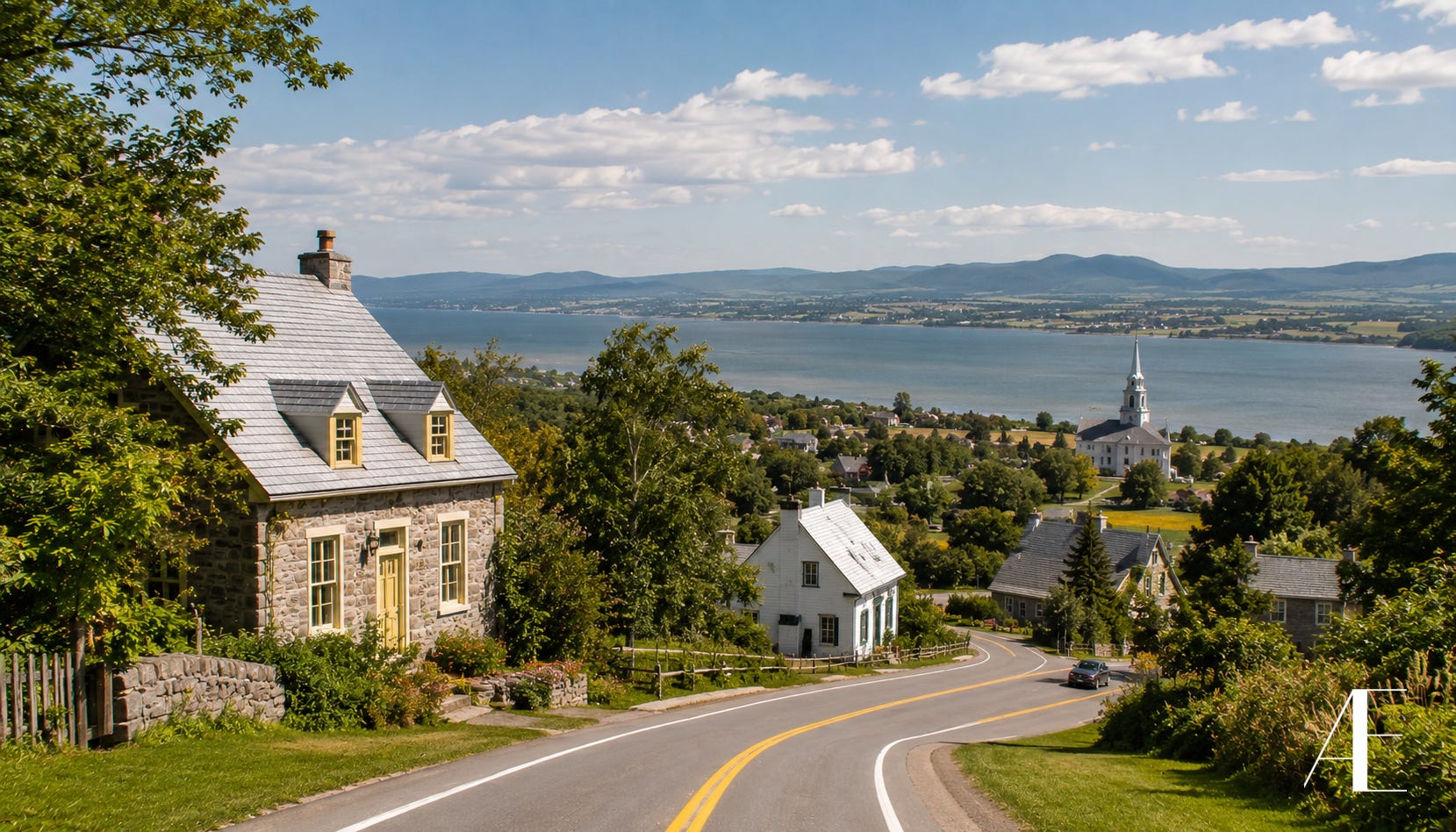
Twelve kilometres east of the Old Town, connected to the mainland by a single bridge, Île d’Orléans is a 35-kilometre island in the St. Lawrence where farming families have worked the same land since the 17th century. The island supplies a significant portion of what Québec City restaurants put on their menus: strawberries in June, raspberries and blueberries in July, apples from September through October, maple products year-round. A circuit of the island by car takes two to three hours without stops, considerably longer if you follow the farm stands, cideries, vineyards, chocolateries, and the island’s microbrewery. The Manoir Mauvide-Genest in Saint-Jean, built in 1734, is one of the last seigneurial manors still standing in Québec and is open for guided tours. There is no meaningful public transport to the island; a car or a guided tour is required.
Côte-de-Beaupré: Montmorency Falls, Sainte-Anne-de-Beaupré, and Canyon Sainte-Anne

The Côte-de-Beaupré, the stretch of the north shore east of the city, contains three very different experiences within a 45-minute drive. Montmorency Falls (described above in the “Things you should not miss” section) is the first stop coming from the city. Further east, the Basilica of Sainte-Anne-de-Beaupré is one of the most significant Catholic pilgrimage sites in North America, receiving close to a million visitors per year; the Gothic Revival building, completed in 1926, is impressive in scale and opulence, and the collection of ex-votos and crutches left by pilgrims whose ailments were reportedly healed constitutes a genuinely strange and moving testament to religious devotion. Beyond Sainte-Anne, Canyon Sainte-Anne offers a gorge carved by the Sainte-Anne-du-Nord River, with three suspension bridges, hiking trails, and a zipline in summer. The three can be combined in a single day without rushing.
Charlevoix: Baie-Saint-Paul and beyond
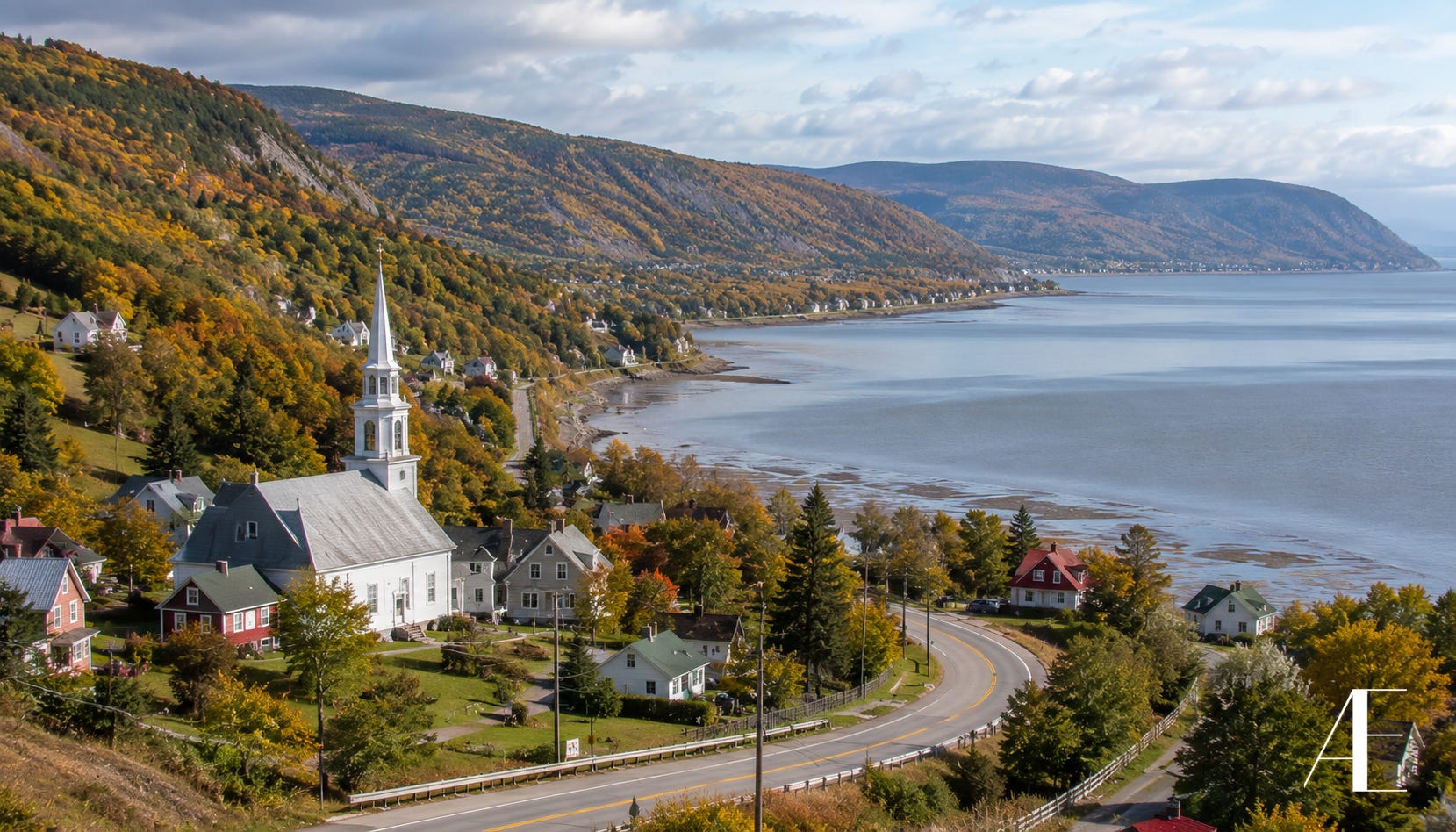
The Charlevoix region, beginning roughly 80 kilometres northeast of Québec City along the St. Lawrence, is one of the most scenically dramatic landscapes in eastern Canada. The road follows the river through a series of ridges and valleys carved by ancient meteor impact (the entire Charlevoix basin is a UNESCO Biosphere Reserve), with views across the water toward the south shore that are genuinely extraordinary. Baie-Saint-Paul, the main town, has developed a reputation as an arts community over the past three decades: galleries, artisan studios, and a restaurant scene that now includes its own Michelin Bib Gourmand. The Train de Charlevoix, a scenic tourist railway, departs from the Montmorency Falls station and runs to Baie-Saint-Paul and beyond, following the river closely and offering one of the finest train journeys in the country for those who prefer not to drive. La Malbaie, a further hour along the river, is home to the Fairmont Le Manoir Richelieu and the Casino de Charlevoix, set on cliffs above the river with views that border on theatrical.
Jacques-Cartier National Park

Forty-five minutes north of the city, the Parc national de la Jacques-Cartier occupies a valley carved by the Jacques-Cartier River through the Canadian Shield: steep, densely forested walls dropping to a river corridor of remarkable beauty. Hiking, kayaking, canoeing, and cycling in summer; cross-country skiing and snowshoeing in winter. The park is managed by Sépaq and requires a daily access fee; reservations for camping and guided activities are strongly recommended in peak summer months.
When to visit
Québec City is genuinely a four-season destination, and the honest answer is that the right time to visit depends entirely on what you are looking for.
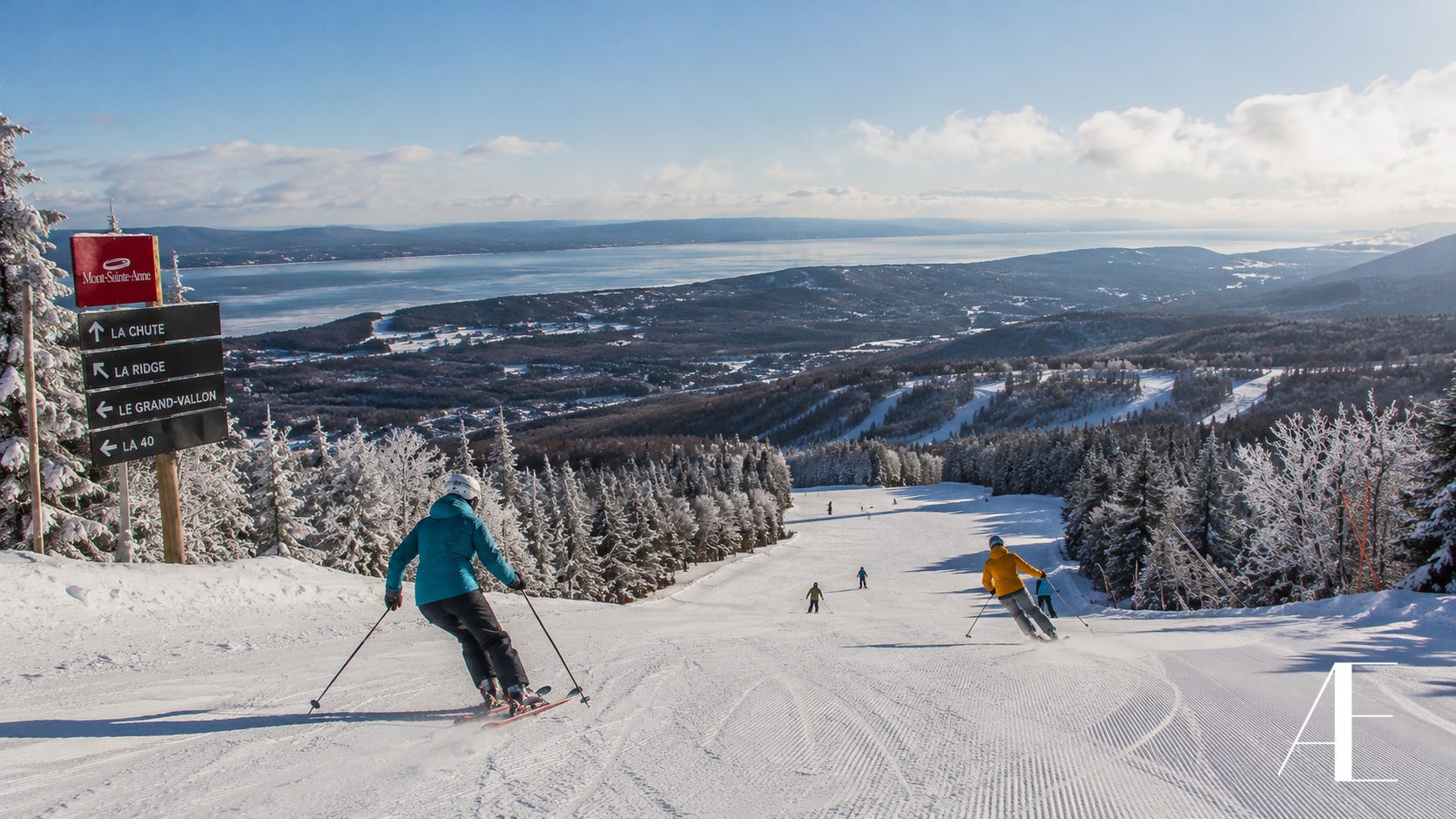
Winter (December to March) is when the city is most distinctly itself. The snow transforms Old Québec into something that photographers spend years trying to capture. The Carnaval de Québec, held for ten days in early February, is the largest winter festival in the world: 500,000 visitors, an ice palace, night parades, an ice canoe race on the St. Lawrence, and the Caribou, the warming winter drink made with red wine, spirits, and maple syrup, which is pressed into visitors’ hands at every turn. For those who dress appropriately, meaning serious layering with windproof outer layers, winter in Québec City is not a hardship; it is a specific experience available nowhere else in North America. Accommodation rates in winter outside of Carnaval are among the lowest of the year.
Spring (April to May) is the shoulder season, genuinely transitional and occasionally unpredictable: snow is possible into April, and the city has not yet fully activated its terrace culture. That said, May is increasingly pleasant, and the absence of summer crowds makes it worth considering for visitors who prioritise unhurried access to the Old Town over reliable sunshine.
Summer (June to September) is when Québec City operates at full intensity. The Festival d’été de Québec in early-to-mid July is one of the largest music festivals in the Francophone world, drawing major international acts and filling every hotel in the city. The terraces on Grande Allée are open and crowded. Île d’Orléans is producing its best strawberries and raspberries. Montmorency Falls is at full volume. This is the most popular time to visit, and prices reflect it: hotel rates can be three to four times the winter off-season norm. Book well in advance, particularly for July.
Autumn (September to November) is, for many experienced travellers, the best time to visit. September offers summer temperatures with noticeably smaller crowds, and the foliage in and around the city, particularly in Charlevoix and Jacques-Cartier National Park, is spectacular from late September through mid-October. November is quieter and less comfortable, but the city’s restaurant scene operates year-round and the museums are never crowded.
How many days to spend
Three days is the minimum to see the essential Québec City without feeling rushed: the Old Town, the Plains of Abraham, Montmorency Falls, and a serious dinner or two. Four days allows you to add a day trip to Île d’Orléans or Charlevoix, which meaningfully expands the experience. Five days gives you time to explore the less-visited neighbourhoods of Saint-Roch and Saint-Jean-Baptiste, visit the MNBAQ properly, and let the city’s pace slow you down, which is ultimately how Québec City is best experienced.
A week in and around Québec City is entirely justified if you combine the city with Charlevoix and the surrounding region. This is increasingly how the destination is packaged by serious travel planners, and it is an approach that works.
Suggested 4-day itinerary
Day 1: The Old Town, Upper and Lower
Begin on Dufferin Terrace in the early morning, before the crowds arrive, with the Château Frontenac to your left and the river spreading out below. Walk the ramparts east toward the Citadelle and follow them south before descending into the city through one of the gates. Spend the late morning in Upper Town: Place d’Armes, the Notre-Dame de Québec Basilica-Cathedral, and the streets around Rue du Trésor where local artists display their work. After lunch in Saint-Jean-Baptiste, take the funicular or the Escalier Casse-Cou down to Lower Town. Spend the afternoon in Place Royale, the Church of Notre-Dame-des-Victoires, and the Quartier du Petit-Champlain. Book dinner somewhere in the Old Port.
Day 2: Battlefields, Museums, and Montcalm
A morning at the Plains of Abraham, including the museum if history is your interest, followed by the National Museum of Fine Arts. Lunch on Grande Allée. Afternoon at leisure in Montcalm or back in the Old Town. In the evening, take a reservation in Saint-Roch.
Day 3: Île d’Orléans
A full day on the island, following the circuit road at whatever pace suits you. Prioritise the Chocolaterie de l’Île d’Orléans at Sainte-Pétronille at the tip of the island with its views back toward Québec City, at least one ciderie or vineyard stop, and the Manoir Mauvide-Genest in Saint-Jean for context. Return to the city for dinner.
Day 4: Montmorency Falls and Côte-de-Beaupré
An early start to reach Montmorency Falls before the day-trip buses arrive. Climb the stairs rather than taking the cable car for the full physical experience of the gorge. Continue east to Sainte-Anne-de-Beaupré and, if time allows, Canyon Sainte-Anne. Return to Québec City for a final dinner in Petit-Champlain or Saint-Jean-Baptiste.
Where to eat
Québec City’s restaurant scene has undergone a transformation over the past decade that is only now beginning to register with international visitors. The May 2026 Michelin Guide Québec, the second edition for the province, confirmed what local food writers have been arguing for years: this city has developed a distinct culinary identity rooted in local terroir, boreal ingredients, and a relationship with the land and river that shows up clearly on the plate. Québec City is now home to the province’s only two-Michelin-starred restaurant, and has six additional starred addresses. That is not an accident.
What follows is a curated selection across price points, rather than an exhaustive list.
Fine dining
Tanière3
Contemporary tasting menu · Place Royale
The province’s only two-Michelin-starred restaurant, and the most ambitious dining experience available in Québec City. Chef François-Emmanuel Nicol operates out of 17th-century vaults beneath Bistro L’Orygine in the Old Port, and the setting matches the ambition of the cooking. The menu is a tasting experience of 15 to 20 courses built around Québec’s indigenous terroir: the signature scallops with caviar and raphaëlle potatoes have remained a constant; past dishes have included arctic char with spruce bark and maitake mushroom. The Chef’s Table at 290 CAD per person is among the most coveted reservations in the province. Booking months in advance is not an exaggeration; this is a table that requires planning. Open Thursday through Sunday from 5 p.m.
Laurie Raphaël
Modern Québec tasting menu · Old Port
A Michelin one-star institution opened in 1991 by celebrity chef Daniel Vézina and now led by his son, chef Raphaël Vézina. The cooking is refined, locally rooted, and consistently executed: spot prawns with Île d’Orléans pears and wild ginger, buckwheat tartlet with foie gras and Jerusalem artichoke, the Magdalen Islands providing the scallops and Québec’s waters the rest. The Michelin inspectors noted its “longstanding commitment to local producers and sublime use of sustainable seafood.” This is the fine dining room for visitors who want the full Québec City gastronomic experience without the intensity of a 20-course tasting format.
Légende
Boreal tasting menu · Old Québec
Also one-Michelin-starred, Légende is the dining room that takes the concept of Québec terroir furthest into unexpected territory. Executive chef Elliot Beaudoin, a Tanière3 alumnus, works with wild and foraged ingredients to produce cooking that the Michelin inspectors described as boreal cuisine taken to “new heights.” Deer-heart pie and coal halibut are emblematic dishes. This is not conservative cooking; it is the restaurant for visitors who want to understand what Québec’s ingredients taste like when pushed to their limits.
Le Clan (ARVI Le Clan)
Modern French-Boreal · Old Québec
Newly awarded a Michelin star in the 2026 guide, Le Clan is helmed by Catalan chef Stéphane Modat, whose cooking draws on game, Gaspésie Arctic char, and boreal traditions with a distinctly European technical foundation. One of the more exciting recent additions to the city’s fine dining landscape and now formally recognised.
Mid-range and bistro
Buvette Scott
French-Québécois bistro · Saint-Jean-Baptiste
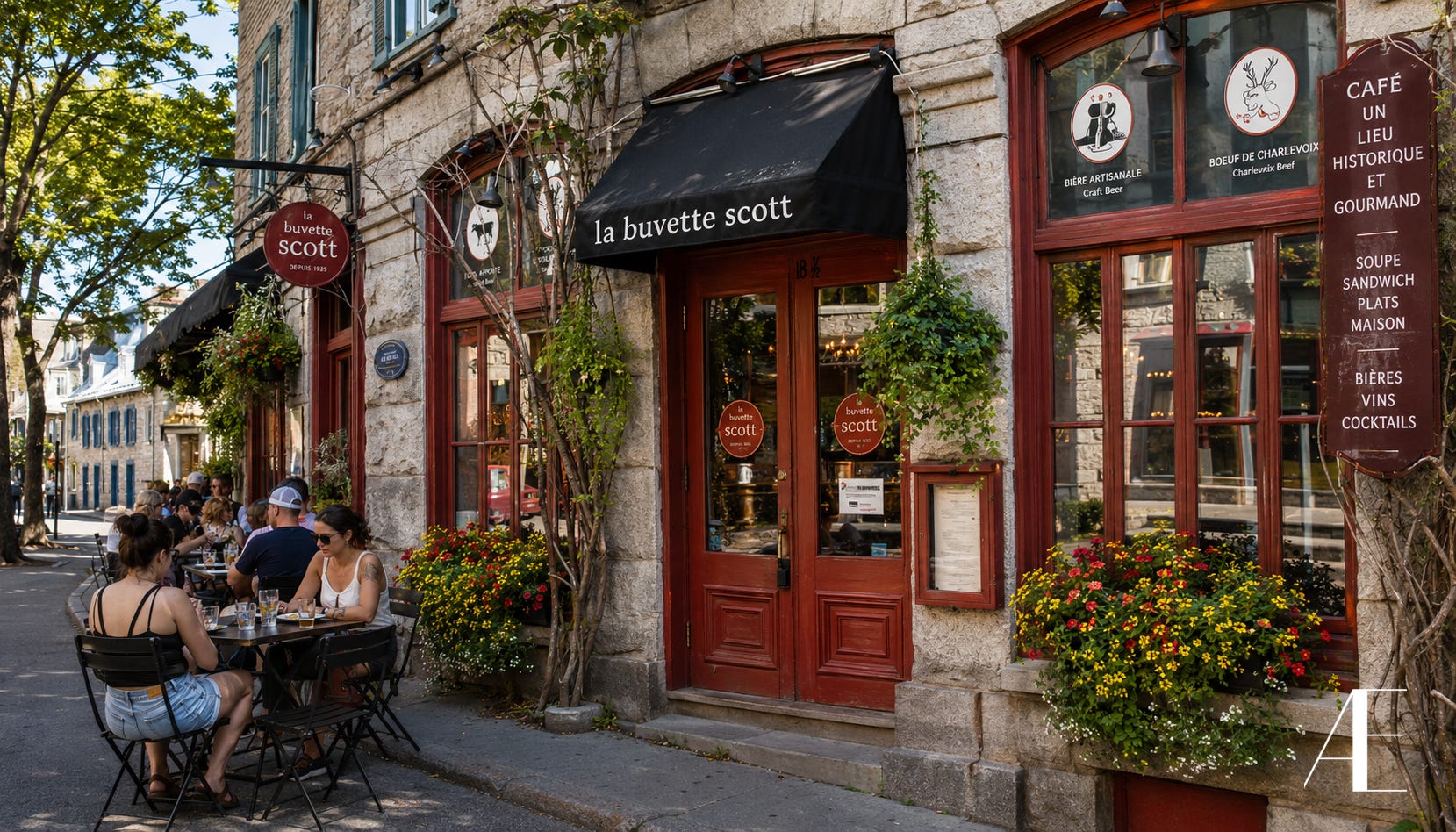
A Michelin Bib Gourmand (2025) and one of the most beloved neighbourhood restaurants in the city. Diner-style tables, chalkboard menus, natural wine, and a menu that changes regularly around Québec terroir. The cooking is creative and unpretentious, and the room fills early with regulars who know it. Reservations recommended; open Tuesday through Saturday from 5 p.m.
Melba
French bistro · Saint-Sauveur
A Michelin Bib Gourmand (2025) micro-restaurant in the Saint-Sô neighbourhood with no sign on the door and a menu of French classics reimagined with local ingredients: scallops with squash bouillabaisse, rabbit with olives and roasted carrots. Seats are limited, the atmosphere is intimate, and the cooking consistently overperforms its price point.
Le Clocher Penché
Brasserie · Saint-Roch
Newly awarded a Michelin Bib Gourmand in the 2026 guide, Le Clocher Penché is a converted church in Saint-Roch that has been a neighbourhood anchor for years, and now has formal recognition to match its local reputation. Comfortable, reliably good cooking and a strong wine list.
Le Continental
Classic French · Old Québec
One of the great old rooms of Old Québec: tableside flambé preparations, a wine cellar of genuine depth, and a formality that feels earned rather than affected. The cooking is traditional French in the best sense, and the experience of dining at Le Continental is a reminder that there is a version of Québec City that predates the farm-to-table era and remains entirely convincing. The city’s older visitors tend to know it; younger ones discover it and become devoted.
jjacques
Seafood and cocktails · Old Québec
A restaurant-bar hybrid that operates behind a closed door and heavy curtains: seafood-led menu, the finest cocktail program in the city, and a kitchen that stays open until 1 a.m. Listed among Canada’s top ten bars in 2025. Required for visitors who eat and drink seriously and do not want the evening to end at nine.
Essential experiences
No visit to Québec City is complete without at least one encounter with the city’s signature food traditions: a proper poutine (fries, cheese curds, gravy) at a casse-croûte where the cheese curds squeak; maple products in any form, from the syrup to the candies to the taffy poured on snow and collected on a stick; a tourtière in winter, the spiced meat pie that appears on tables across Québec from late November through February. These are not tourist traps. They are what people here actually eat.
Where to stay
Luxury
Fairmont Le Château Frontenac Old Town, Upper
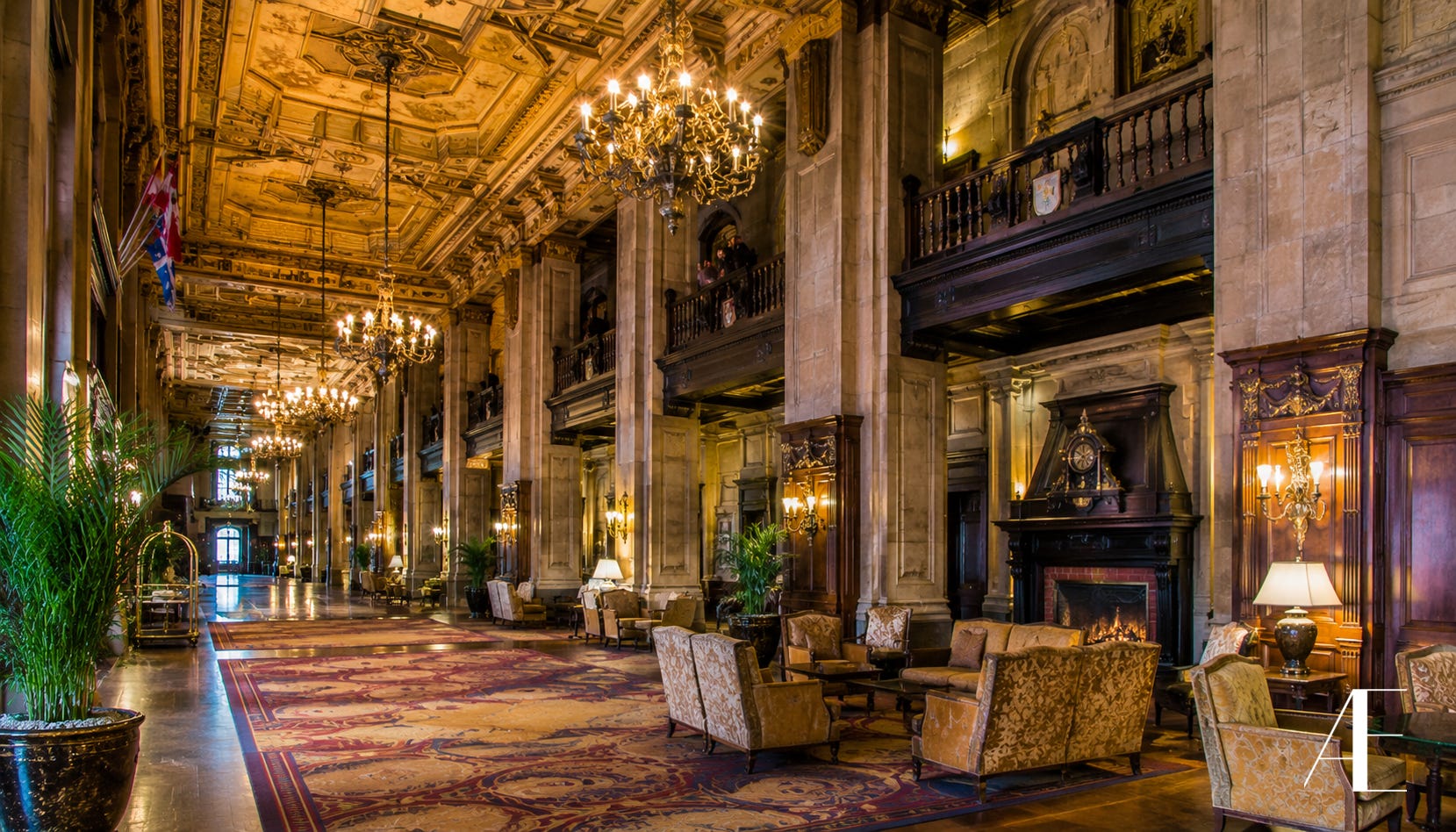
The most photographed hotel in Canada and, by some measures, in the world. Opened in 1893, the Château is not merely a place to sleep: it is a national landmark and the defining structure of the city’s skyline. The 611 rooms and suites range from standard to extraordinary; the higher floors toward the river command views that justify the premium. Six dining venues, a full spa, an indoor pool, and the weight of 130 years of history. Staying here is a deliberate choice to live inside the postcard image of Québec City for a few days, and it is a choice that rewards itself. Book as far in advance as possible, particularly for summer and Carnaval.
Auberge Saint-Antoine Old Port, Lower Town
The most interesting hotel in Québec City, owned and operated by the Price family and built directly above an archaeological site whose artifacts are displayed throughout the property. The rooms are warm, contemporary, and comfortable without the grandeur of the Château; the hotel’s character comes from its specificity of place rather than its scale. The on-site restaurant Chez Muffy, in a stone warehouse with river views, is outstanding. Four-star service in a setting that feels genuinely personal.
Boutique and mid-range
Hôtel 71 Old Port, Lower Town
A sophisticated boutique hotel in a heritage building on Rue Saint-Pierre, steps from the Museum of Civilization and the Old Port. Known for its design, its inviting public spaces, and a well-regarded Italian restaurant. The rooms are smaller than the Château or the Saint-Antoine, but the location and the character are both excellent.
Hôtel Le Priori Old Port, Lower Town
A cozy boutique in a building dating to 1734 in the Old Port quarter, with 26 rooms of genuine character and a gourmet breakfast included. One of the most atmospheric places to sleep in the Lower Town, and a useful reminder that not every charming address needs 200 rooms to be memorable.
Hôtel Boutique Ophelia Grande Allée, Montcalm
A newer boutique property on Grande Allée, well positioned for access to Battlefields Park and the Plains of Abraham, with well-regarded dining on-site and rooms that manage contemporary comfort without sacrificing warmth.
Budget and practical
Hôtel du Vieux-Québec Old Town, Upper
A three-star property in the heart of the Upper Town, within walking distance of everything in the walled city. The rooms are straightforward rather than remarkable, but the location makes it one of the most practical budget options in the Old Town.
Saint-Roch and Saint-Jean-Baptiste For visitors comfortable being a 15-minute walk from the walls, several well-priced hotels and guesthouses operate in Saint-Roch and Saint-Jean-Baptiste. The Auberge Le Vincent in Saint-Roch is the name most often mentioned in this tier. The trade-off is proximity to the Old Town for access to the city’s most interesting restaurant neighbourhoods.
Practical information
Language. Québec City is French-speaking, and the French here is not merely official: it is the natural language of the street, the restaurant, and the neighbourhood. Virtually all tourist-facing staff speak functional to excellent English, and English speakers will encounter no practical difficulty. That said, making an effort in French, even at the level of a greeting or a phrase of thanks, is always noticed and always appreciated.
Currency. Canadian dollars. Major credit cards are accepted everywhere. Cash is useful for smaller vendors at farmers’ markets, farm stands on Île d’Orléans, and the occasional small café.
Getting there. Québec City’s Jean Lesage International Airport (YQB) handles direct flights from most major Canadian cities and from several American gateways including New York. The airport is approximately 20 minutes from downtown by taxi or rideshare (roughly 35 to 45 CAD).
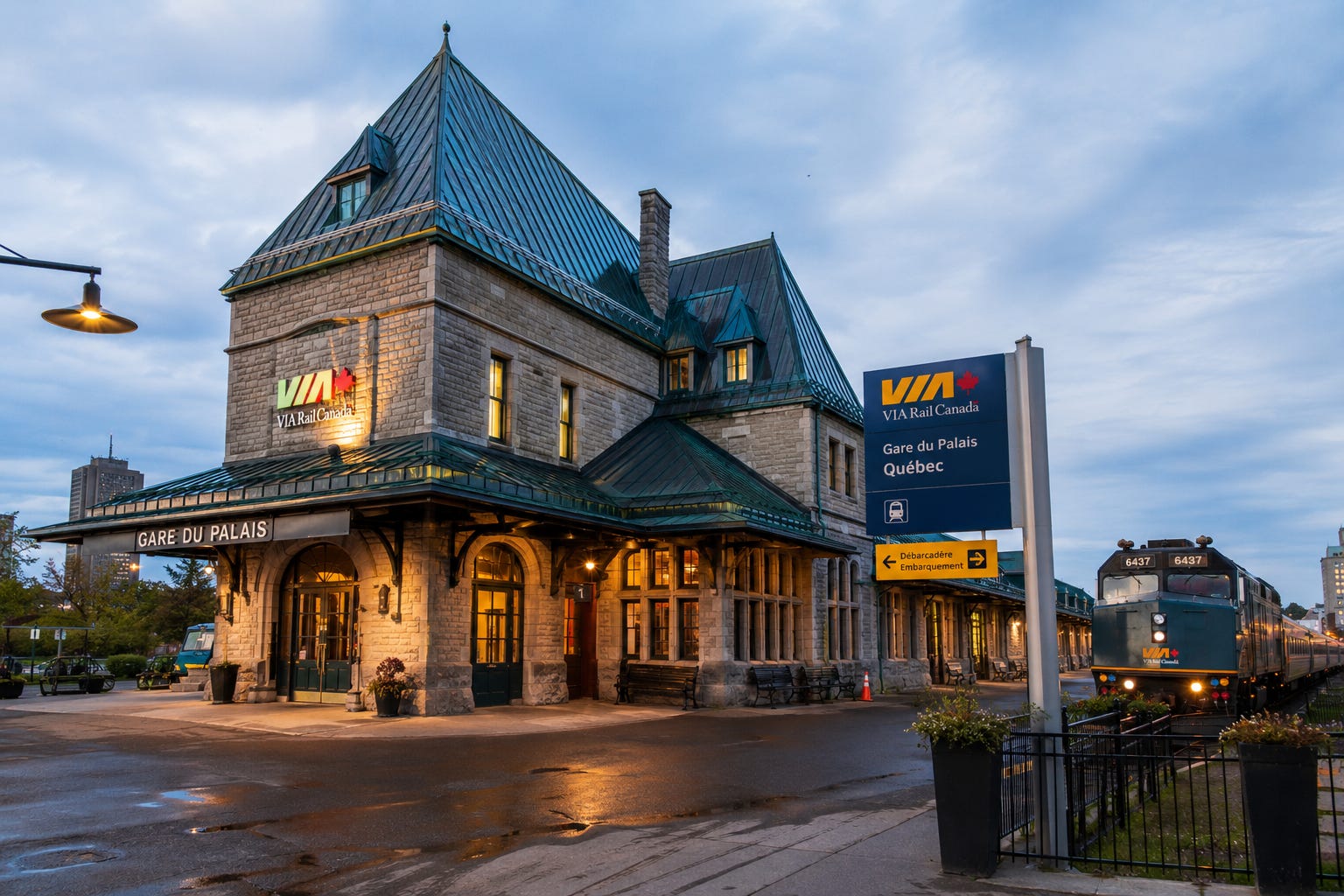
VIA Rail operates train service from Montréal’s Central Station to Québec City’s Gare du Palais in approximately three hours; the Gare du Palais is a beautiful Château-style station in the Old Port, minutes from the Lower Town.
Driving from Montréal takes approximately two and a half to three hours via Highway 20 (south shore) or Highway 40 (north shore), with the south-shore crossing at Québec City offering a particularly fine approach to the city across the Pierre-Laporte Bridge.
Getting around. Within the Old Town and the adjacent neighbourhoods, Québec City is a walking city. The funicular between Upper and Lower Town operates daily and costs approximately 4 CAD one way.
The RTC bus network (Réseau de Transport de la Capitale) covers the wider city; the Nomade app makes navigation straightforward.
For day trips to Île d’Orléans, the Côte-de-Beaupré, and Charlevoix, a rental car is the most practical option, though guided tours are available for all major destinations and are worth considering if you prefer not to drive.
Weather. Winters are genuinely cold: average highs of -8 to -12°C in January, with wind chill that can push the perceived temperature considerably lower. Serious layering is not optional. Summers are warm and humid: average highs of 25 to 27°C in July, occasionally higher. Spring and autumn are transitional and variable.
The city has excellent indoor infrastructure, and the attitude toward weather here is fundamentally that weather is a fact of life to be dressed for rather than an obstacle.
Safety. Québec City consistently ranks among the safest cities in North America. Solo travel, including evening walking through the Old Town and neighbouring areas, presents no meaningful security concern. Standard urban awareness applies.
Tipping. The standard restaurant tip in Québec is 15 to 20 percent. Many payment terminals now suggest 18, 20, or 22 percent; 15 percent remains acceptable. Tip taxi drivers and hotel staff as you would anywhere in Canada.
Taxes. Prices in Québec are displayed before taxes. The combined federal GST (5%) and provincial QST (9.975%) add approximately 15 percent to purchases. Visitors cannot claim these taxes back on departure.
How Québec City fits into a broader trip
The natural pairing for Québec City is Montréal, three hours to the southwest by train or car. The two cities are sufficiently different, in scale, character, and pace, to work well together: Montréal is the cosmopolitan, bilingual, festivals-and-nightlife city; Québec City is the historic, French, architecturally coherent capital. Five to seven days split between the two gives a first-time visitor to the province a complete picture of what Québec is.
For travellers coming from the Maritimes, Québec City is a logical intermediate stop on a journey that might include Prince Edward Island, New Brunswick, and Nova Scotia. For those approaching from Ontario or the northeastern United States, the combination of Montréal and Québec City is the obvious Atlantic Canada introduction.
The Charlevoix region, accessible in a day from Québec City, is sufficiently compelling on its own, with Baie-Saint-Paul, La Malbaie, and the Saguenay Fjord to the north, that it can anchor an additional two to three days for travellers with time. If whale watching on the St. Lawrence is the objective, Tadoussac, at the confluence of the Saguenay and the St. Lawrence, is a three-hour drive from Québec City and one of the finest whale-watching locations in the world from June through October.
Frequently asked questions
Is Québec City worth visiting if I’ve already been to Montréal?
Unequivocally yes. The two cities share a province and a language, but they are otherwise quite different experiences. Montréal is large, cosmopolitan, and multi-lingual; Québec City is smaller, architecturally coherent, historically dense, and more specifically French. Visitors who find Montréal slightly overwhelming often find Québec City to be exactly the right scale. Visitors who love Montréal’s energy and diversity discover in Québec City a different kind of pleasure: slower, more concentrated, and with a European texture that Montréal, for all its charms, does not quite replicate.
Do I need to speak French?
No. English speakers will not encounter practical difficulty anywhere in the tourist areas, and most restaurant and hotel staff in the city centre are comfortable in both languages. That said, Québec City is more French than Montréal in its everyday character, and a willingness to try, even minimally, is always received warmly.
How many days do I need?
Three days is sufficient for a focused first visit to the city itself. Four or five days allows you to add at least one meaningful day trip. A full week, incorporating Charlevoix, is ideal for anyone who wants to understand the region rather than just the city.
Is Québec City worth visiting in winter?
For travellers who dress appropriately for cold weather, winter in Québec City is not merely worth visiting: it is one of the most distinctive seasonal travel experiences available in North America. The Carnaval in February is the obvious draw, but the city in December and January, before the festival season, has its own quiet magic that the summer crowds cannot approximate. If you go in winter, invest in proper gear. The cold is real, and it rewards respect.
Can I get around without a car?
Within the city and the walled Old Town, absolutely. The car becomes useful for day trips, particularly to Île d’Orléans (which has no meaningful public transport), the Côte-de-Beaupré, and Charlevoix. Guided tours are available for all of these destinations and are a reasonable alternative if you prefer not to drive.
What is the best neighbourhood to stay in?
For first-time visitors, the Old Town (Upper or Lower) puts you inside the experience from the moment you step outside. The Château Frontenac and Auberge Saint-Antoine are the most notable addresses. For those who prefer a slightly more local atmosphere at better rates, Saint-Jean-Baptiste is an excellent alternative: excellent restaurants on the doorstep, walkable to the Old Town in 10 minutes.
Is the Carnaval suitable for families?
The Carnaval is exceptionally family-friendly. Children under 12 enter free, and the programming is designed around activities that work for all ages: the toboggan slides, the snow sculptures, the Ice Palace, the outdoor games and zip lines. It is also worth noting that children seem genuinely delighted by Bonhomme Carnaval in a way that adults watching them find unexpectedly moving.
Are the Michelin-starred restaurants worth the price?
Tanière3 at 250 to 290 CAD per person for the tasting menu is a serious expenditure, and it delivers a serious experience. For visitors who eat at this level and want to understand what Québec’s food culture is capable of at its apex, it is unambiguously worth it. The one-starred restaurants (Laurie Raphaël, Légende, Le Clan) are more accessible and offer comparable quality relative to their price points. The Michelin Bib Gourmands (Buvette Scott, Melba, Le Clocher Penché) are where you eat extremely well for 50 to 70 CAD per person, and they are the right choice for most dinners in a week-long visit.
Plan your trip to Québec City with ÆRIA Voyages
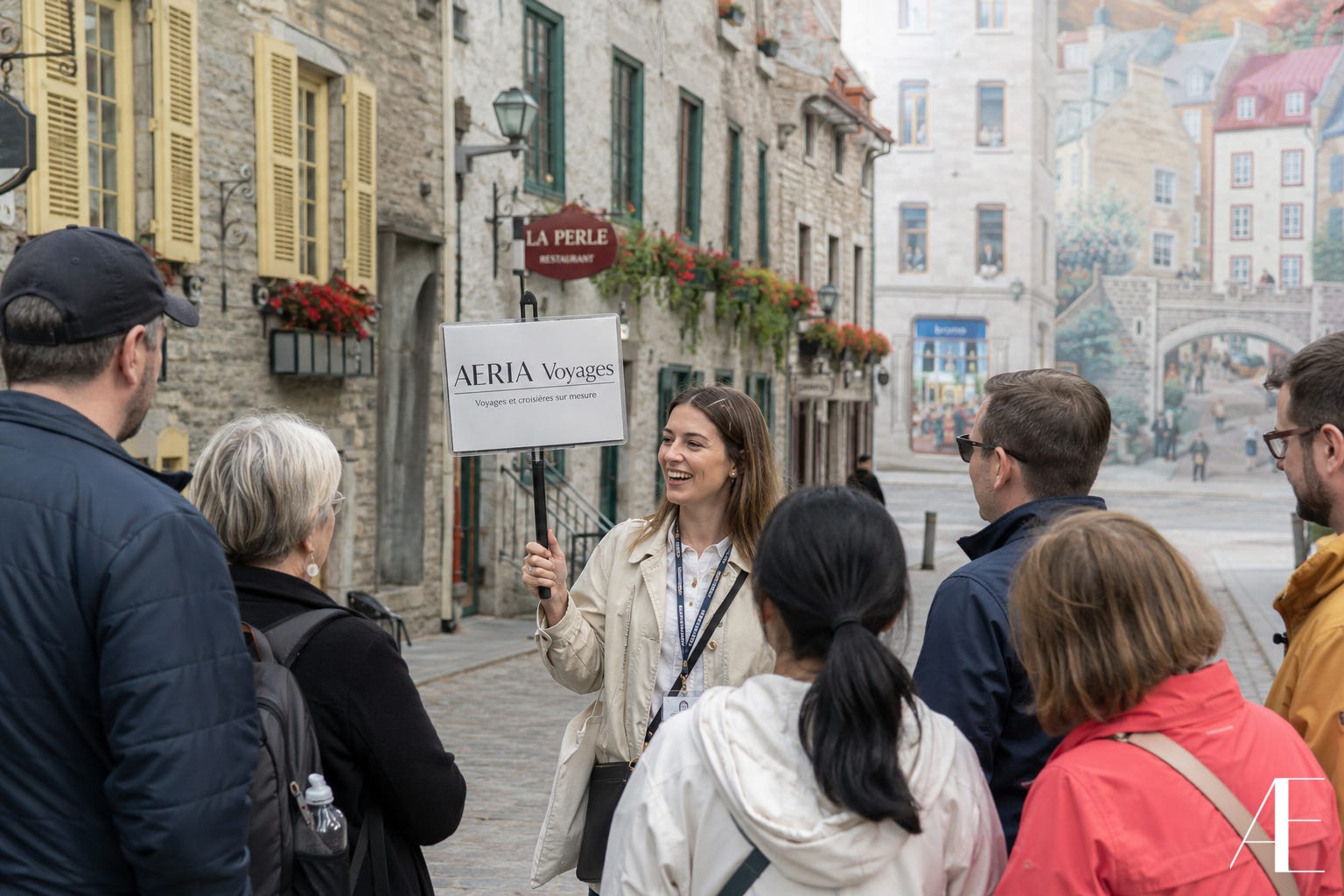
Québec City is one of those destinations that is easy to visit and genuinely difficult to do justice to on a first attempt without some preparation. The difference between a pleasant trip and a memorable one often comes down to details: which neighbourhood to stay in for the kind of experience you’re looking for, which restaurants actually require advance reservations versus which ones you can walk into, whether the Carnaval dates justify building an entire itinerary around them, how to combine the city with Charlevoix or Île d’Orléans in a way that doesn’t feel rushed.
This is where I can help. Whether you’re planning your first visit to the city, a return trip that finally gets into the region beyond the Old Town, or a longer Québec itinerary that uses the city as a starting point, I can put together an itinerary that reflects how you actually travel, not a generic package.
If you’re considering combining Québec City with a cruise departure from Montréal or a river experience on the St. Lawrence, that’s a conversation worth having as well. The region lends itself to it more than most people realise.
Reach out, and let’s start planning.
Yvan Junior Blanchette
Travel & Cruise Specialist
ÆRIA Voyages📩 yvanblanchette@aeriavoyages.com
📞 1-888-460-3388
🌐 aeriavoyages.com