

The Ultimate Vancouver Travel Guide: What to know, where to go, and how to make the most of your visit
Updated 2026 | British Columbia | First-time visitors | In-depth travel
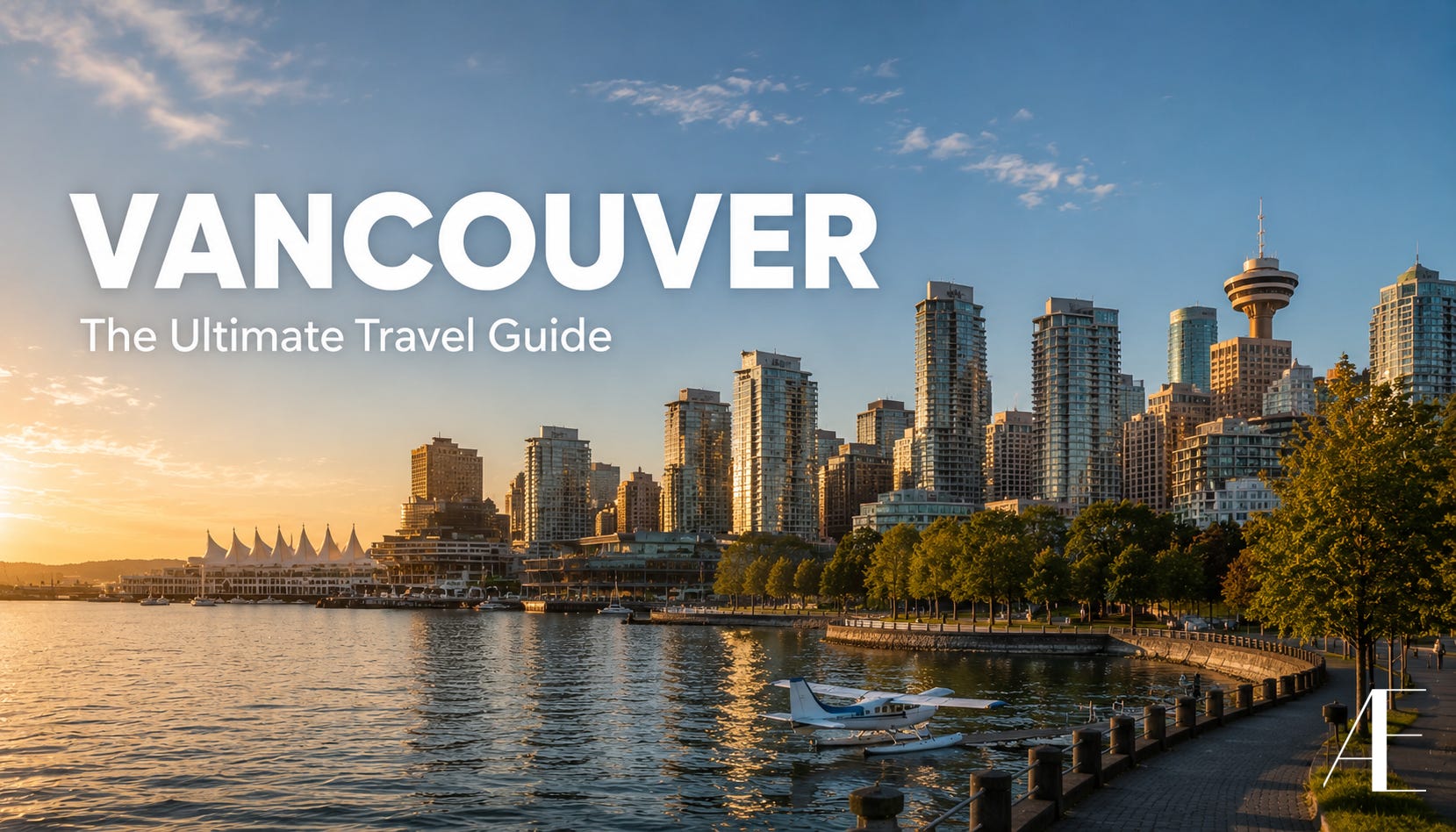
Vancouver does not reveal itself from a hotel window or a tourist map. It is a city that asks you to move through it: along the seawall at first light, through the covered stalls of Granville Island in the rain, up into the North Shore mountains when the weather breaks clear. Nowhere else in North America can you ski a world-class mountain in the morning and eat some of the finest Japanese food on the continent by evening, all within the same square of coastline.
And underneath the outdoor culture and the gleaming towers, a city shaped by Indigenous history, immigrant ambition, and a coastline that makes daily life feel, even for people who have lived here for decades, like something that might not quite be real.
This guide covers the neighbourhoods worth knowing, the experiences that define the city, where to eat and stay at every level, the practical details to have before you leave, and how to plan the right number of days for the kind of trip you want to take.
Table of Contents
Why Vancouver is worth it
There is a version of Vancouver that sells itself easily: mountains, ocean, Stanley Park, sushi. That version is real, and it is genuinely impressive. What most first-time visitors do not expect is how much lies underneath it.
Vancouver is one of the most culinarily sophisticated cities in North America, with twelve Michelin-starred restaurants as of the 2025 Guide and a food culture built on Pacific Northwest ingredients, a vast Asian diaspora, and a generation of chefs who have turned the combination into something original. It has a public transit system that works, a walkable downtown, and a coastline long enough that you can spend a full morning on the seawall and still feel like you have not covered it.
Its Indigenous heritage is visible and alive in a way that few North American cities can claim: in the totem poles at Brockton Point, in the Great Hall of the Museum of Anthropology at UBC, in the acknowledgment of unceded Musqueam, Squamish, and Tsleil-Waututh territory that opens every public event.
It is also a city that scales with time. Three days give you Stanley Park, Granville Island, and a strong first impression. Five days begin to reveal Gastown, Chinatown, the North Shore, and the restaurant scene that most visitors leave having only scratched the surface of. A week starts to show you what daily life in one of the world’s most spectacular settings actually looks like.
Vancouver is Canada’s Pacific city: younger, looser, and more international than Toronto or Montreal, built facing Asia rather than Europe, shaped by mountains and water in a way that affects how people move through it every day. For travellers arriving from the east or from across the Atlantic, it is often a revelation. For those who come from the Pacific, it is a recognition.
The neighbourhoods to know
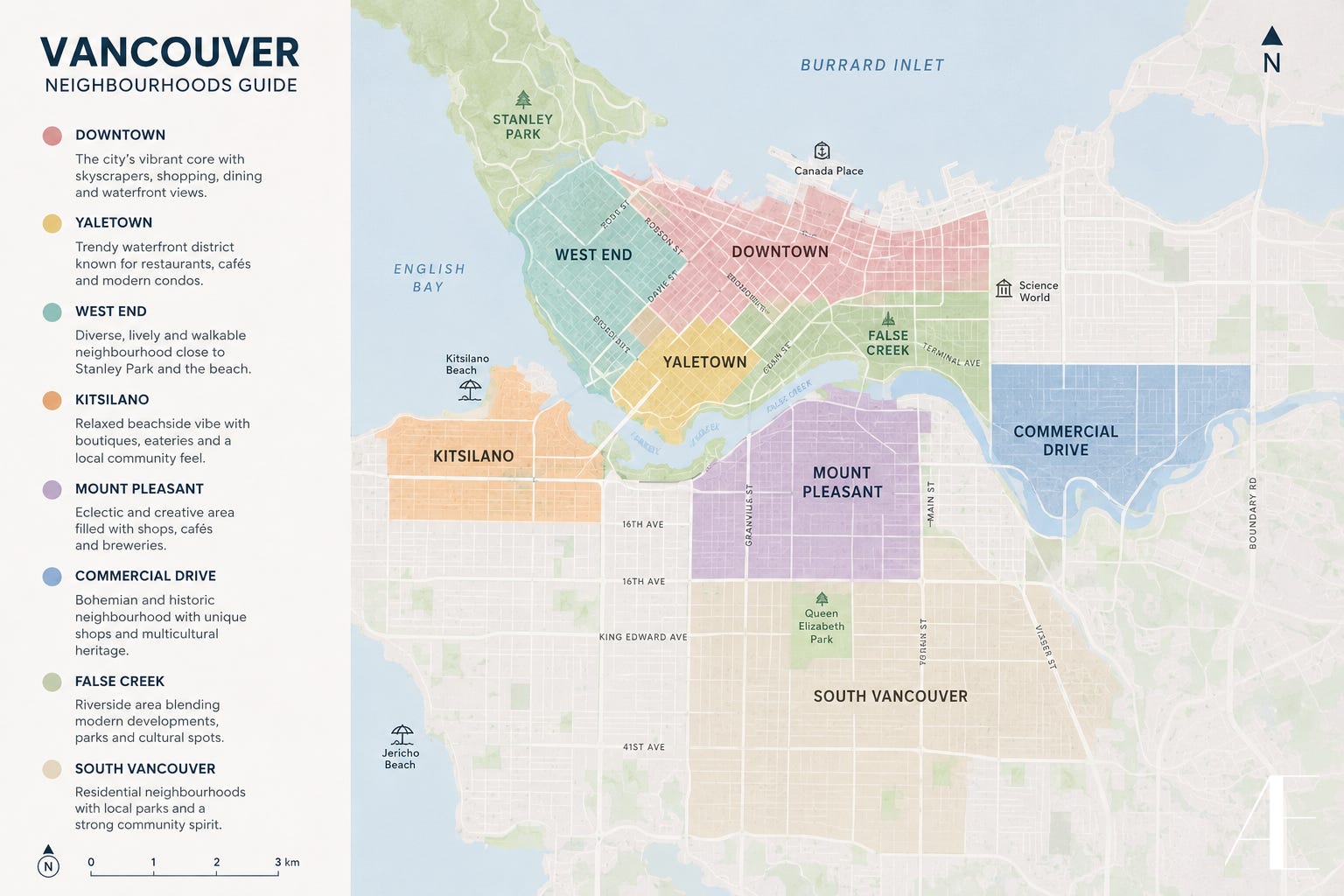
Vancouver is a collection of distinct communities, each with its own rhythm. The downtown core is compact and walkable, and the broader city unfolds in a series of neighbourhoods that reward exploration.
Downtown and Coal Harbour
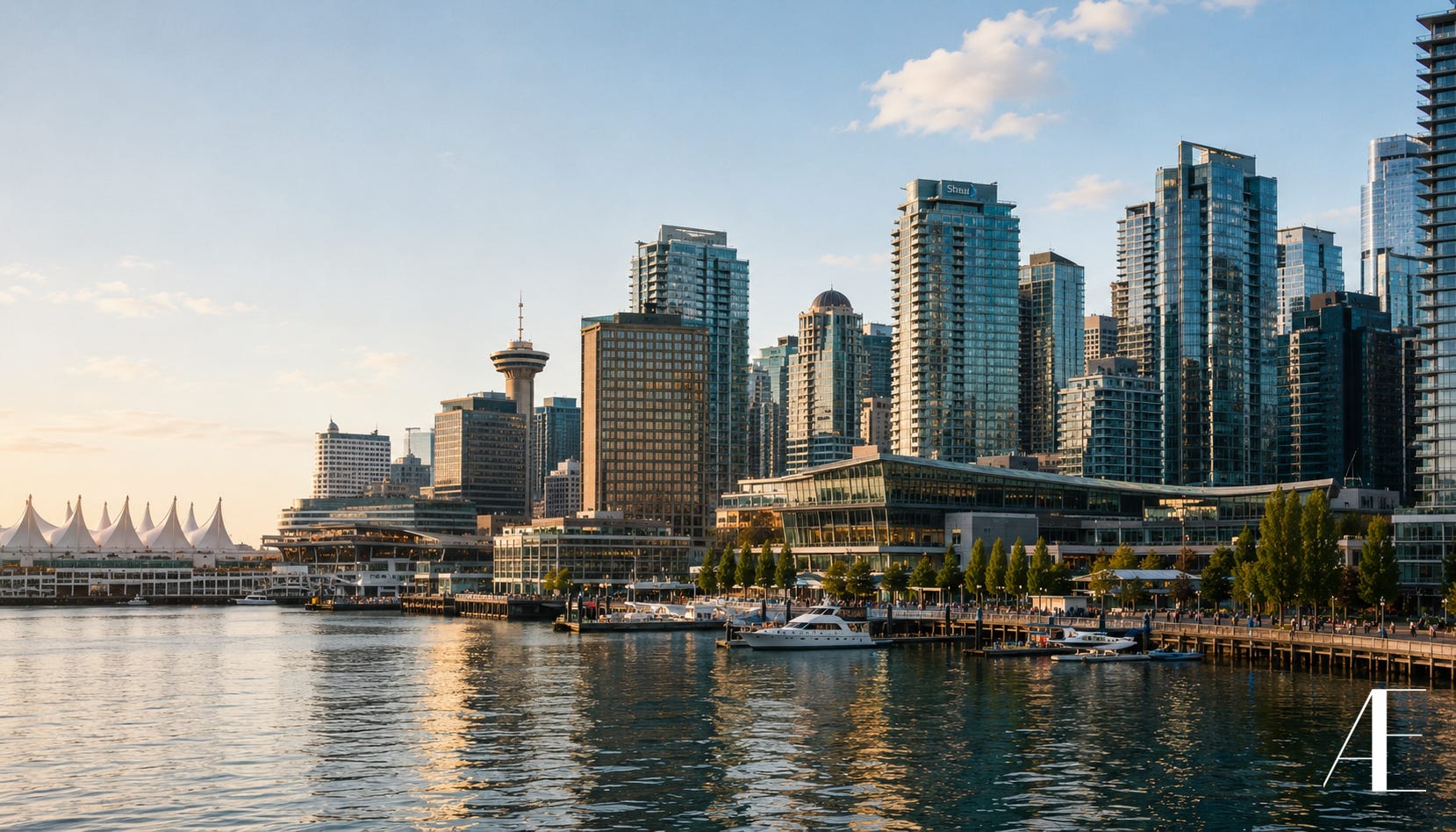
The business heart of the city, lined along the waterfront with the Canada Place cruise terminal, the Convention Centre, and the floatplane terminal where Harbour Air seaplanes take off every few minutes toward Victoria, the Gulf Islands, and Seattle.
Coal Harbour, the residential stretch west of the Convention Centre, is quieter and more local in character: cafés along the marina, morning walks along the seawall with the North Shore mountains directly ahead. This is where cruise passengers arrive, where business travellers stay, and where the city’s skyline photographs best from the water.
Gastown
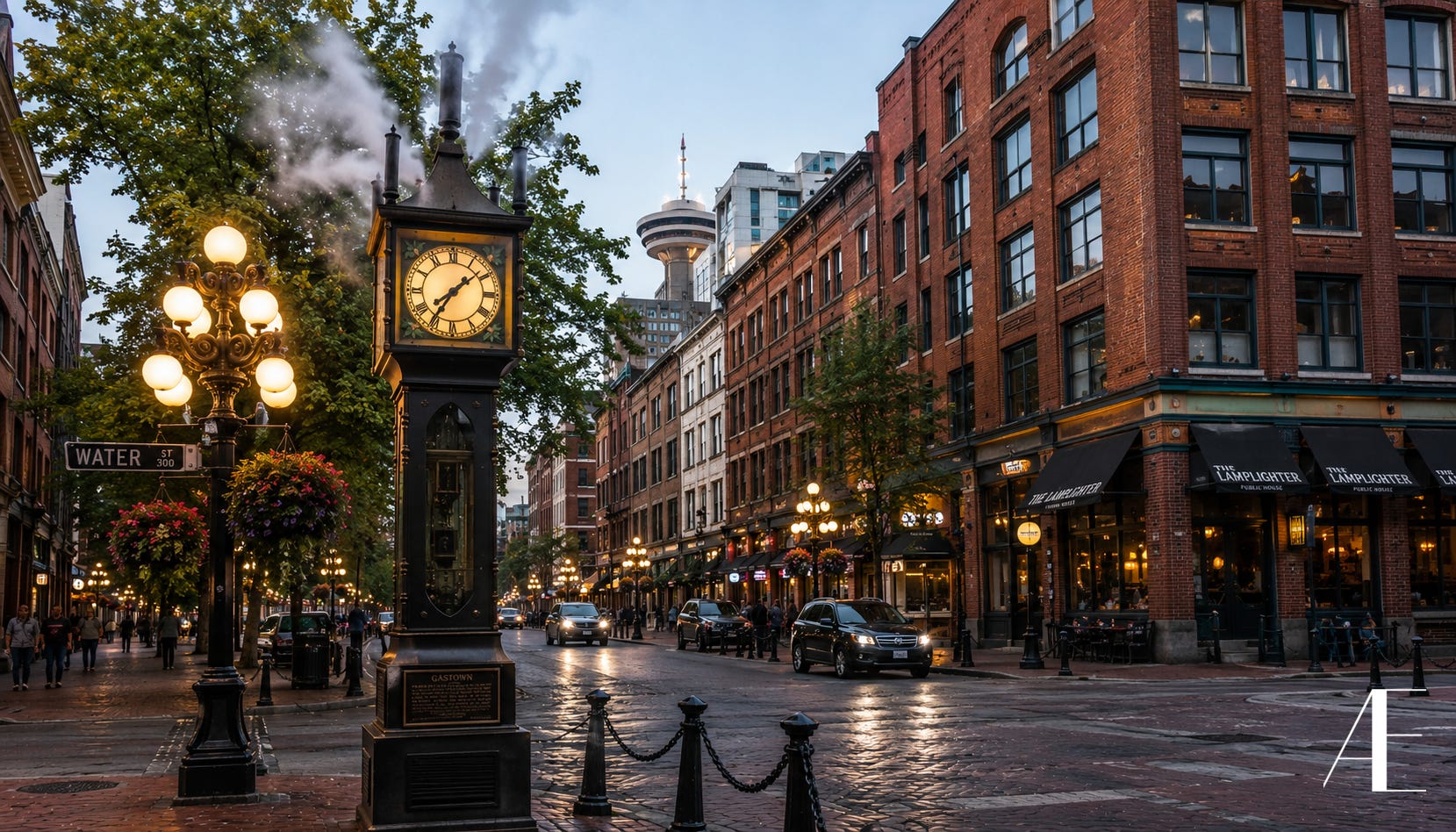
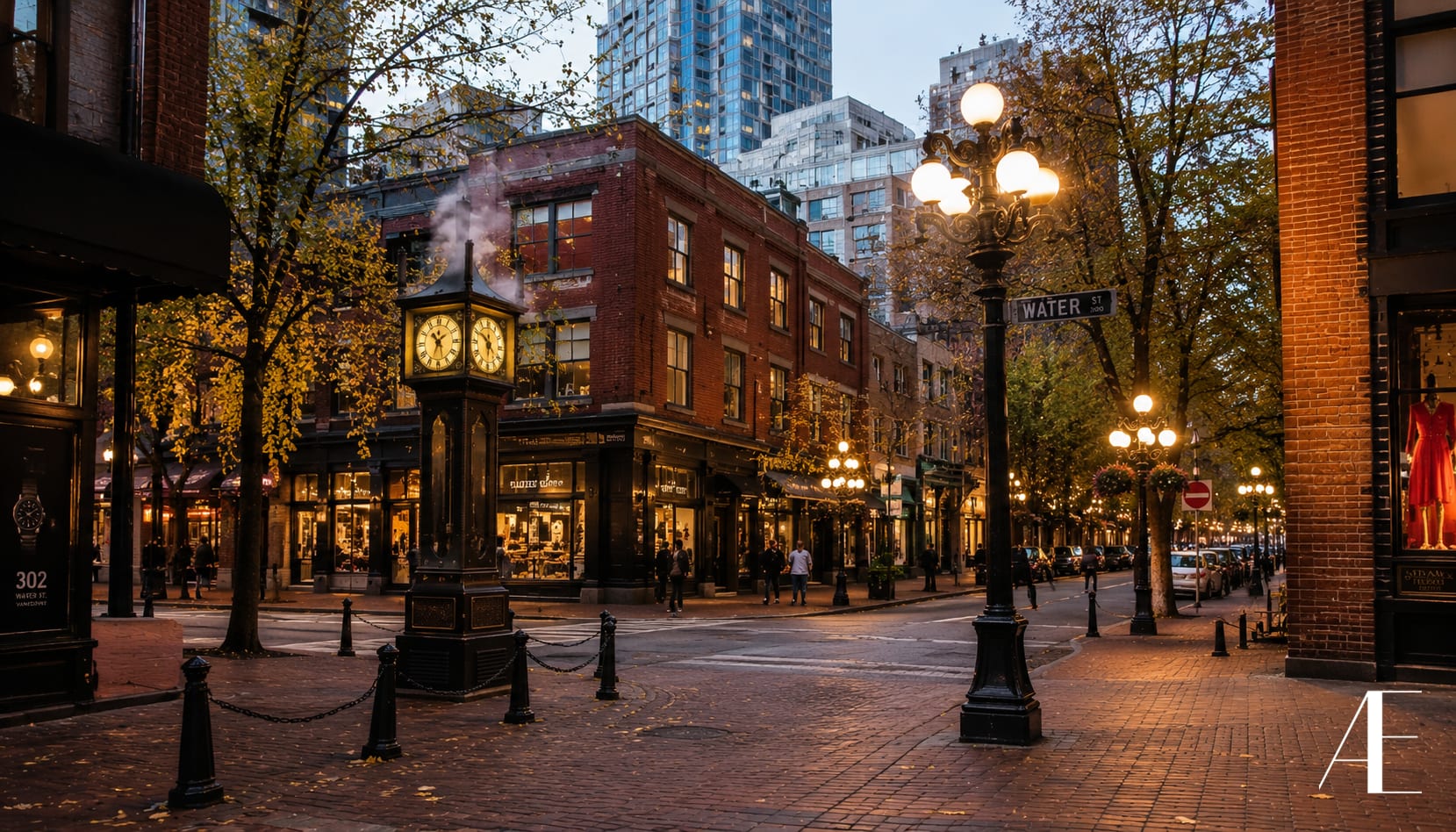
Vancouver’s oldest neighbourhood, founded in 1867 around a single tavern run by “Gassy Jack” Deighton, a Yorkshire sailor whose gift for storytelling drew workers from the nearby sawmill faster than his whisky did. The cobblestoned streets and Victorian brick facades have survived, and today Gastown houses a dense concentration of the city’s best restaurants, cocktail bars, and independent design shops.
Water Street, the main artery, ends at the famous steam clock, which has been whistling every fifteen minutes since 1977. The side streets are where the more interesting discoveries happen: laneway bars, Indigenous art galleries, and the kind of restaurant that does not need to advertise because the neighbourhood does it for them.
Chinatown
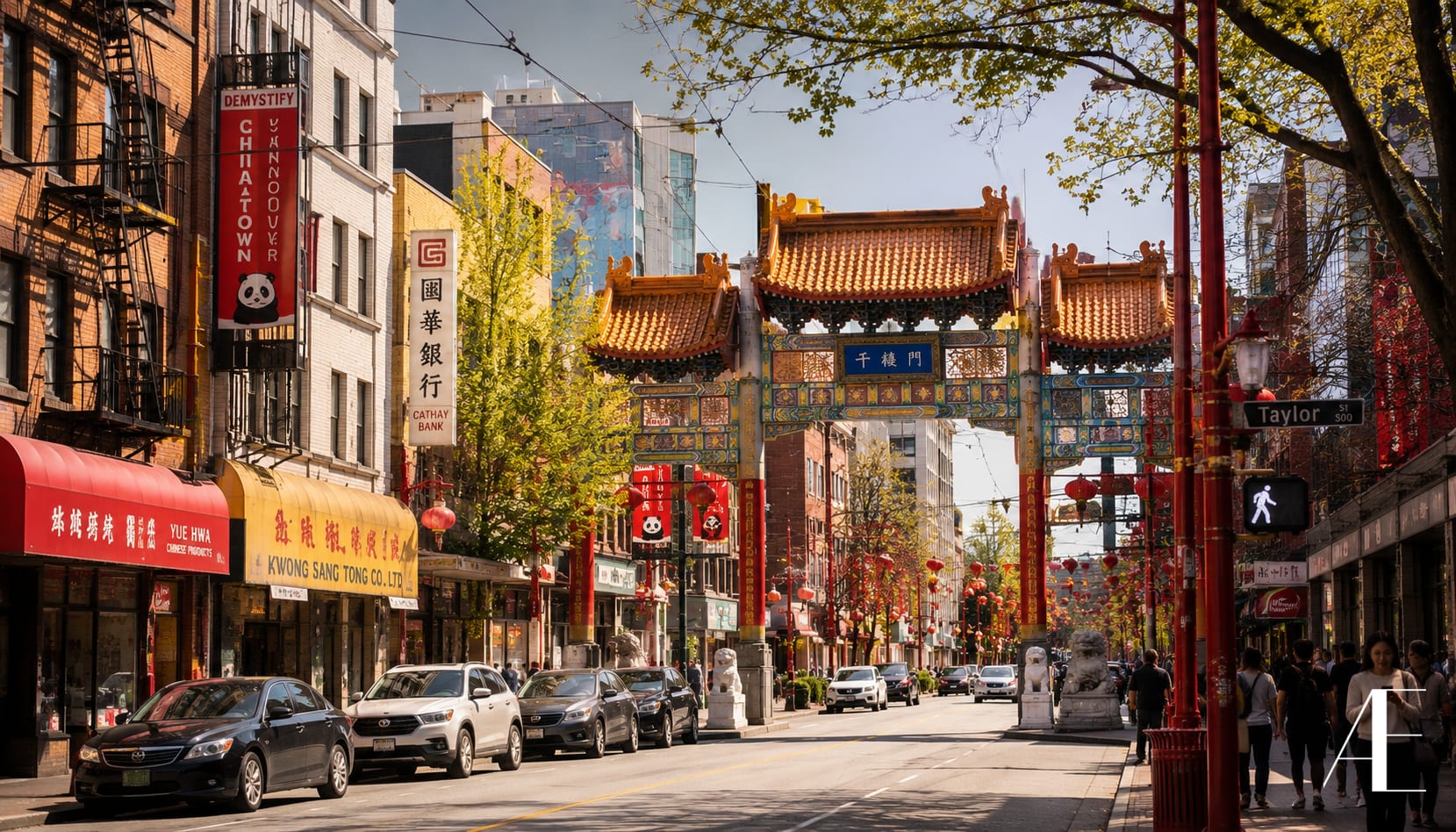
The second-largest Chinatown in North America after San Francisco’s, and one of the most historically significant neighbourhoods in Vancouver. Chinese workers who built the Canadian Pacific Railway settled here from the 1880s onwards, in a community that survived systematic legal exclusion and emerged as a cultural anchor for one of the city’s defining communities.
The Dr. Sun Yat-Sen Classical Chinese Garden, completed in 1986 with master artisans brought from Suzhou, is the only full-scale classical Chinese garden outside China. The Sam Kee Building, built in 1913, is credited as the world’s narrowest commercial building at 1.8 metres wide, constructed in deliberate defiance of city planners who had expropriated most of the lot.
Chinatown has changed significantly in recent decades, but its bones remain, and the best of the neighbourhood’s food and culture is still very much alive.
Yaletown
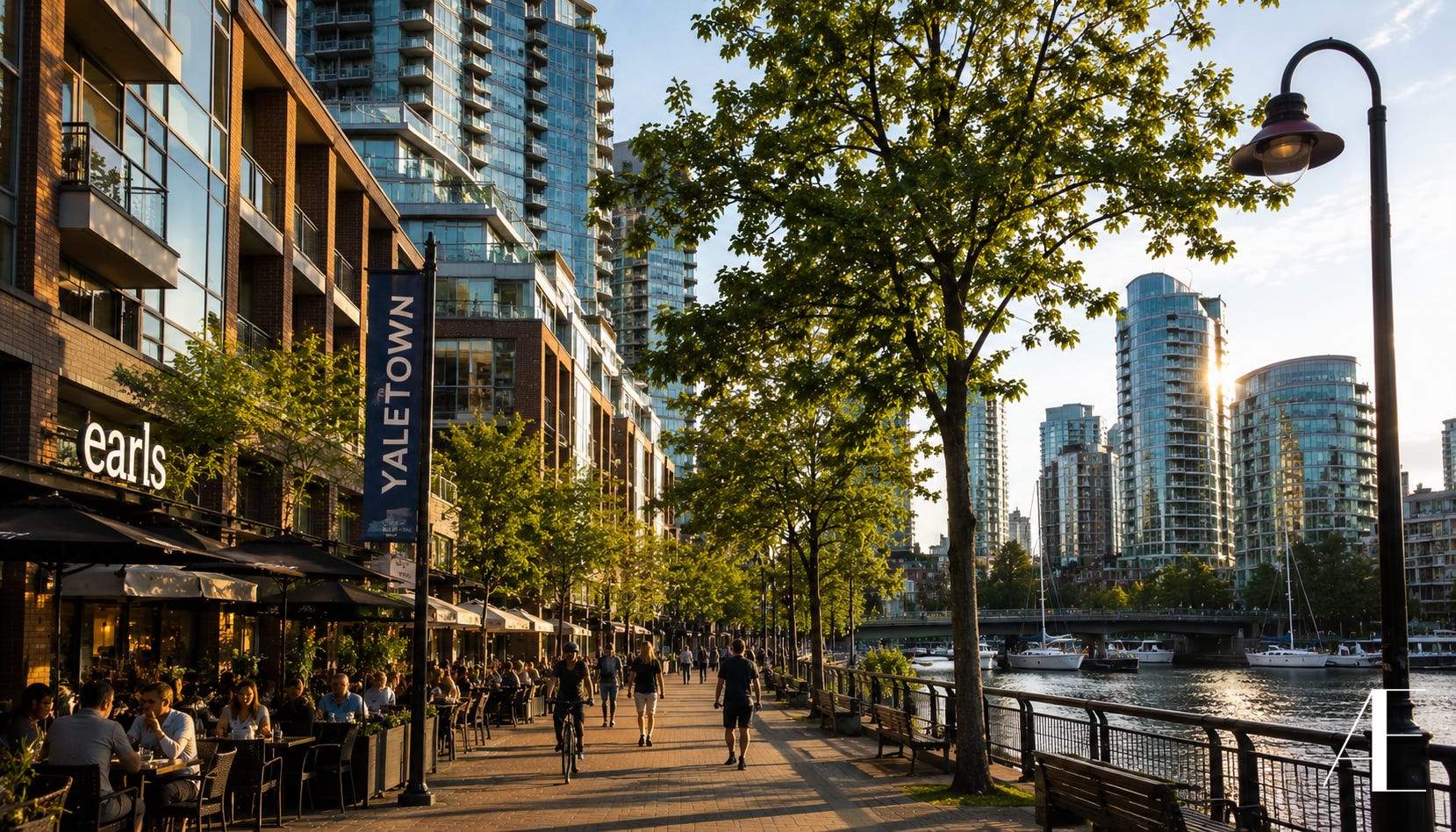
Once the western terminus of the Canadian Pacific Railway, Yaletown underwent its first transformation for Expo 86 and its second in the years that followed, becoming Vancouver’s most self-consciously fashionable neighbourhood. The converted red-brick warehouses along Hamilton and Mainland Streets now hold upscale restaurants with terrasse seating, boutiques, and the kind of bar where the cocktail list runs to four pages. The False Creek waterfront, accessible directly from the neighbourhood, offers one of the finest short walks in the city, with kayak rental, the Aquabus ferry to Granville Island, and views across the water toward the mountains.
Granville Island
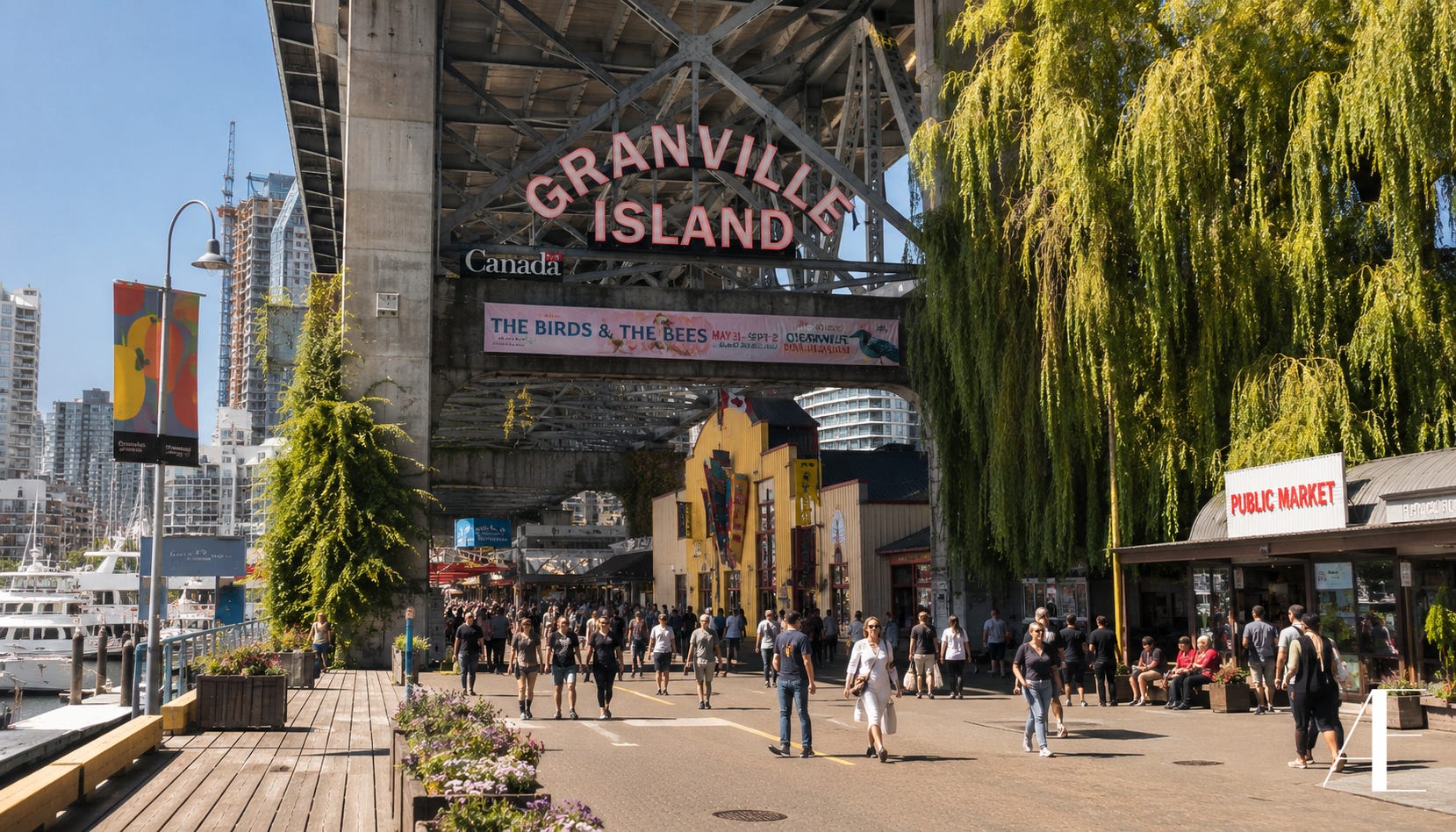
Technically a peninsula rather than an island, accessible on foot from the Granville Bridge or by the small Aquabus ferries that cross False Creek in five minutes. Granville Island is anchored by the Public Market, a covered year-round market with more than fifty vendors selling fresh produce, charcuterie, cheese, baked goods, Pacific seafood, and prepared foods of exceptional quality. Beyond the market, the island holds artisan studios, a brewing company, theatres, a school of art, and enough restaurants for a full afternoon. It is one of the rare tourist destinations in any North American city that local residents genuinely use every week.
Kitsilano
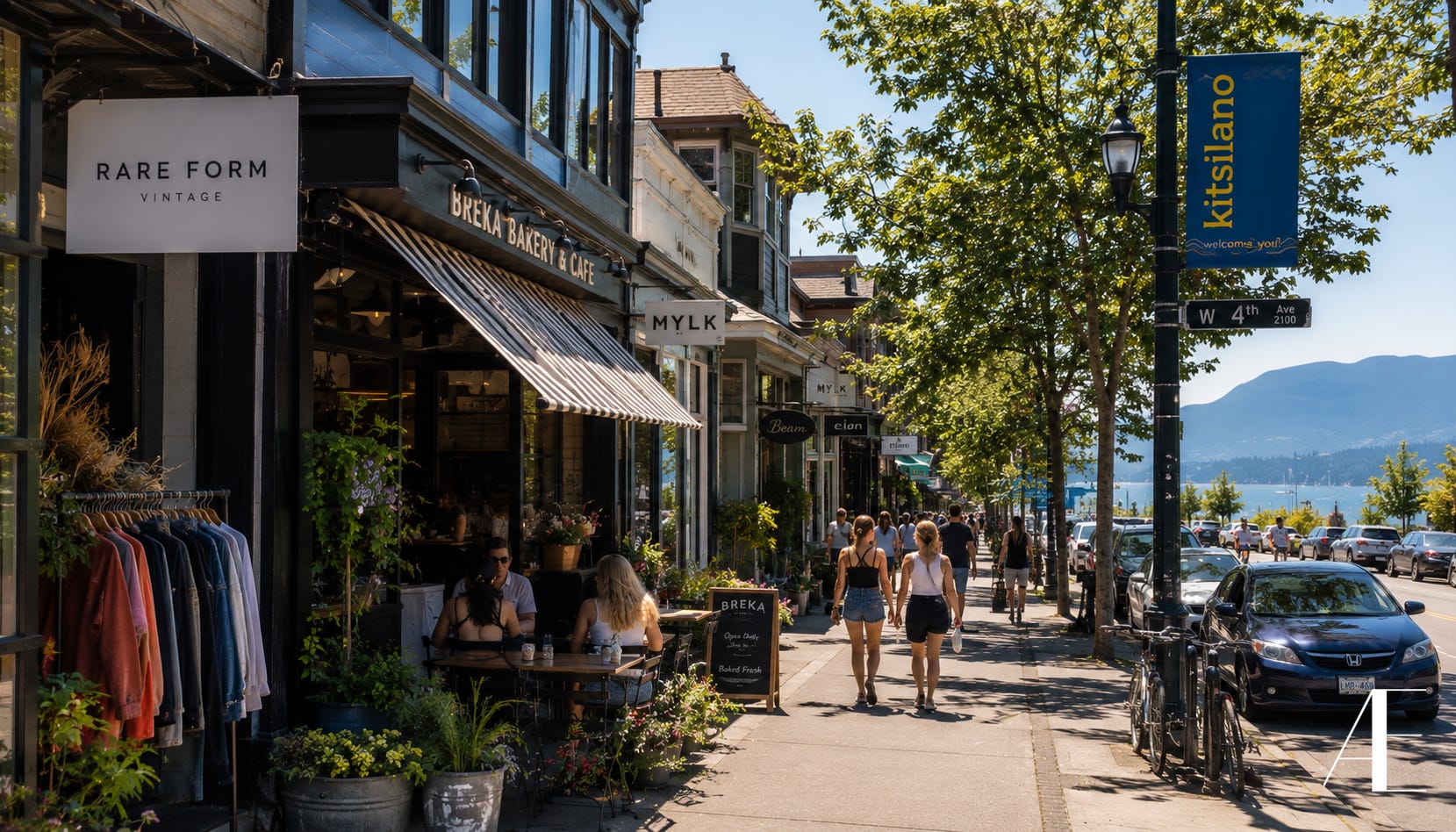
Known universally as “Kits,” the neighbourhood across English Bay from downtown is where Vancouver exhales. Tree-lined residential streets, independent cafés and bookshops, Kitsilano Beach with its outdoor saltwater pool open in summer, and the stretch of West 4th Avenue with the city’s best concentration of outdoor gear shops and neighbourhood restaurants. It is the Vancouver of the imagination for people who live elsewhere: the beach volleyball, the evening run along the seawall, the Saturday morning farmers market. It earns that reputation.
Commercial Drive and Mount Pleasant
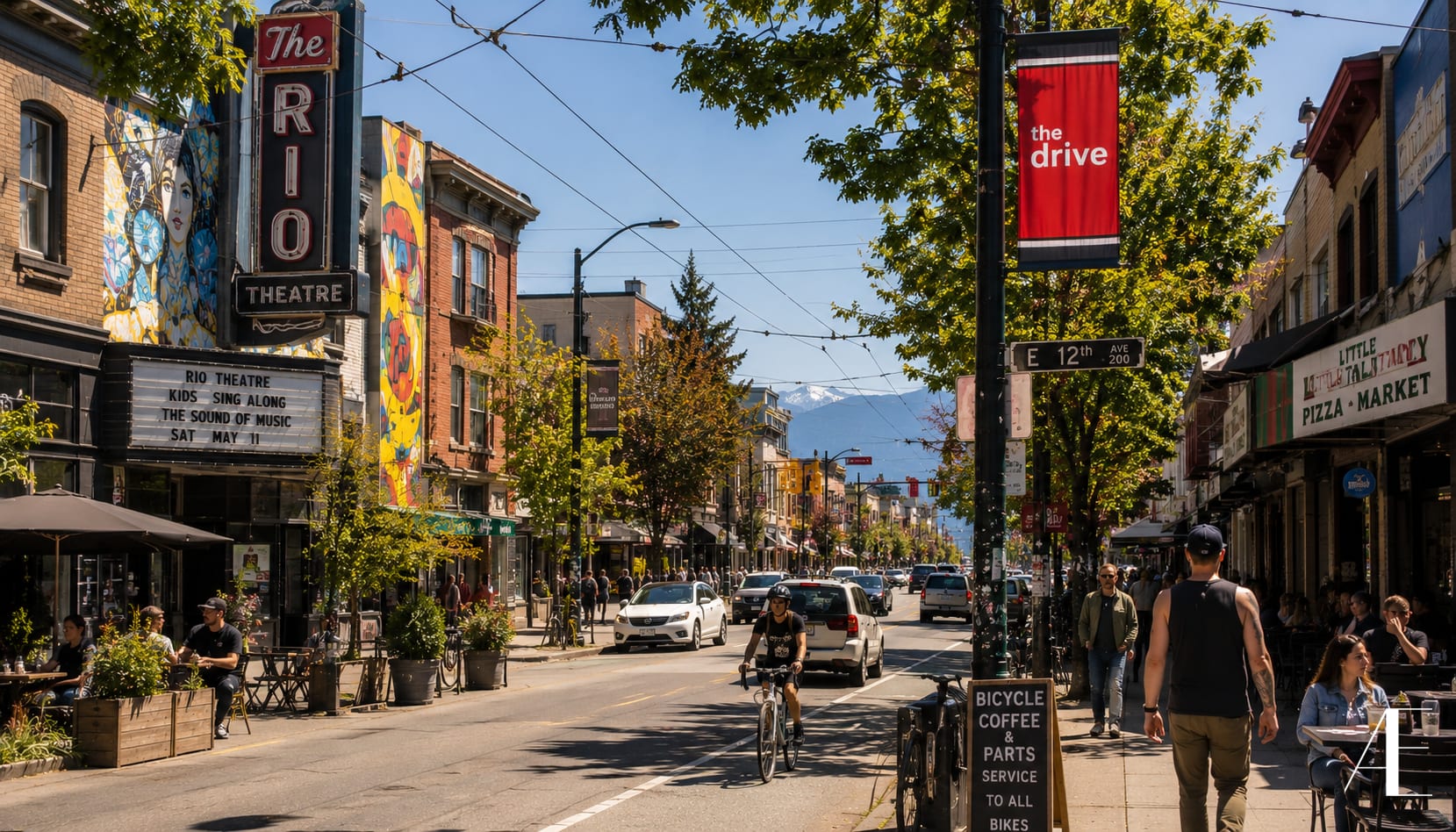
The two neighbourhoods most representative of the city’s East Side character. Commercial Drive, known as “The Drive,” runs from Broadway north into East Vancouver with a density of Italian cafés, vintage shops, Latin American restaurants, and independent music venues that gives it more personality per block than most of the city’s shinier districts. Mount Pleasant, immediately to the west, has transformed over the past decade into the city’s creative hub: craft breweries, independent galleries, studio spaces, and a mural festival each summer that turns the neighbourhood’s alleyways into an open-air gallery.
The North Shore
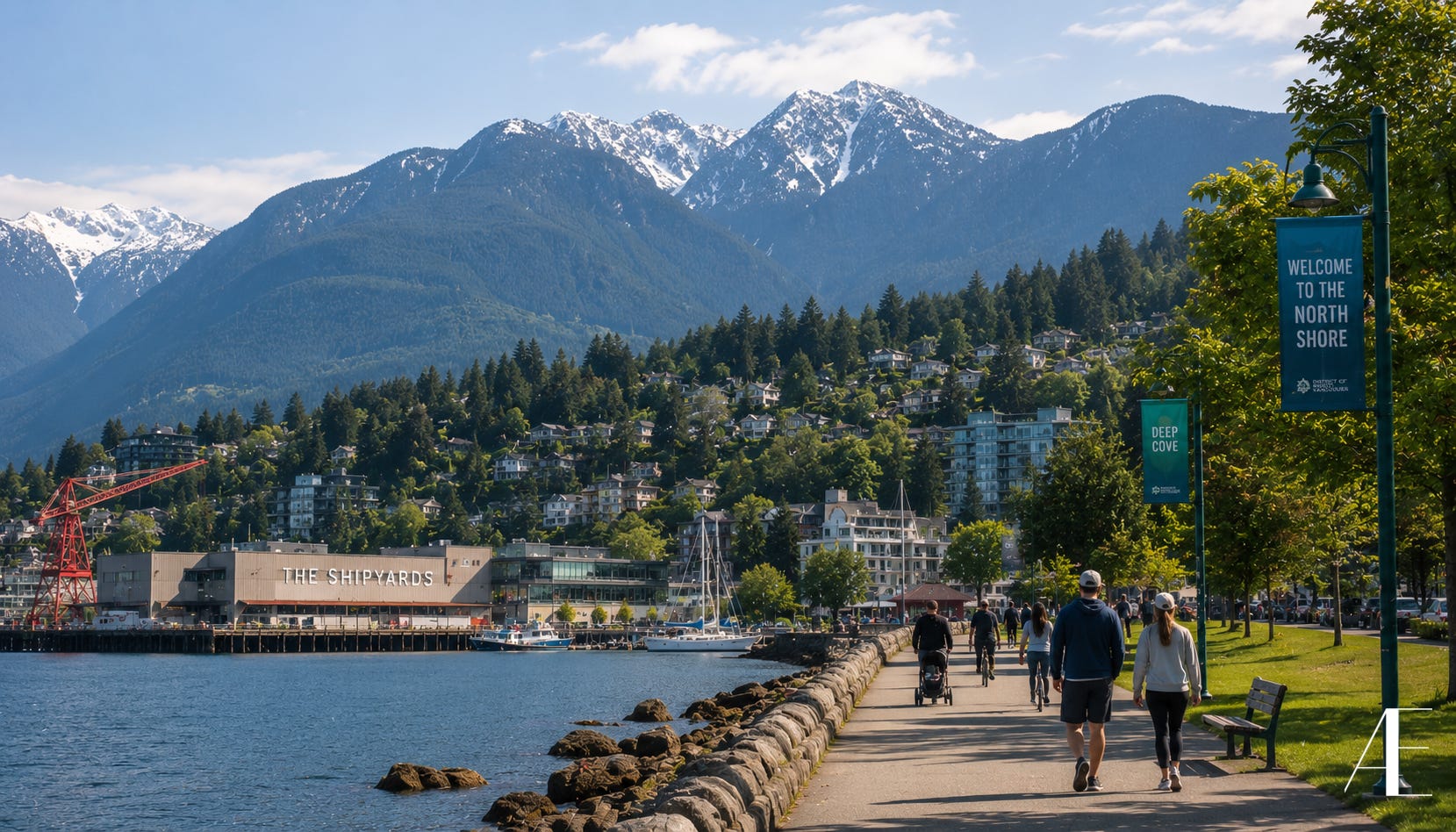
Technically the separate municipalities of North Vancouver and West Vancouver, reached by the SeaBus ferry from Waterfront Station or by car across the Lions Gate Bridge. The North Shore is where the mountains begin: Grouse Mountain, Cypress Mountain, and the trails of Lynn Headwaters Regional Park are all here, along with the Capilano Suspension Bridge and some of the most desirable real estate in the country. Lonsdale Quay, directly opposite the SeaBus terminal in North Vancouver, has a good market and a row of waterfront restaurants that look back across the harbour at the downtown skyline.
Things you should not miss
Vancouver offers more first-rate experiences per square kilometre than its casual reputation might suggest. These essentials cover the full range of what the city has to offer.
Stanley Park
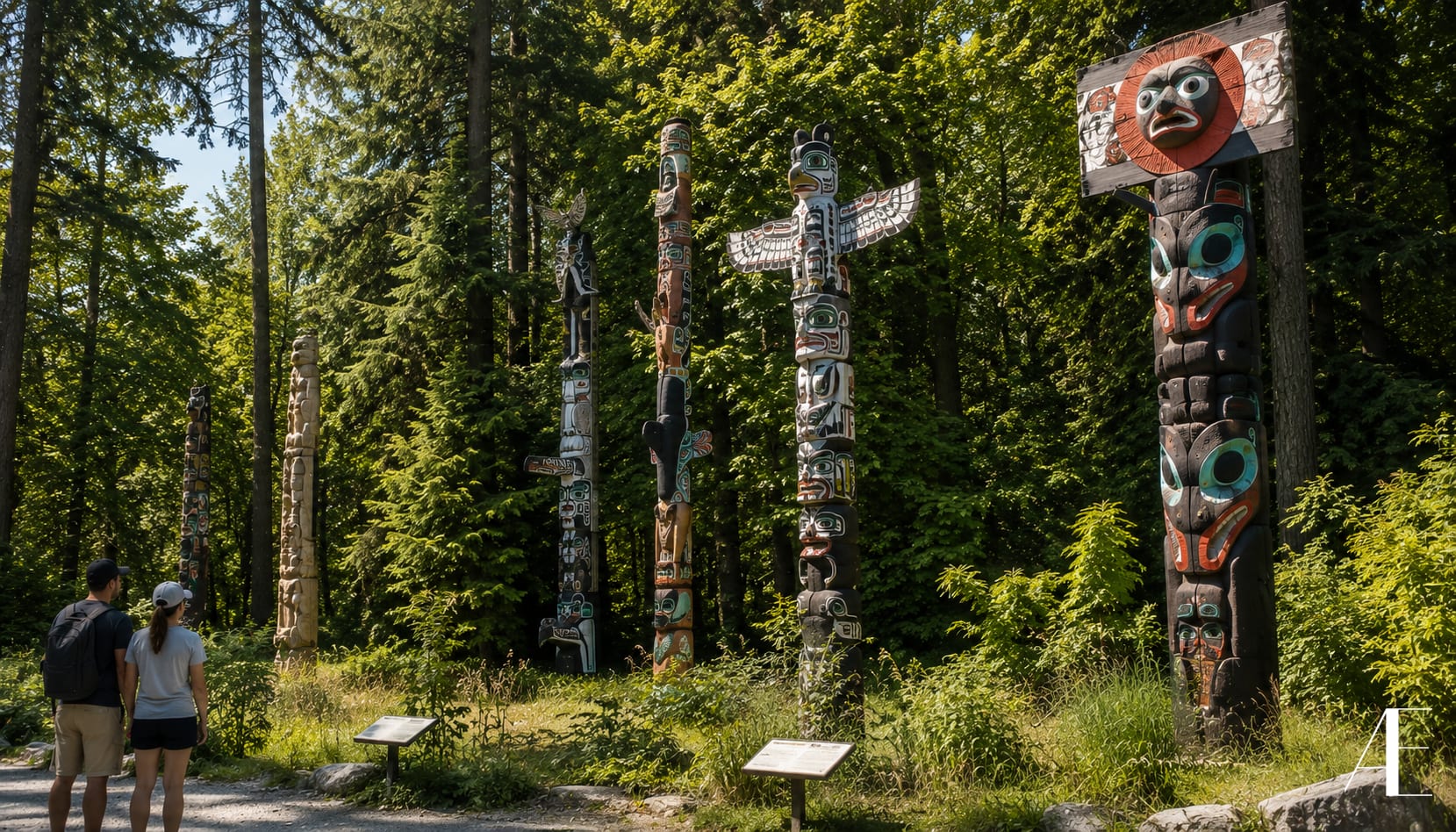
A thousand acres of old-growth forest on a peninsula extending into Burrard Inlet, three blocks from the downtown core. Stanley Park is the condition that makes Vancouver liveable.
The Seawall, a 22-kilometre paved path that circumnavigates the park and continues along the False Creek waterfront, is where the city’s morning runs, afternoon cycles, and evening walks take place. Inside the park: Brockton Point with its nine totem poles, Beaver Lake, Prospect Point with the most dramatic view of the Lions Gate Bridge, and Second Beach with its outdoor pool.
The park is never truly empty, but the old-growth forest interior, with Douglas firs and western red cedars that have been standing since before European contact, absorbs its visitors without difficulty. Allow at least half a day, and more if you intend to walk the full Seawall.
Granville Island Public Market
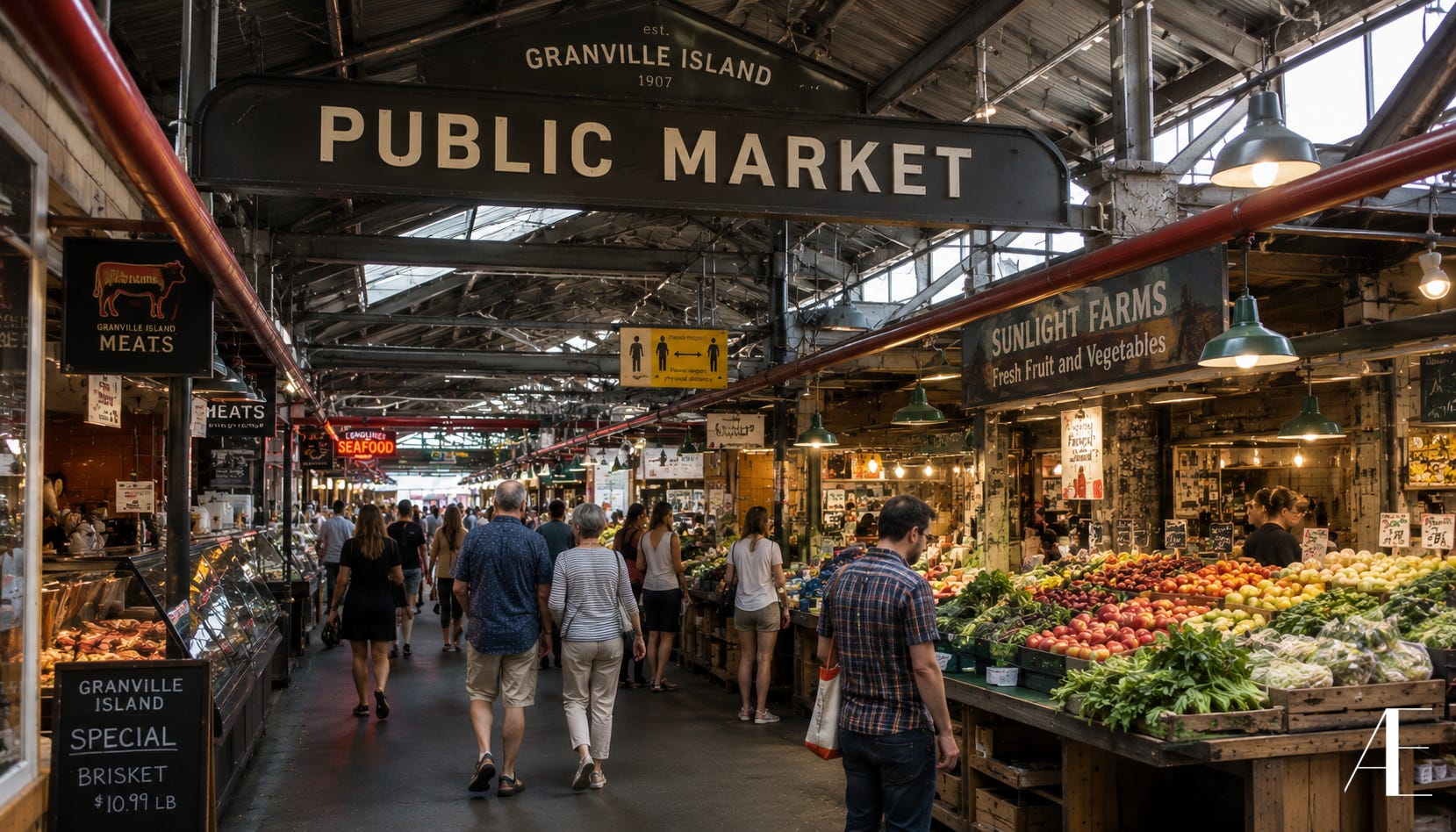
Not a tourist market in the diluted sense. The Granville Island Public Market is where chefs shop, where residents do their weekly food run, and where the standard of produce, fish, and prepared food is high enough that eating lunch at the market is a genuinely good meal rather than a concession to convenience. Lee’s Donuts, which has been operating since 1979, is the legendary reference. The fish vendor from the Fisherman’s Wharf end of the market is where the Pacific halibut, wild sockeye salmon, and spot prawns come in season. Plan for at least two hours, and expect to leave with more than you intended to buy.
The Museum of Anthropology at UBC
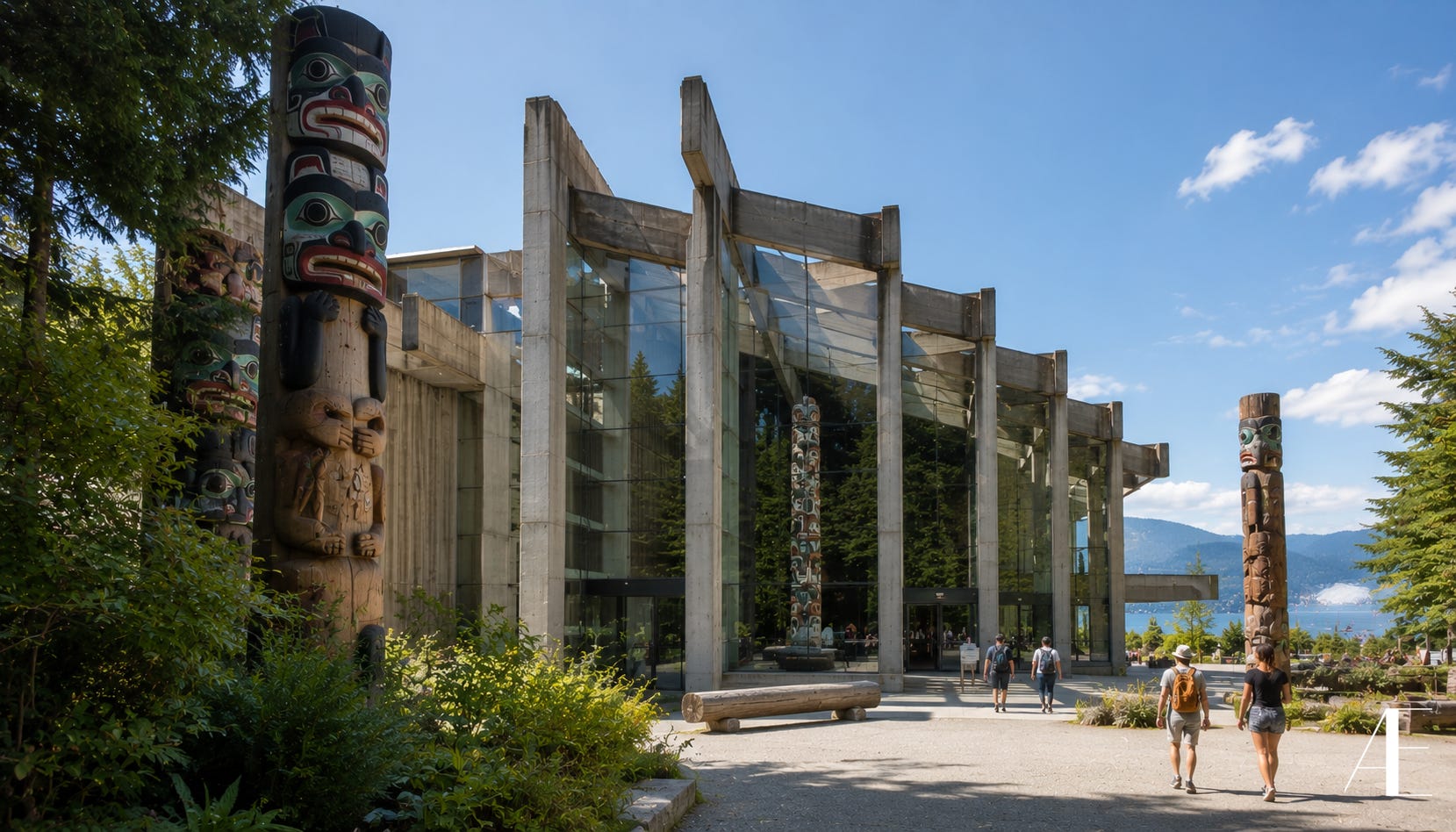
The most significant cultural institution in Vancouver and one of the great museums in Canada, located on the University of British Columbia campus twenty minutes from downtown.
Designed by Arthur Erickson and reopened fully in 2024 after seismic upgrading, the museum holds the world’s most extensive collection of Northwest Coast First Nations art: totem poles, ceremonial masks, feast dishes, woven blankets, and works by Bill Reid, the Haida artist whose gold sculpture “The Raven and the First Men” is the centrepiece of its rotunda.
The Great Hall, with its soaring glass walls facing the Strait of Georgia, houses monumental carvings that no photograph adequately prepares you for. The museum’s approach is one of the most thoughtfully developed in North America in terms of Indigenous voice and collaborative curation. Allow three hours minimum, and go on a Thursday evening when admission is half price.
Capilano Suspension Bridge Park
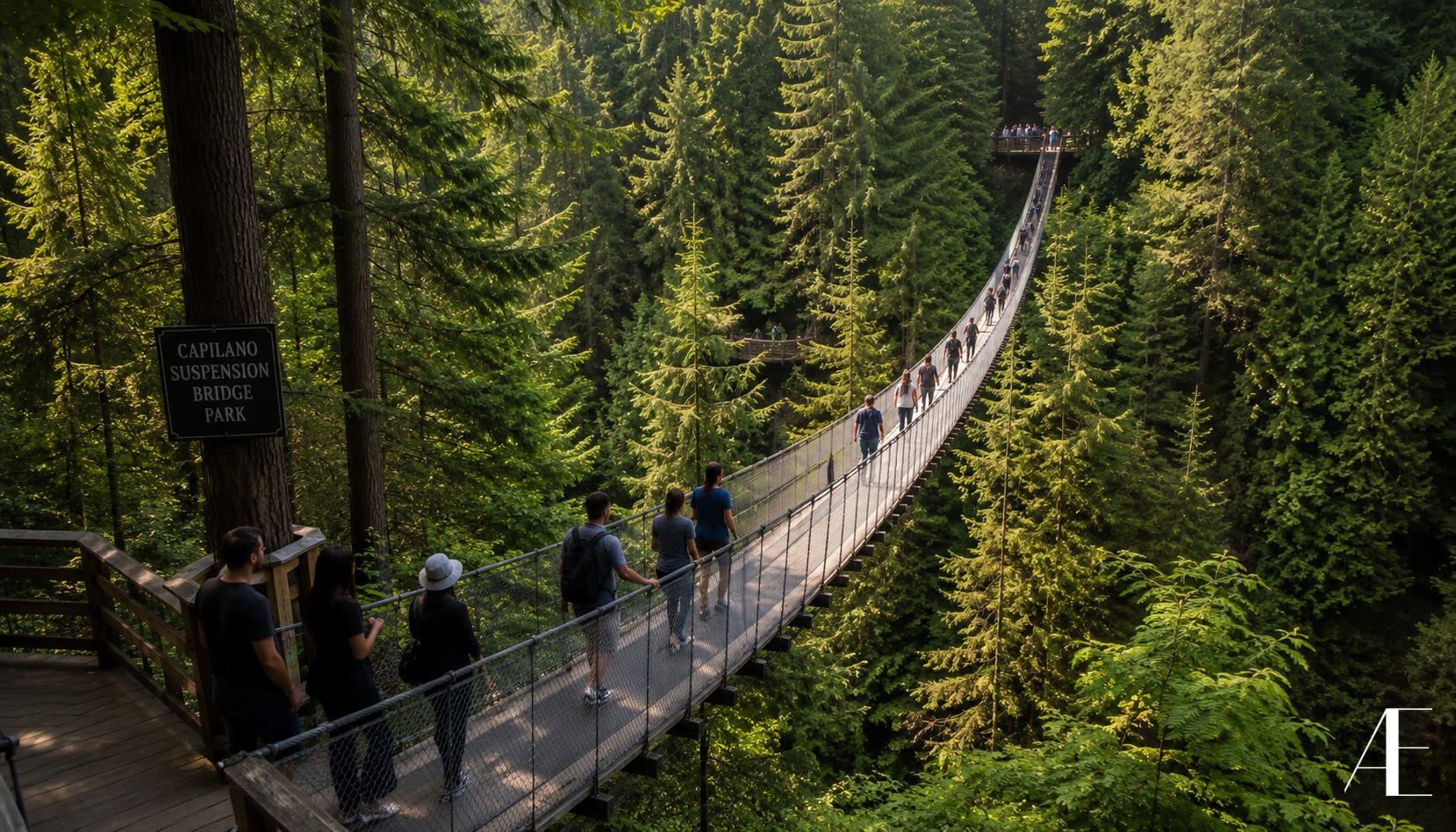
A privately operated park in North Vancouver built around a 137-metre suspension bridge, 70 metres above the Capilano River. The park has been a tourist destination since 1889, when Scottish developer George Grant Mackay built the original hemp rope structure in consultation with Squamish Nation builders August and Willie Jack Khahtsahlano.
The current bridge is strong enough to hold the weight of two fully loaded 747s. Beyond the bridge itself, the park includes the Treetops Adventure (seven smaller bridges connecting 200-year-old Douglas firs at heights of up to 30 metres), the Cliffwalk (a cantilevered glass walkway clinging to the canyon wall), and the Kia’palano cultural area showcasing First Nations totem poles and history.
Admission is $79.95 CAD per adult in 2026, which is significant, and worth acknowledging: Lynn Canyon in North Vancouver offers a free suspension bridge and excellent forest trails for those who prefer to save the money. That said, the Capilano experience is more comprehensive, and the Treetops Adventure alone justifies the visit for many travellers. A free shuttle runs from several downtown hotels.
Grouse Mountain
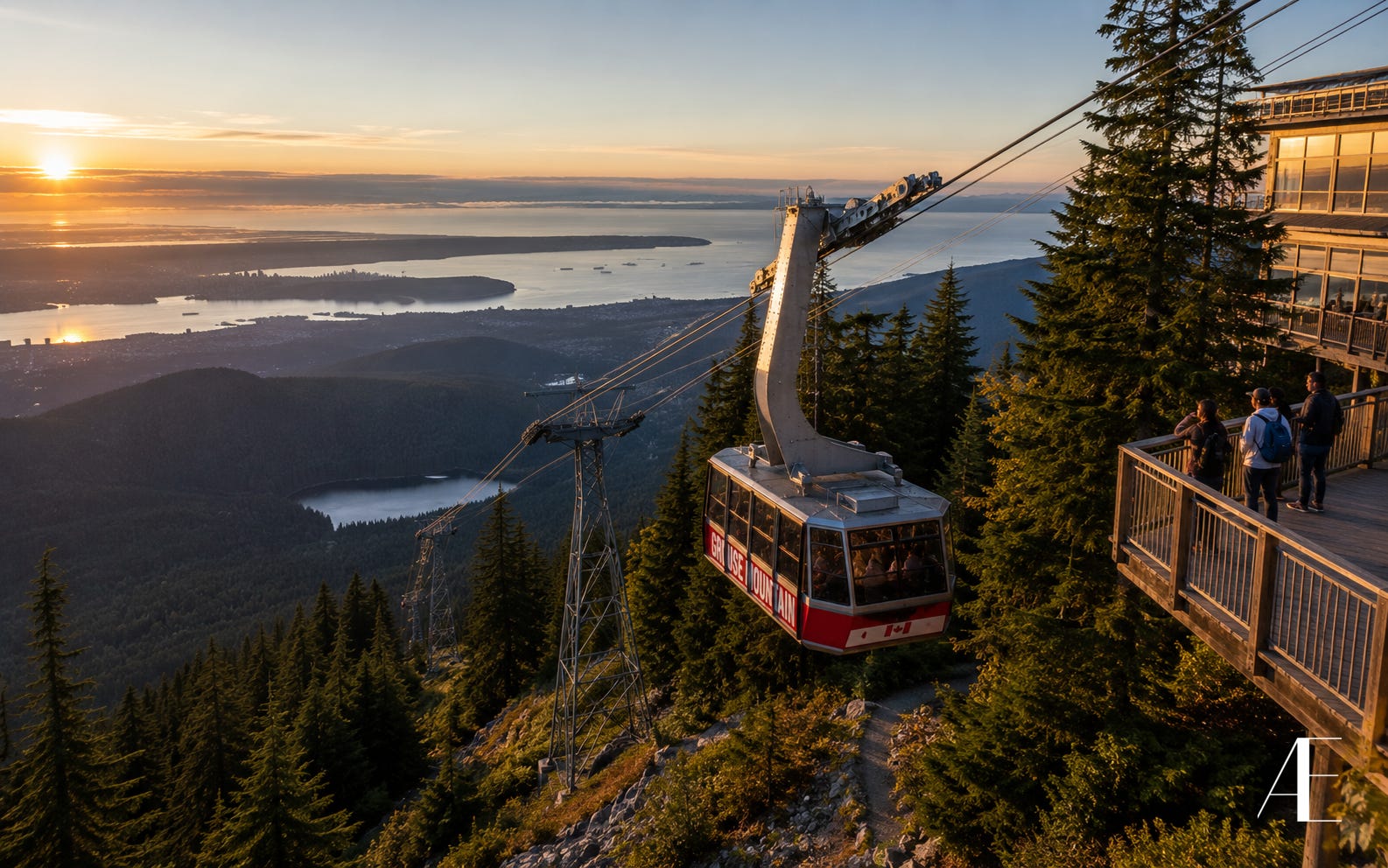
The mountain directly above North Vancouver, accessible by gondola from the base and operating year-round. In winter, it is a functioning ski and snowboard mountain twenty-five minutes from downtown, with runs that look down over the city lights in the evening, an experience unlike any other urban ski destination in the world.
In summer, it is a destination for hiking, lumberjack shows, the resident grizzly bear brothers Grinder and Coola (rescued as orphaned cubs in 2001 and living at the refuge at the summit), and a gondola ride that ascends 1,200 metres while the city spreads out below. The Grouse Grind, a 2.9-kilometre trail of relentless switchbacks known locally as “Mother Nature’s Stairmaster,” is one of the most climbed recreational trails in Canada.
The Seawall
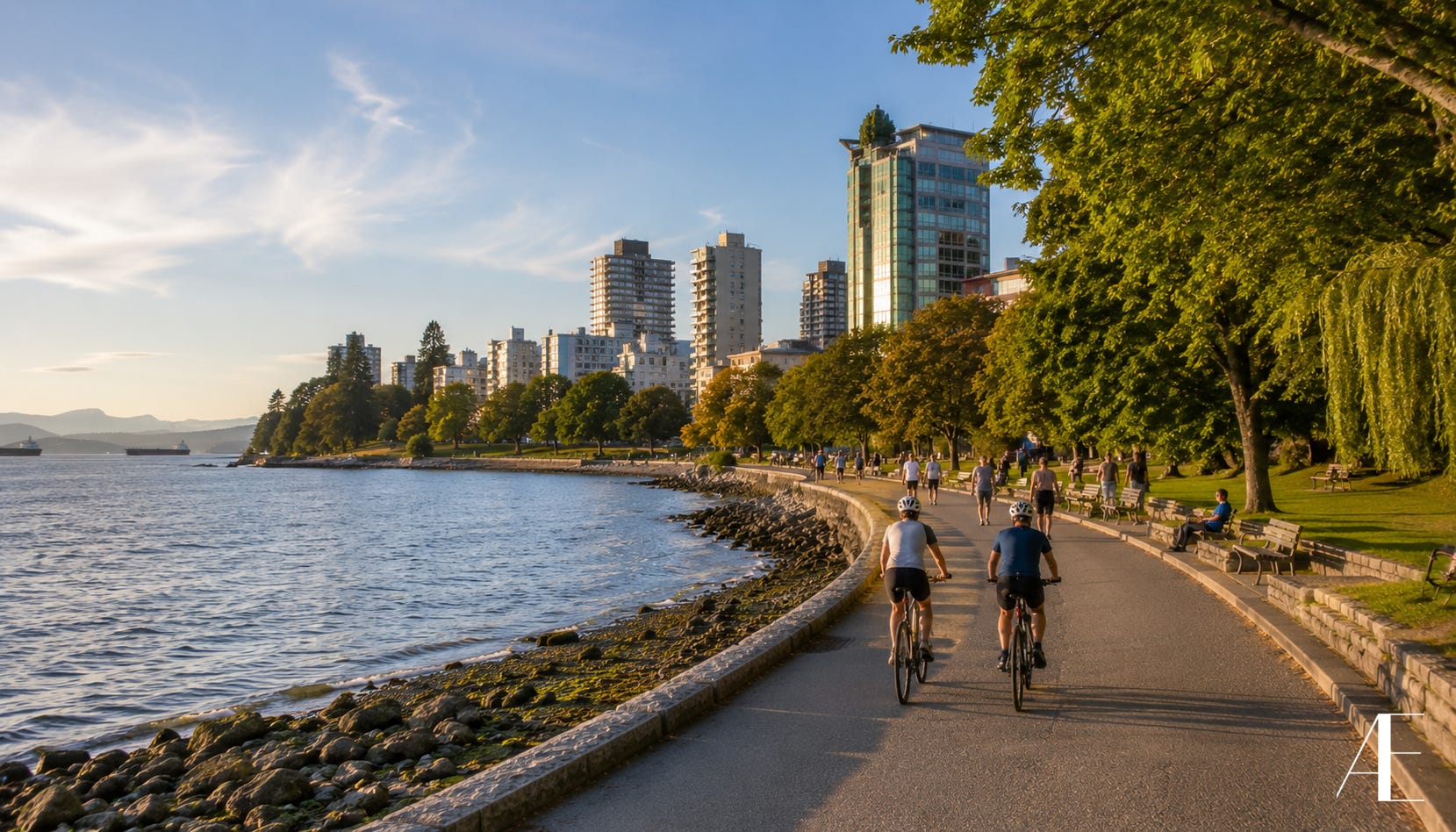
The full 22-kilometre Seawall, running from Canada Place around Stanley Park and along the False Creek waterfront to Science World, is one of the great urban walks in North America. Most visitors do not complete it in a single stretch, which is entirely sensible: the Stanley Park portion alone takes two to three hours on foot. Renting a bicycle or a rollerblade from one of the rental shops near Denman Street and cycling the full loop takes about two hours, covers more ground, and rewards with the kind of extended waterfront views that are rare in any major city. Go in the morning, before the afternoon crowds arrive.
A meal in Chinatown
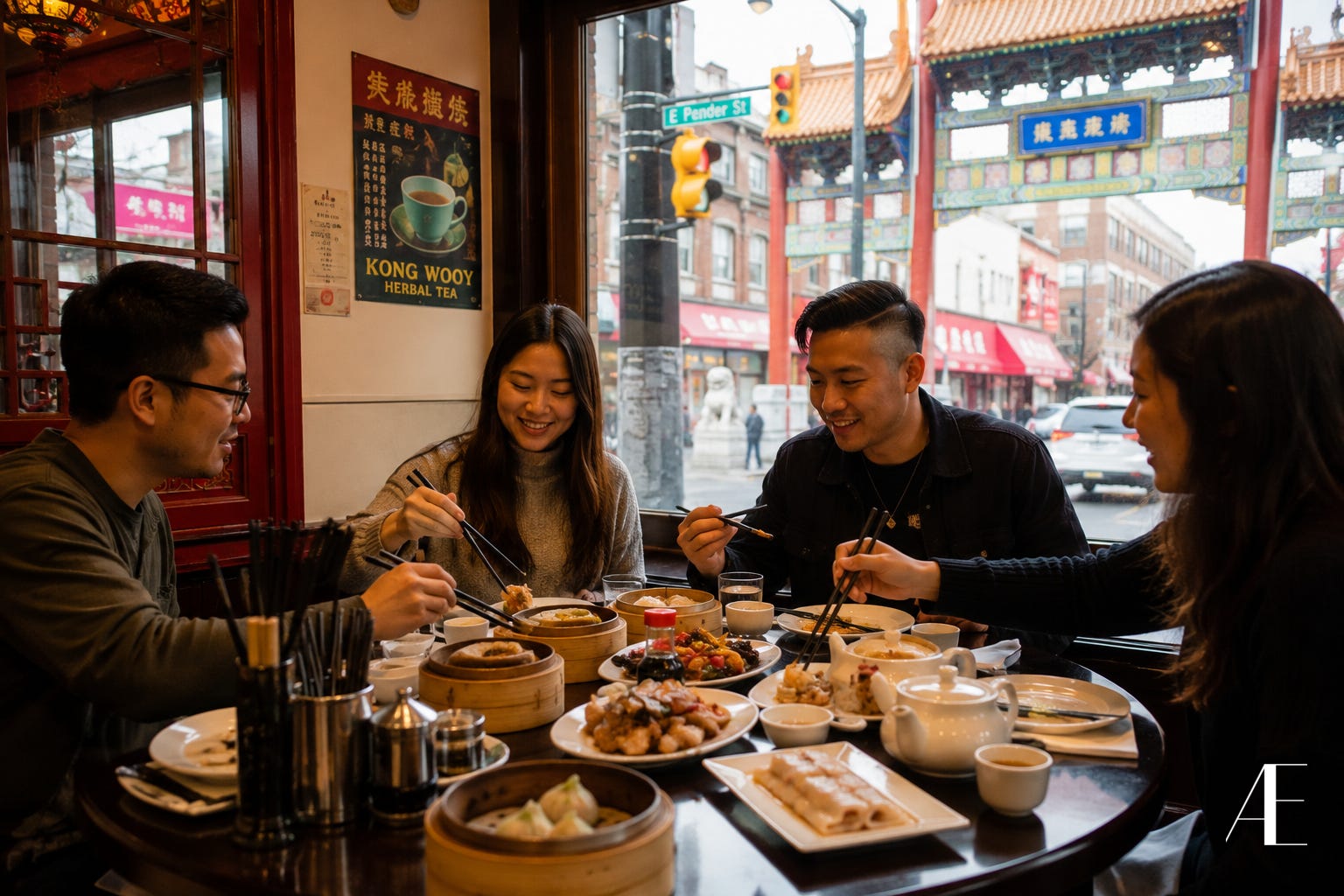
Vancouver’s Chinatown is home to some of the finest Chinese food in the world outside China itself. The city’s Cantonese dim sum tradition runs deep, with restaurants that open at 8am on weekends and fill with multigenerational families who have been going to the same table for decades.
The newer wave of restaurants, several of them Michelin-starred or recommended, works across regional Chinese cuisines with a sophistication that matches anything being done with the cuisine anywhere in the English-speaking world. A dim sum breakfast at a classic Chinatown restaurant, with the trolleys and the noise and the very particular pleasure of being outnumbered by regulars who know exactly what to order, is one of the defining Vancouver experiences.
Whale watching from the harbour
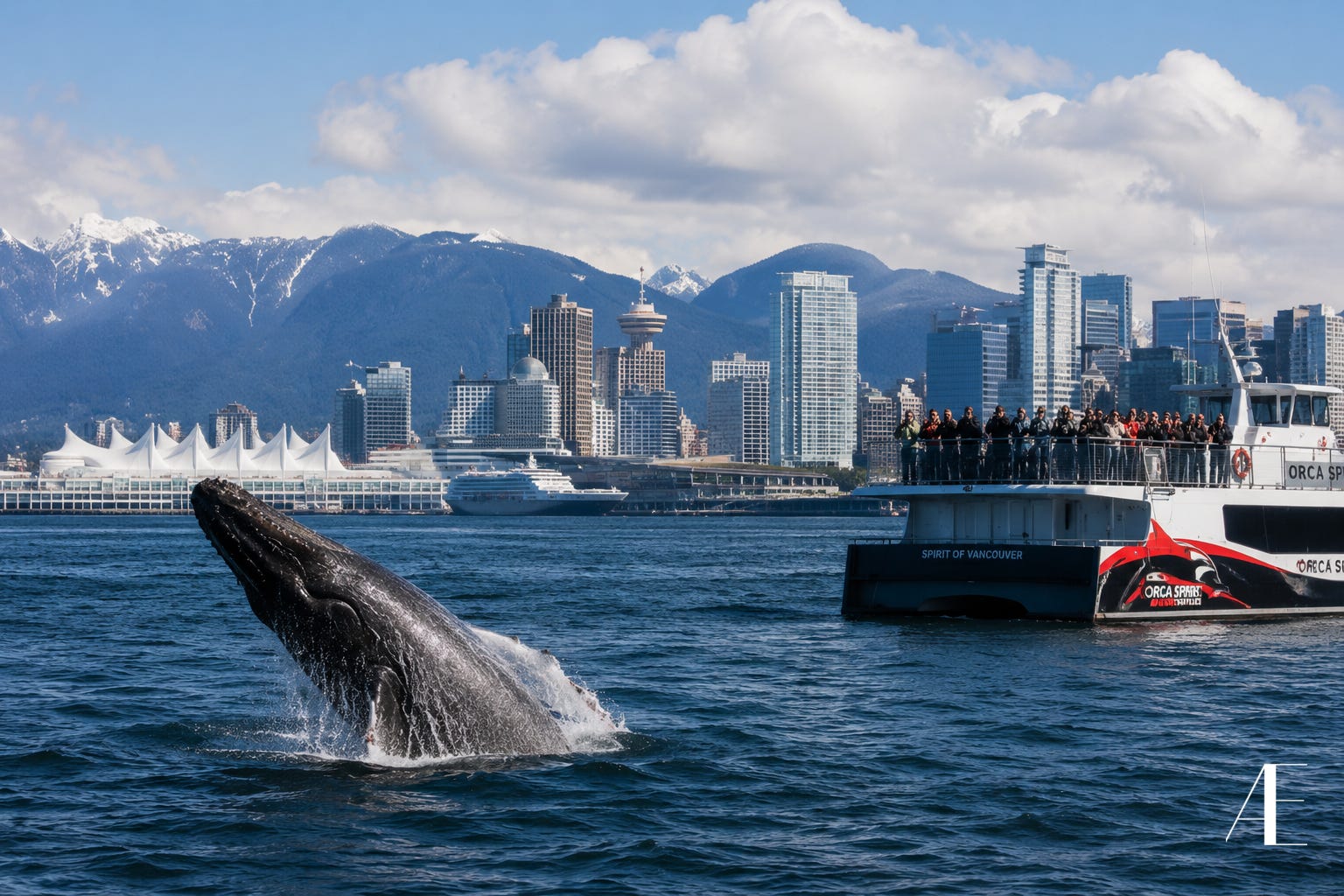
The waters around Vancouver are among the most productive for whale watching on the Pacific Coast. Orca pods use the Strait of Georgia as feeding grounds throughout the year, and humpback whales, grey whales, minke whales, Dall’s porpoises, and harbour seals are all common sightings. Several operators run daily tours from the downtown waterfront from spring through autumn, typically three to four hours, with marine biologists or naturalists on board. Book in advance in July and August.
Day trips from Vancouver
British Columbia is, by any measure, one of the most spectacular provinces in the world for day trips. The mountains, islands, fjords, and wine country accessible within a two-hour drive or ferry ride from Vancouver are enough to sustain a separate week.
Whistler and the Sea to Sky Highway
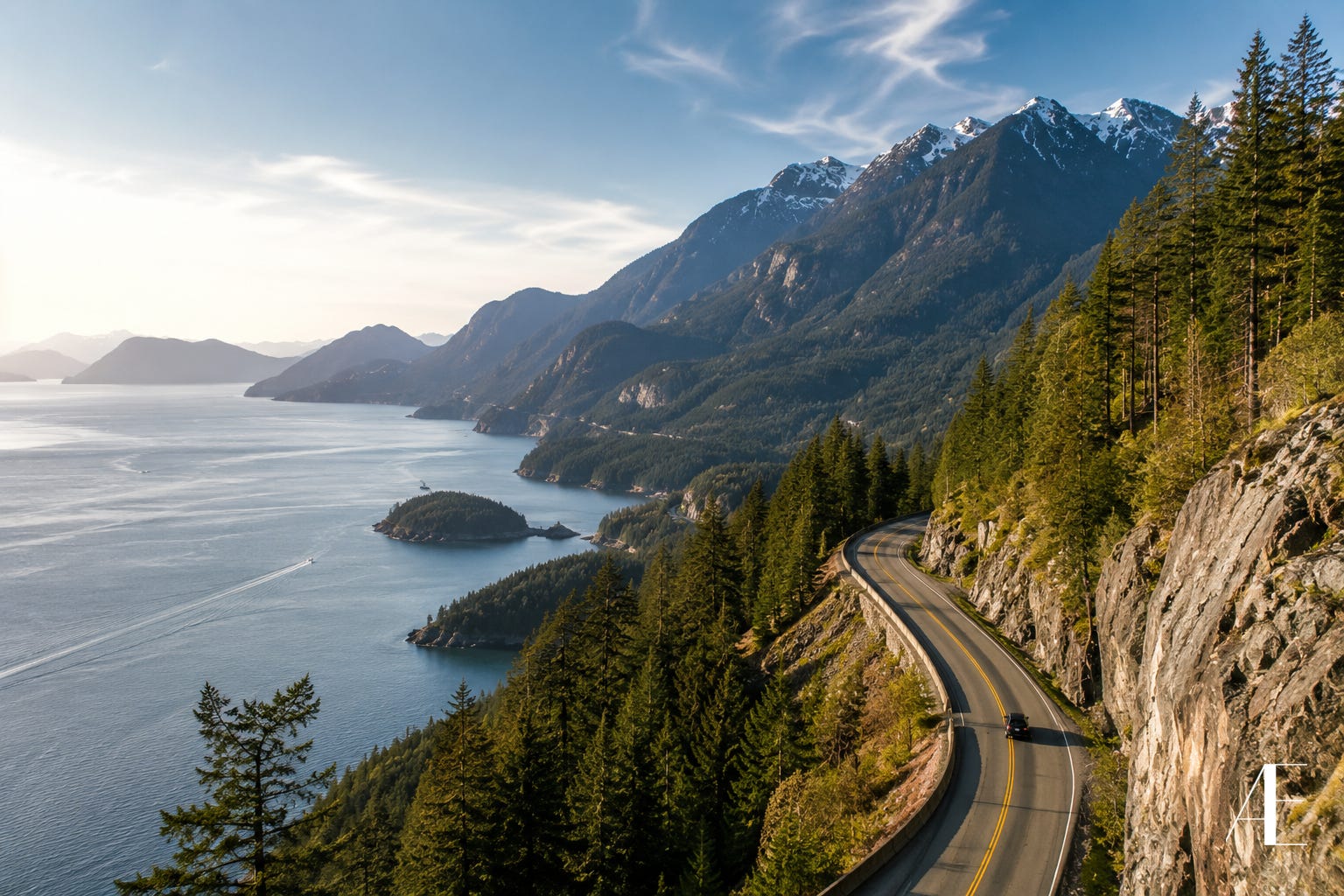
The most dramatic drive in British Columbia, and one of the finest drives in North America. Highway 99 north from Vancouver follows the coast through Horseshoe Bay, then climbs through the fjord landscape of Howe Sound, past the Stawamus Chief (a 710-metre granite monolith that is the second-largest of its kind in the world), through Squamish, and up to Whistler Village 121 kilometres from downtown.
Allow two hours each way without traffic, longer on winter weekends. Stops en route worth building in: Shannon Falls Provincial Park (a 335-metre waterfall three minutes from the highway), the Sea to Sky Gondola near Squamish (a ten-minute ride to 885 metres above sea level, with a suspension bridge at the summit), and the town of Squamish itself, which has become a serious destination in its own right for climbing, mountain biking, and an increasingly strong restaurant scene.
Whistler Village in winter means two mountains, more than 200 runs, and the Peak 2 Peak Gondola connecting them. In summer, it means hiking, mountain biking, and the village itself, which is better than most ski village architecture deserves to be.
Victoria and Vancouver Island
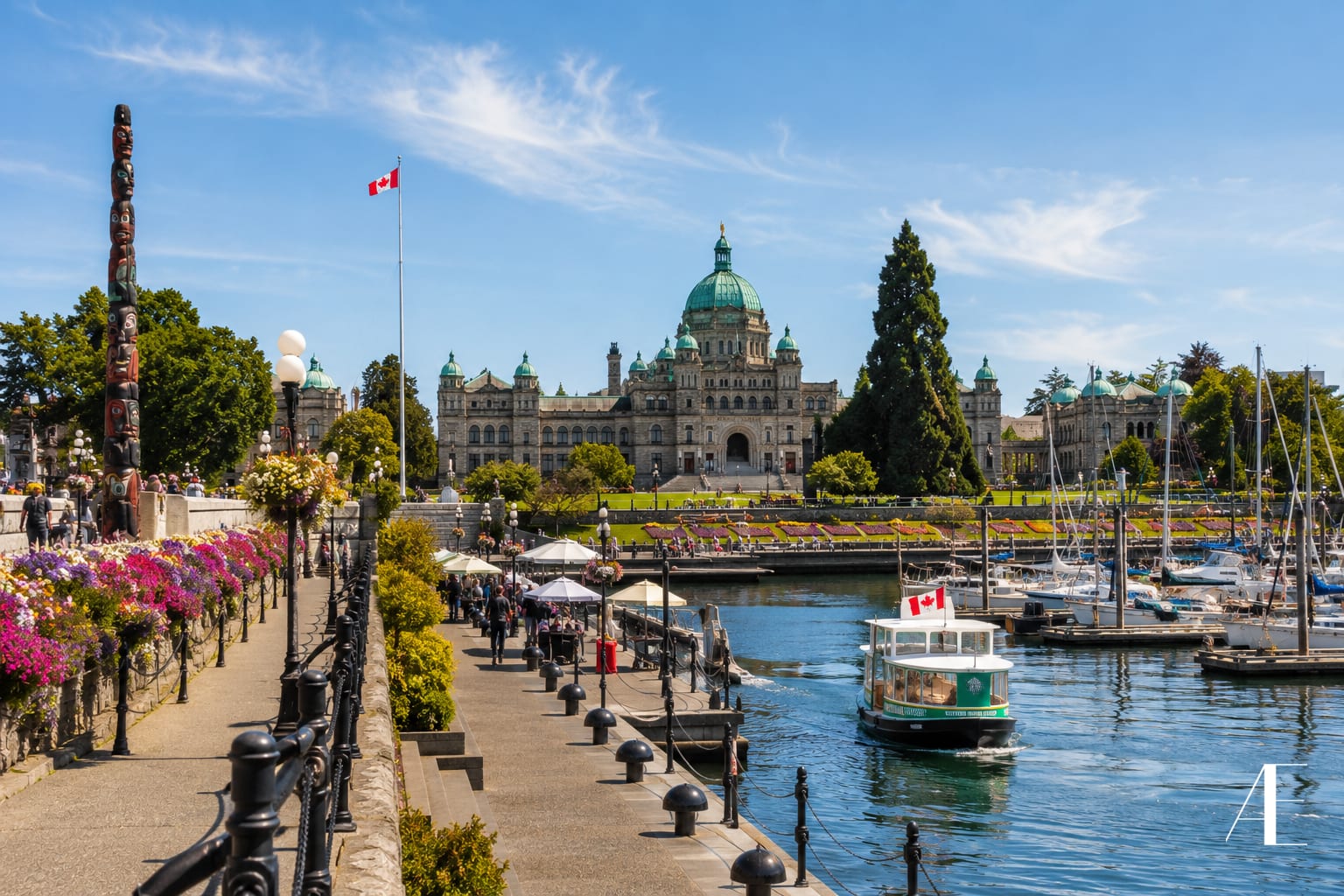
The provincial capital, reachable by BC Ferries from Tsawwassen south of Vancouver (about an hour and a half crossing to Swartz Bay, then 30 minutes by car or bus to Victoria), or by floatplane from downtown Vancouver in 35 minutes. Victoria is a city of a genuinely different character from Vancouver: smaller, older, more British in its architecture and pace, with a waterfront Inner Harbour dominated by the Fairmont Empress and the Parliament Buildings.
Butchart Gardens, 20 kilometres north of Victoria, is one of the great horticultural destinations in Canada, particularly spectacular in its summer evening illuminations. Victoria’s restaurant scene, while smaller than Vancouver’s, punches significantly above its weight, with several properties named among the best hotels in Western Canada by Condé Nast Traveller in 2025. A day trip to Victoria is possible but rushed; an overnight is significantly more satisfying.
The Gulf Islands
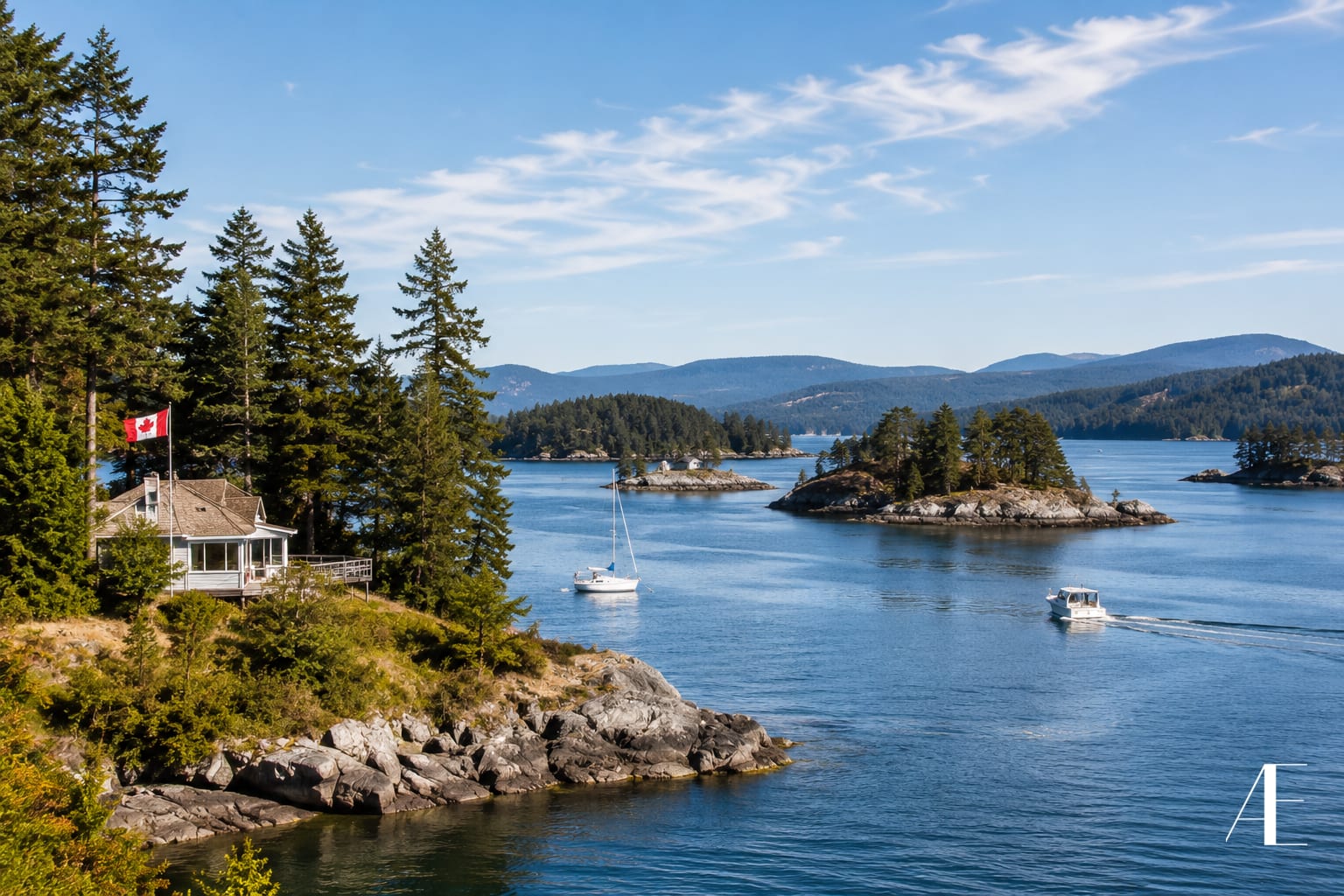
The cluster of islands between the BC mainland and Vancouver Island, scattered through the Strait of Georgia and accessible by BC Ferries or floatplane from Vancouver. Salt Spring Island, the largest and most accessible, has the Saturday market at Ganges (the finest farmers market in the province), a community of artists and smallholders, and the kind of unhurried pace that makes a two-day visit feel like a week of decompression. Hornby Island, Galiano Island, and Pender Island each have their own character. The Gulf Islands are not a day trip in the traditional sense, they are best approached as an overnight at minimum, but a seaplane from Vancouver to Salt Spring Ganges Harbour takes thirty minutes and arrives in a completely different world.
The Fraser Valley and Wine Country
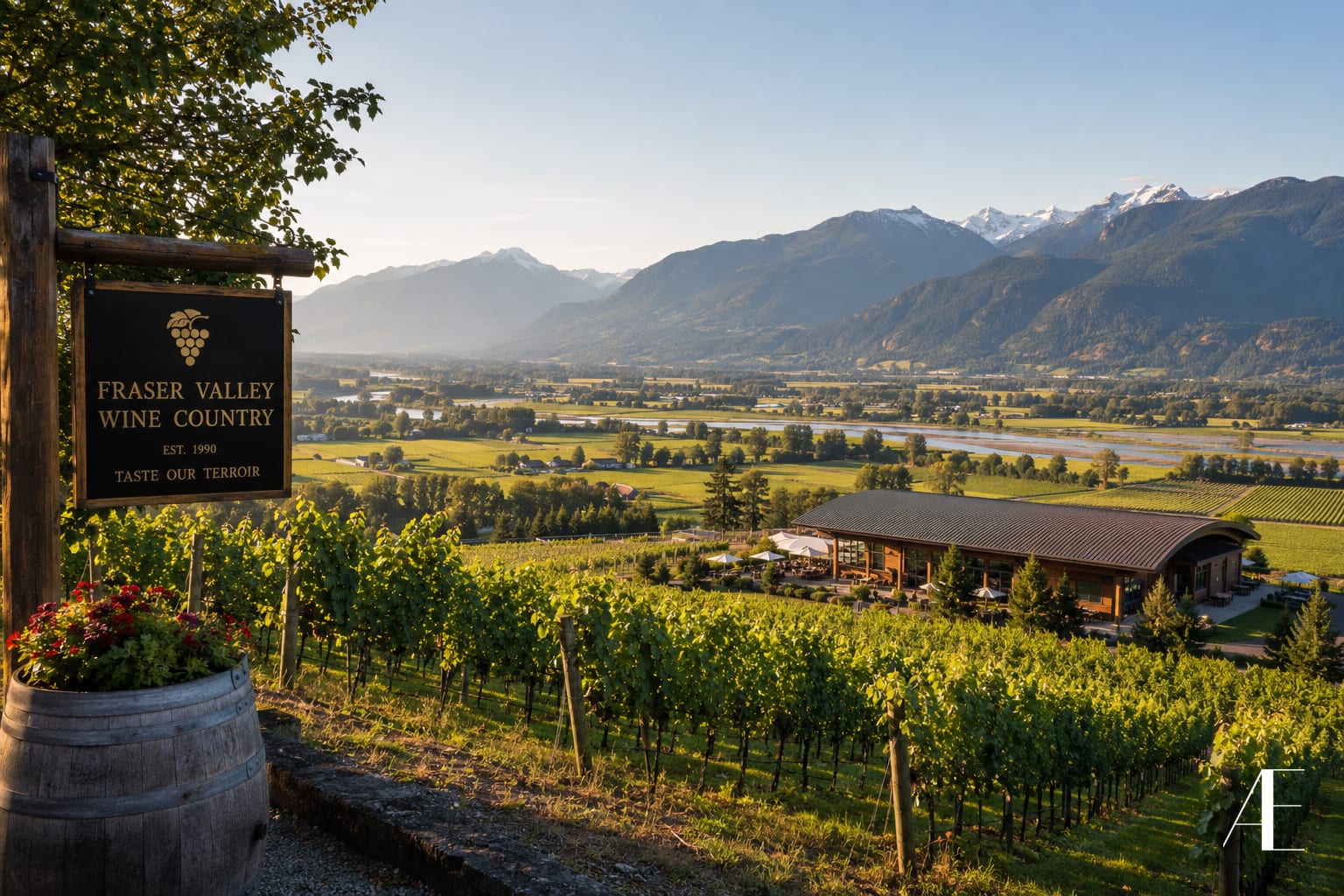
East of Vancouver, the Fraser Valley opens into agricultural lowlands that produce exceptional soft fruit and, increasingly, serious wine. The Okanagan Valley, the province’s main wine region, is four to five hours east by car and warrants its own trip. Closer at hand, the area around Langley and Abbotsford has a growing concentration of small wineries and farm-to-table restaurants that make for a useful half-day loop from the city. Agassiz, at the far end of the valley, is the gateway to Harrison Hot Springs, a geothermal resort town on a lake two hours from downtown that operates year-round.
When to visit Vancouver
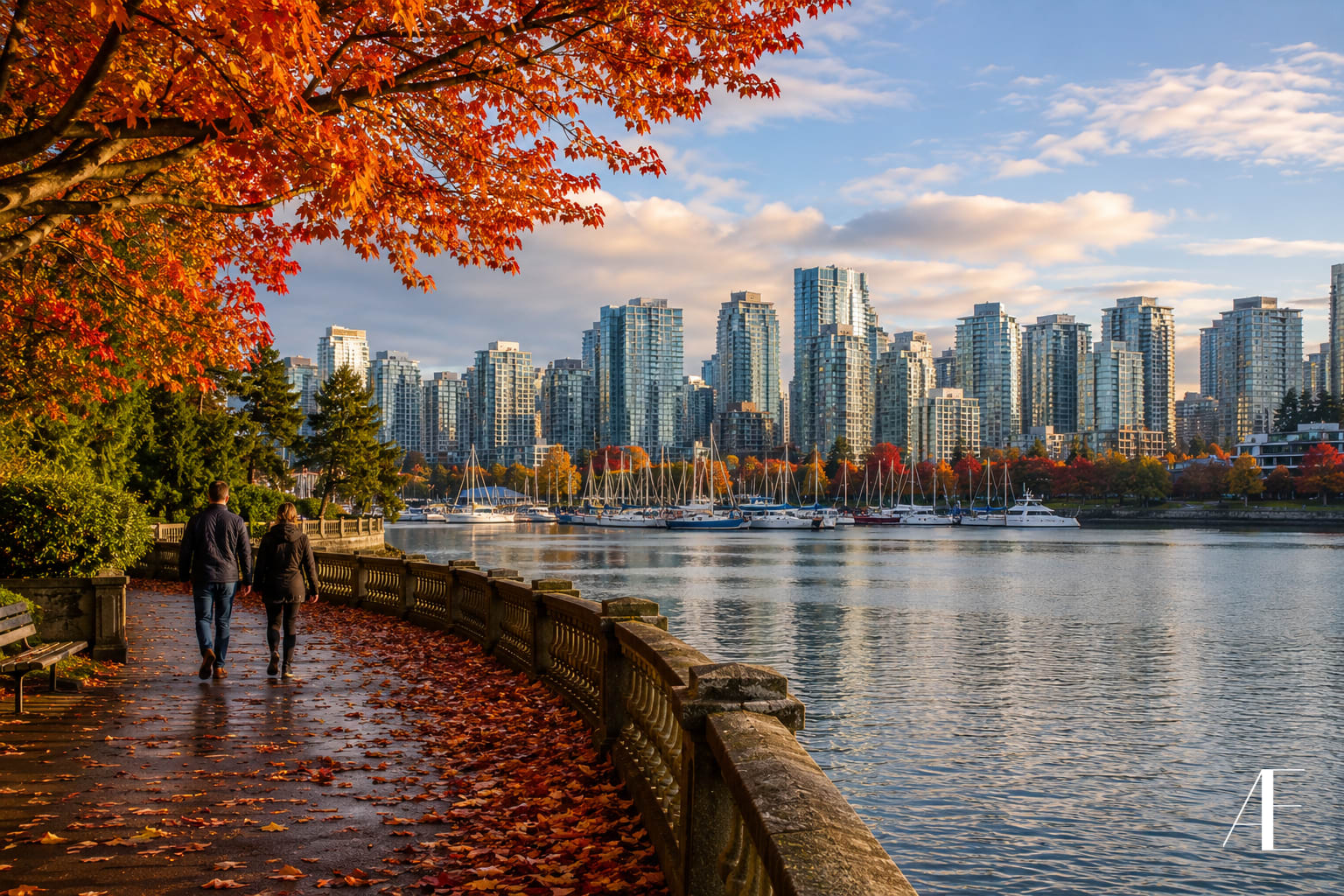
Vancouver is a city for most seasons, though not equally. The weather is the variable, and it can vary significantly within a single day, let alone a week.
🌸 Spring (March to May)
The cherry blossoms, which typically peak in late March or early April, are one of the most spectacular seasonal events in any North American city. Vancouver has more than 40,000 cherry trees, and during the two weeks of peak bloom, the city’s residential streets become extraordinary. Mild temperatures, manageable crowds, and long enough days to explore comfortably. Some mountain trails remain closed until late May due to snow. One of the two best times to visit.
☀️ Summer (June to August)
The long days (sunset after 9pm in June and July) give summer in Vancouver a particular quality. The city is at full activity: beach volleyball at Kitsilano, the outdoor Bard on the Beach Shakespeare festival in Vanier Park, the Pride Parade in late July, and the Pacific National Exhibition in August. The mountains are accessible for hiking, the whale watching is at its peak, and the outdoor dining on restaurant terraces is a genuine pleasure. The FIFA World Cup 2026, with Vancouver hosting seven matches from June, makes this summer exceptional but also significantly more crowded. Book well in advance.
🍂 Autumn (September to November)
The crowds thin, the prices drop, and the light becomes extraordinary: low and golden through the coastal forest in October and November. The restaurant season is at its most creative, with chefs leaning into autumn Pacific Northwest produce. Mushroom season brings chanterelles, porcini, and matsutake from the interior forests to market and onto menus. The first serious storms usually arrive in late October, which has its own dramatic appeal along the Seawall. The second best time to visit, and significantly underrated.
❄️ Winter (December to February)
Wet and grey, with exceptions. The mountains receive heavy snowfall from late November and offer world-class skiing within thirty minutes of downtown, which is a genuinely unusual combination. The Christmas lights at Capilano Canyon Lights are one of the best seasonal events in the city. January and February are the quietest and least expensive months, and the quality of dining does not diminish. If skiing is part of the plan, winter in Vancouver is exceptional.
How many days to spend in Vancouver
Three days cover Stanley Park, Granville Island, Gastown, and a North Shore excursion at a comfortable pace. Four to five days add the Museum of Anthropology, Kitsilano, Commercial Drive, and either Whistler or Victoria as a day trip. A week begins to reveal the city’s depth: a whale watching trip, a day in the Fraser Valley, a full evening devoted to the restaurant scene at a level that requires more than a single dinner.
Vancouver rewards time. Three days give you the landmarks. Five days give you the neighbourhoods. A week starts to show you why people who come for the Olympics or a conference end up returning every few years until, eventually, they start looking at what it would take to stay.
Suggested 4-day itinerary
Day 1: Stanley Park and the Seawall
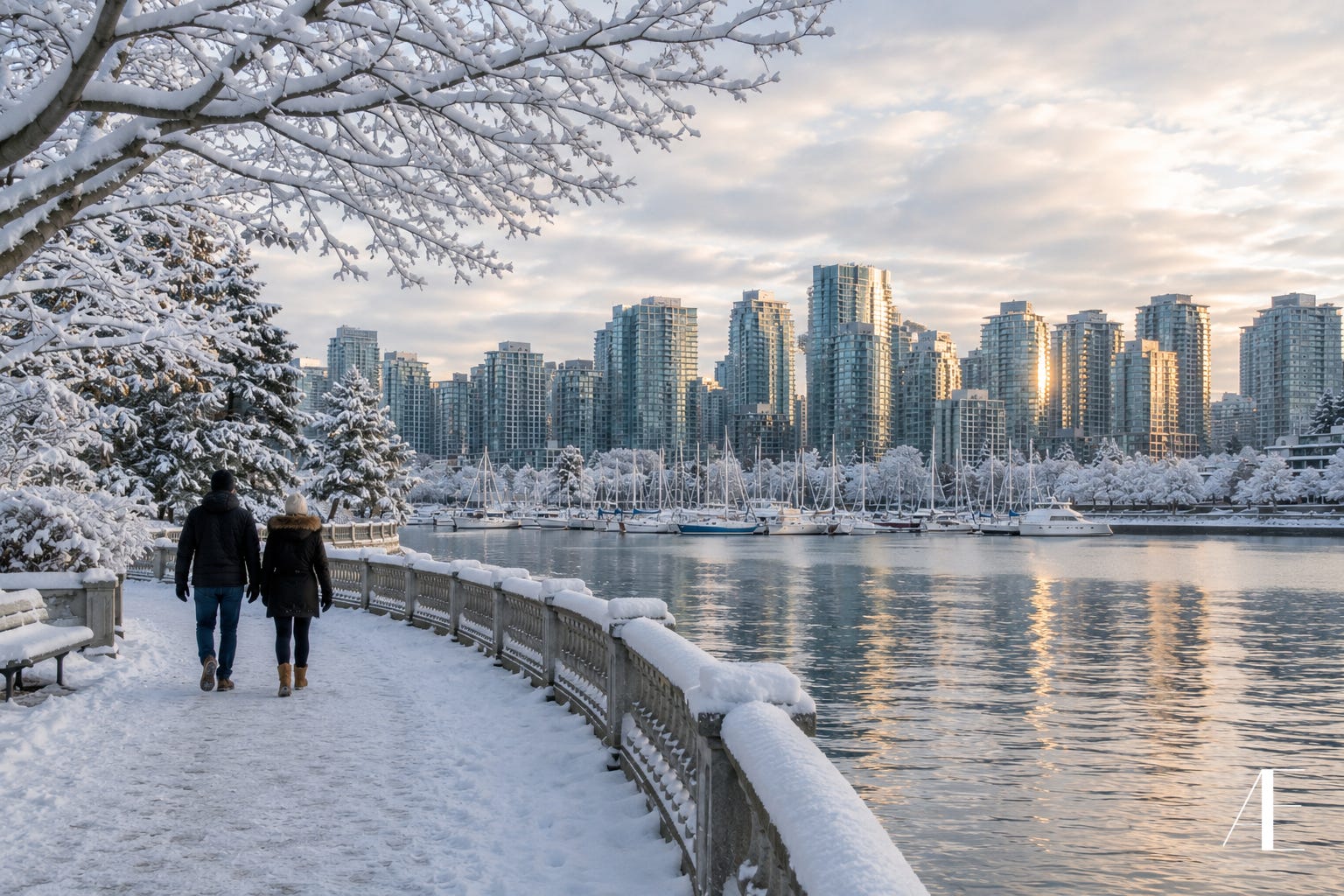
Early start on the Seawall before the crowds arrive. Walk or cycle the Stanley Park portion: Brockton Point, the totem poles, Prospect Point, Third Beach. Lunch at one of the cafés near English Bay. Afternoon: explore the West End, then walk down Denman Street into Coal Harbour. Evening: Gastown for dinner, with a cocktail at one of the neighbourhood’s better bars afterward.
Day 2: Granville Island, Chinatown, and Yaletown
Morning at the Granville Island Public Market: buy breakfast from the vendors, explore the artisan studios. Take the Aquabus back across False Creek to Yaletown. Lunch in Chinatown or in the Chinatown-adjacent restaurant strip on East Pender. Afternoon: Dr. Sun Yat-Sen Classical Chinese Garden, a walk through Chinatown. Evening in Yaletown: dinner at one of the waterfront restaurants, evening walk along the False Creek Seawall.
Day 3: North Shore
SeaBus from Waterfront to Lonsdale Quay. Coffee at the market. Capilano Suspension Bridge Park (allow three hours). Afternoon: Grouse Mountain gondola, or a walk through the Lynn Headwaters trails if hiking is the priority. Dinner in North Vancouver before taking the SeaBus back. The return crossing at dusk, with the city lit up across the water, is one of the better views the day produces.
Day 4: Museum of Anthropology and Kitsilano
Take the bus or drive to UBC for the Museum of Anthropology when it opens. Allow three to four hours. Lunch near campus or back in Kitsilano. Afternoon: Kitsilano Beach (swimming in summer, walking year-round), West 4th Avenue for browsing. Sunset at the UBC Rose Garden if the day is clear: the cliffs overlook the Strait of Georgia with the mountains of Vancouver Island visible on a good day. Final dinner in Kitsilano or back in the city centre.
Where to eat
Vancouver’s food scene has undergone a transformation over the past fifteen years that has left it in a genuinely different position from most North American cities. The combination of Pacific seafood, exceptional Asian culinary tradition, and a generation of chefs trained in international kitchens and returned to cook at home has produced a restaurant culture that rewards serious attention.
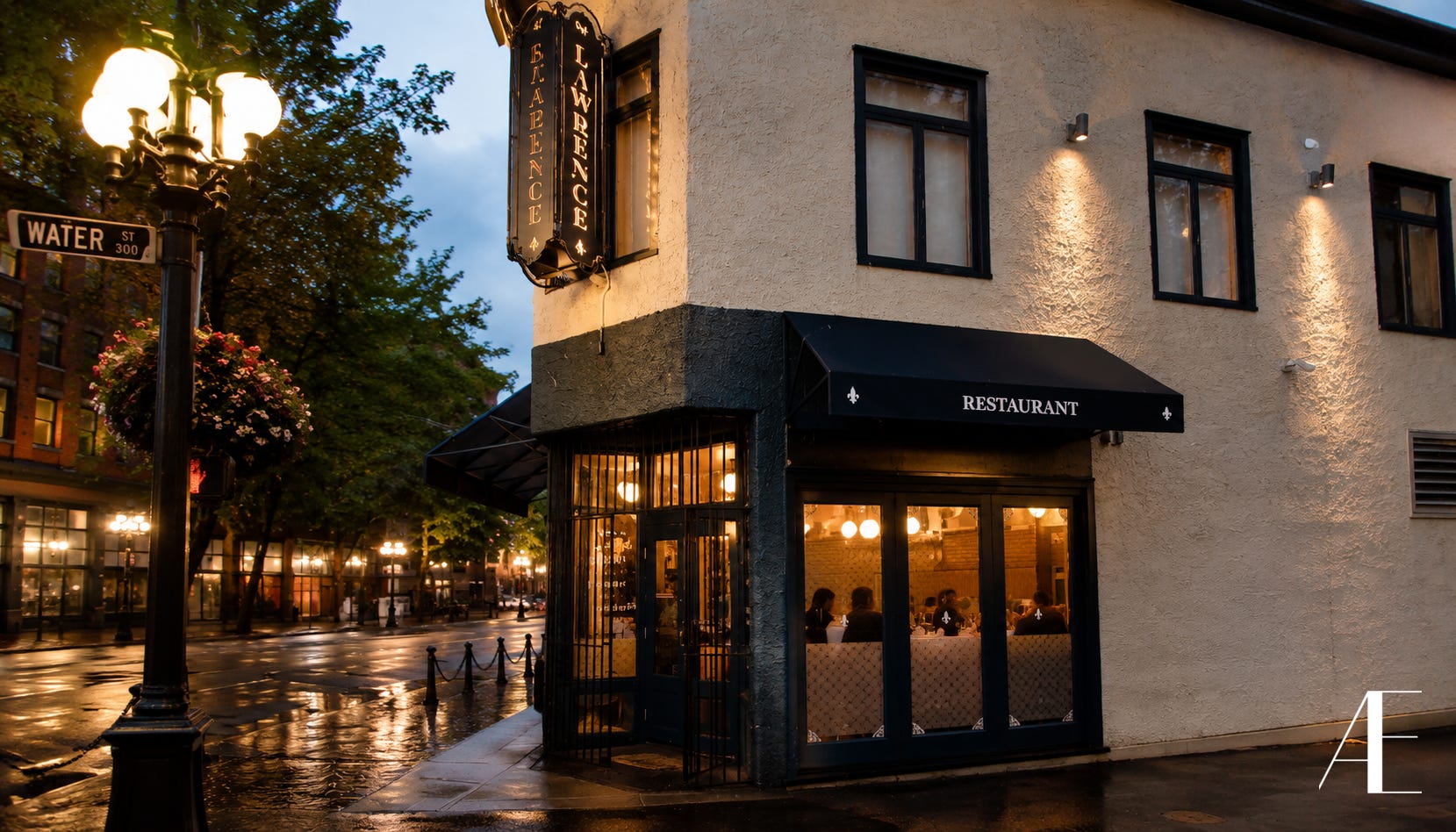
St. Lawrence French-Canadian, Gastown The most acclaimed restaurant in Vancouver, the Michelin Guide’s 2025 Best Service award winner and consistently among the top tables in Canada. Chef J-C Poirier draws on Québécois and classical French cooking traditions with a precision and generosity that makes the tasting menu one of the most satisfying in the country. The cassoulet, the foie gras terrine, the selection of Quebec cheeses: this is cooking that argues seriously for French-Canadian cuisine as a distinct and serious tradition. Book weeks ahead.
Kissa Tanto Japanese-Italian, Chinatown The kind of restaurant that sounds like a concept and turns out to be a masterpiece. Kissa Tanto combines Japanese and Italian cooking traditions in a narrow Chinatown space that evokes a 1960s Tokyo jazz bar: low lights, lacquered tables, the kind of room where the meal becomes an event. The pasta with sea urchin and the wagyu dishes have become Vancouver standards. One Michelin star. Reservations essential.
Burdock & Co. Seasonal Pacific Northwest, Main Street Chef Andrea Carlson’s restaurant on Main Street is the clearest expression of what Pacific Northwest cooking means when it is taken seriously: foraged ingredients, hyper-local produce, coastal seafood, and a menu that changes with what is actually available rather than what would be convenient to source. One Michelin star. The room is small and the atmosphere is warm in the particular way that only happens when the people cooking genuinely believe in what they are doing.
Hawksworth Restaurant Contemporary Canadian, Downtown David Hawksworth’s flagship in the Rosewood Hotel Georgia is the city’s most polished formal dining room: a grand space with exceptional service, a wine list that treats British Columbia’s best producers as the equals of anyone, and cooking that takes Canadian produce as seriously as any chef on the continent. The tasting menu is the right call.
AnnaLena Pacific Northwest, Kitsilano One Michelin star in a neighbourhood room on West 1st Avenue: one of those restaurants that makes Kitsilano feel like the right place to be. The menu is ingredient-led and confident, the natural wine list is excellent, and the room has the kind of energy that sustains a full evening without anyone feeling rushed.
Anh and Chi Vietnamese, Main Street The finest Vietnamese restaurant in Vancouver and the definitive rebuttal to anyone who still thinks of Vietnamese food as a budget category. Anh and Chi applies the same rigor to pho, bun bo hue, and the cooking of central and southern Vietnam that the Michelin-starred rooms apply to their tasting menus. The Bib Gourmand designation is accurate: it is genuinely exceptional value for the level. No reservations; expect a queue on weekends.
The Mackenzie Room Contemporary, Gastown-adjacent A ten-seat chef’s table east of Gastown that operates on a single tasting menu changed regularly by the kitchen. Described by Vancouver Foodie Tours’ founder as her current favourite restaurant in the city. The kind of place that does not advertise and does not need to. Book well in advance.
Where to stay
Vancouver’s hotel landscape has expanded considerably over the past five years. The best areas for a first stay are Coal Harbour and the West End for waterfront access, Gastown for neighbourhood character, and Yaletown for restaurant proximity.
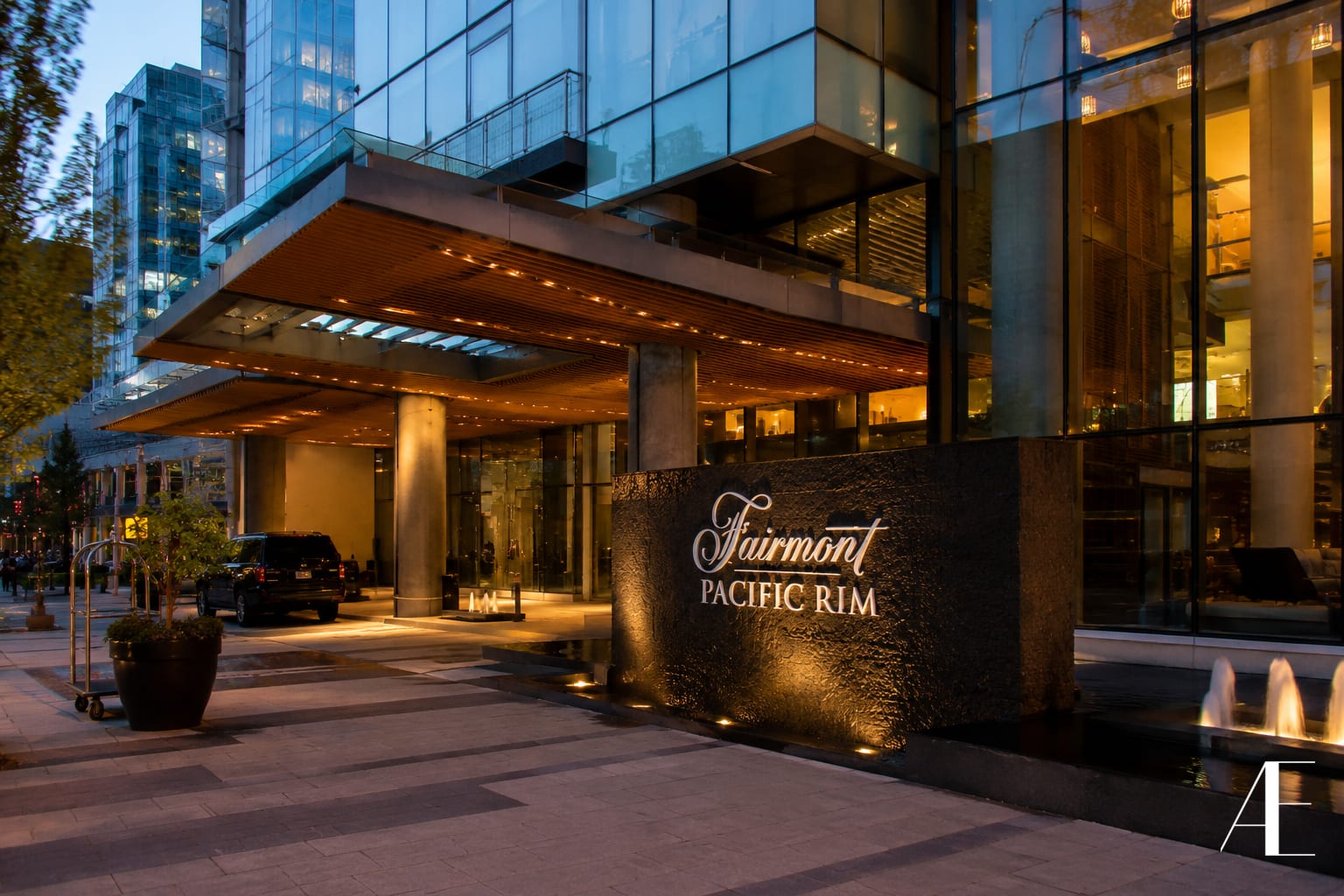
Fairmont Pacific Rim Luxury, Coal Harbour The definitive Vancouver luxury hotel and consistently one of the highest-rated in Western Canada by Condé Nast Traveller. Opened in 2010 directly on the waterfront in Coal Harbour, it has the mountain views, the rooftop pool, and the service infrastructure that the Fairmont name requires. The Botanist restaurant is one of the city’s best hotel dining rooms. Cruise passengers travelling through Canada Place will find no more convenient or more satisfying arrival point.
Rosewood Hotel Georgia Luxury, Downtown A 1927 Georgian Revival landmark that underwent a full restoration and reopened as the most consistently celebrated luxury hotel in the city. Elvis Presley, Katharine Hepburn, and Jennifer Lopez have all stayed here, which the hotel mentions without embarrassment because the point is the building’s history rather than celebrity gossip. The 1927 Lobby Lounge is one of the finest bar rooms in Vancouver. Hawksworth Restaurant, within the hotel, holds its own against anything on the city’s independent dining scene.
Loden Vancouver Boutique, Coal Harbour Seventy-seven rooms in a quiet Coal Harbour location steps from Robson Street and the Stanley Park entrance. The Loden is the boutique reference in Vancouver: genuinely personalised service, design that holds up, and a location that allows you to walk to Stanley Park in ten minutes without being in the middle of the tourist circuit. The most consistent recommendation for travellers who want something smaller than the major luxury properties.
Wedgewood Hotel & Spa Boutique, Downtown Family-owned and operated, which in Vancouver’s hotel market is notable enough to be a distinction. The Wedgewood has 83 rooms and suites in a downtown location across from Robson Square, and operates with the kind of attentiveness that only comes from ownership rather than management. The Bacchus Restaurant in the lobby is a serious room. One of the city’s most reliable choices for guests who know what they want.
Opus Hotel Boutique, Yaletown Ninety-six rooms in the heart of Yaletown, with a design concept built around five fictional character types and the most consistently praised boutique atmosphere in the neighbourhood. Floor-to-ceiling windows, underfloor heating in the bathrooms, a complimentary car service within downtown. The best-positioned hotel for exploring the False Creek waterfront, Granville Island by Aquabus, and the best of the Yaletown restaurant strip.
The Burrard Mid-range, West End A 1956 motor hotel intelligently converted into one of the most characterful mid-range options in the city. Located on Burrard Street between downtown and the West End, with a garden patio and a design sensibility that puts most hotels twice its price to shame. The best value-for-quality option in central Vancouver for travellers who do not require full hotel services.
Practical information
Currency: Canadian dollar (CAD). Contactless payment is accepted universally. Many transactions in tourism contexts are priced in both CAD and USD, though at rates that favour paying in CAD with a Canadian-friendly card. The Canadian dollar typically trades at a significant discount to USD, which makes Vancouver genuinely good value for American visitors.
Language: English. Vancouver’s linguistic reality is considerably more complex, with Mandarin, Cantonese, Punjabi, and Tagalog all widely spoken as community languages. Signage in Chinatown, Richmond, and several other areas is bilingual or primarily Chinese. No adjustment is required, but awareness of the city’s multilingual character adds to understanding it.
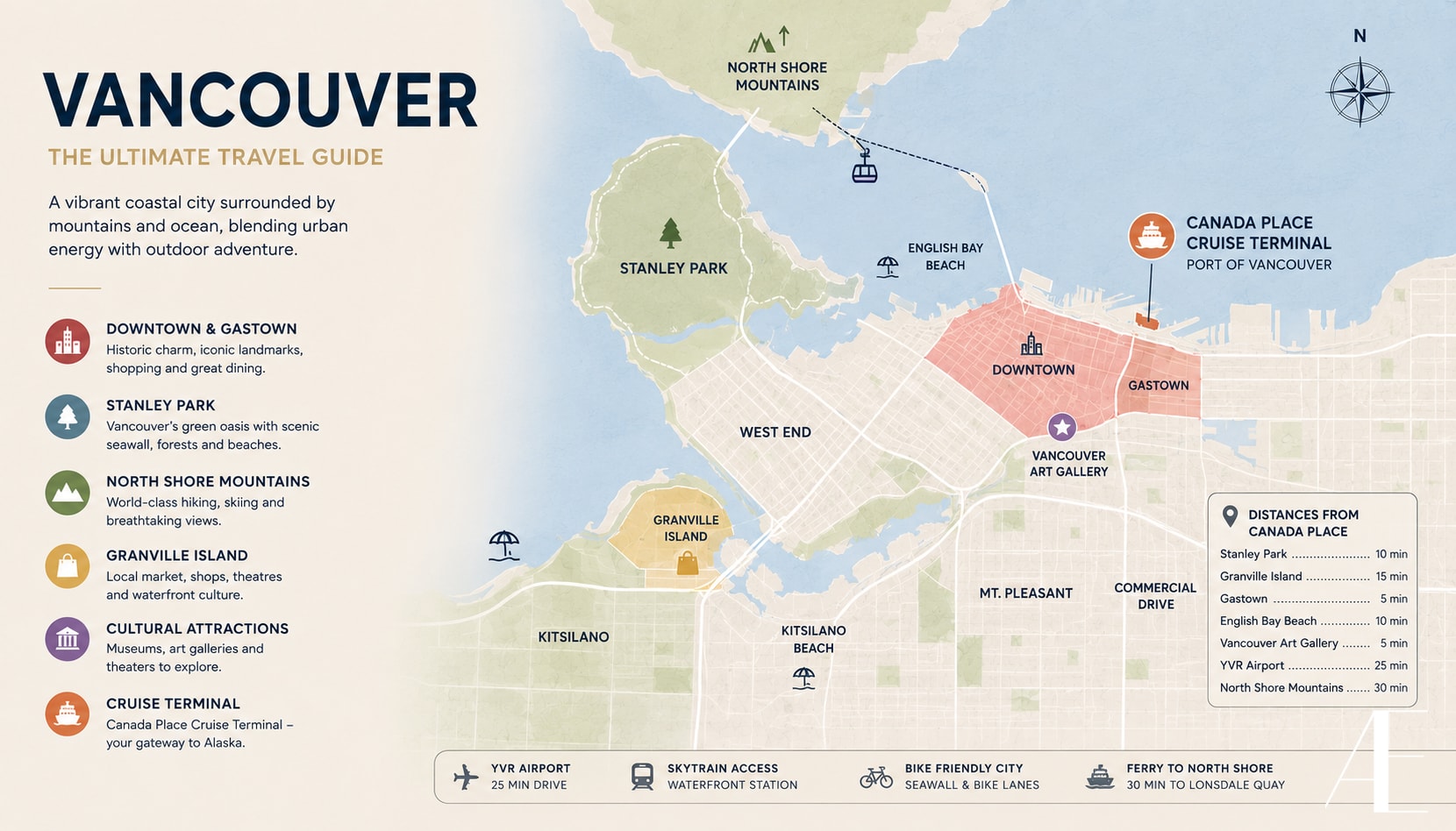
Getting around: The TransLink network covers the city comprehensively. The SkyTrain (rapid rail) has three lines and reaches from the airport to the downtown core in 25 minutes. The SeaBus crosses Burrard Inlet to North Vancouver in 12 minutes. Buses reach most neighbourhoods. A Compass Card (stored-value card) is the most practical transit option; single fares in 2026 start at $3.20. A car is unnecessary for the city proper and creates more problems than it solves given parking costs downtown. For day trips to Whistler or the Fraser Valley, a rental car is useful.
Airport: Vancouver International Airport (YVR) is one of the finest airports in North America. The Canada Line SkyTrain reaches downtown Waterfront Station in 25 minutes. The airport is on Sea Island in Richmond, immediately south of the city.
Weather: Vancouver has a temperate oceanic climate. Rain is the reality from October through April and can appear at any time of year. Always carry a waterproof layer. Summers are reliably warm (20 to 25 degrees Celsius) with occasional heatwaves. Winters are mild by Canadian standards, rarely dropping below freezing at sea level, though the mountains receive heavy snow from November.
Indigenous territories: Vancouver sits on the unceded territories of the Musqueam, Squamish, and Tsleil-Waututh Nations. This is not a formality: it is a statement of fact with ongoing legal significance, and understanding it adds depth to every cultural experience in the city, from the Museum of Anthropology to the totem poles at Brockton Point to the neighbourhood name Kitsilano, which derives from Squamish chief August Jack Khahtsahlano.
Tipping: Expected in restaurants (15 to 20 percent is standard) and for taxis, hotel porters, and tour guides. Not expected for counter service. The shift to automatic tip prompts on debit and credit card machines is universal; 18 percent is the standard suggested minimum.
Safety: Vancouver is a safe city by North American standards. The Downtown Eastside neighbourhood, between Gastown and Chinatown, has significant homelessness and open drug use and is confronting rather than dangerous; standard awareness is sufficient. Gastown and Chinatown, which border the Downtown Eastside, are safe and active restaurant and cultural districts.
FIFA World Cup 2026: Vancouver is co-hosting seven matches in June and early July 2026, bringing approximately one million additional visitors to the city. Accommodation prices will be significantly elevated during match weeks, and transit will be extremely congested on match days. Travellers not attending the tournament should consider scheduling around the match calendar if flexibility allows.
How Vancouver fits into a broader trip to British Columbia
Vancouver is the obvious starting point for any trip to the province, and a natural bookend. The airport is the main international gateway to BC, and the city offers enough to justify three to five days before or after exploring further.
The most natural extension is Victoria and Vancouver Island: a two-hour ferry crossing to one of the most distinctive and pleasant small cities in Canada, and from there north up the island toward Tofino (the surf town on the Pacific coast, four to five hours from Victoria), Cathedral Grove (a stand of 800-year-old Douglas firs near Port Alberni), and the Pacific Rim National Park Reserve.
The Sea to Sky corridor north of Vancouver leads directly to Whistler and, beyond it, into the broader Interior: Kamloops, the Thompson Valley, and eventually the Okanagan. The Okanagan Valley, centred around Kelowna and Penticton, has a wine industry built around Pinot Noir, Chardonnay, and Riesling that has been taken increasingly seriously internationally. It also has lake beaches, orchards, and a pace of life that could not be more different from Vancouver’s urban intensity. Four to five hours by car, with a regional airport at Kelowna for those coming from or continuing onward.
Vancouver is also the western terminus of the Rocky Mountaineer, the luxury daylight train that runs east through the Canadian Rockies and is, without serious competition, one of the great rail journeys in the world. The train departs Vancouver’s downtown station and runs exclusively during daylight hours, so every hour of the journey is visible from the glass-dome coaches.
The most travelled route, First Passage to the West, follows the Fraser Canyon east through Hell’s Gate and the Thompson River canyons, stops overnight in Kamloops, and continues the next morning over Rogers Pass and the Continental Divide to Banff or Lake Louise: two days of landscape that tells you more about the physical scale of Canada than any amount of reading can. The Journey Through the Clouds runs the same first day but continues north to Jasper instead of Banff.
The more expansive Rainforest to Gold Rush route departs from North Vancouver, climbs through Whistler and the Cariboo Gold Rush country, and takes three days to reach Jasper, pausing overnight in both Whistler and Quesnel. GoldLeaf Service places passengers in a bi-level glass dome with meals served in the lower dining room by onboard chefs; SilverLeaf provides the same panoramic windows at a lower price point.
The Rocky Mountaineer combines naturally with a Vancouver pre-stay and either a Calgary or Jasper post-stay, and integrates cleanly with an Alaska cruise at the Vancouver end. Peak-season departures sell out months ahead. This is not marketing language: book well in advance or accept whatever dates remain.
For cruise travellers, Vancouver is the primary embarkation point for Alaska Inside Passage itineraries. Canada Place, the cruise terminal directly in downtown, is one of the most convenient in the world: you can check out of your hotel, walk twenty minutes, and board a ship, or disembark and be in Gastown for dinner in under an hour. Combining three to five days in Vancouver with an Alaska cruise is one of the finest itineraries in North American travel.
Vancouver as a cruise port
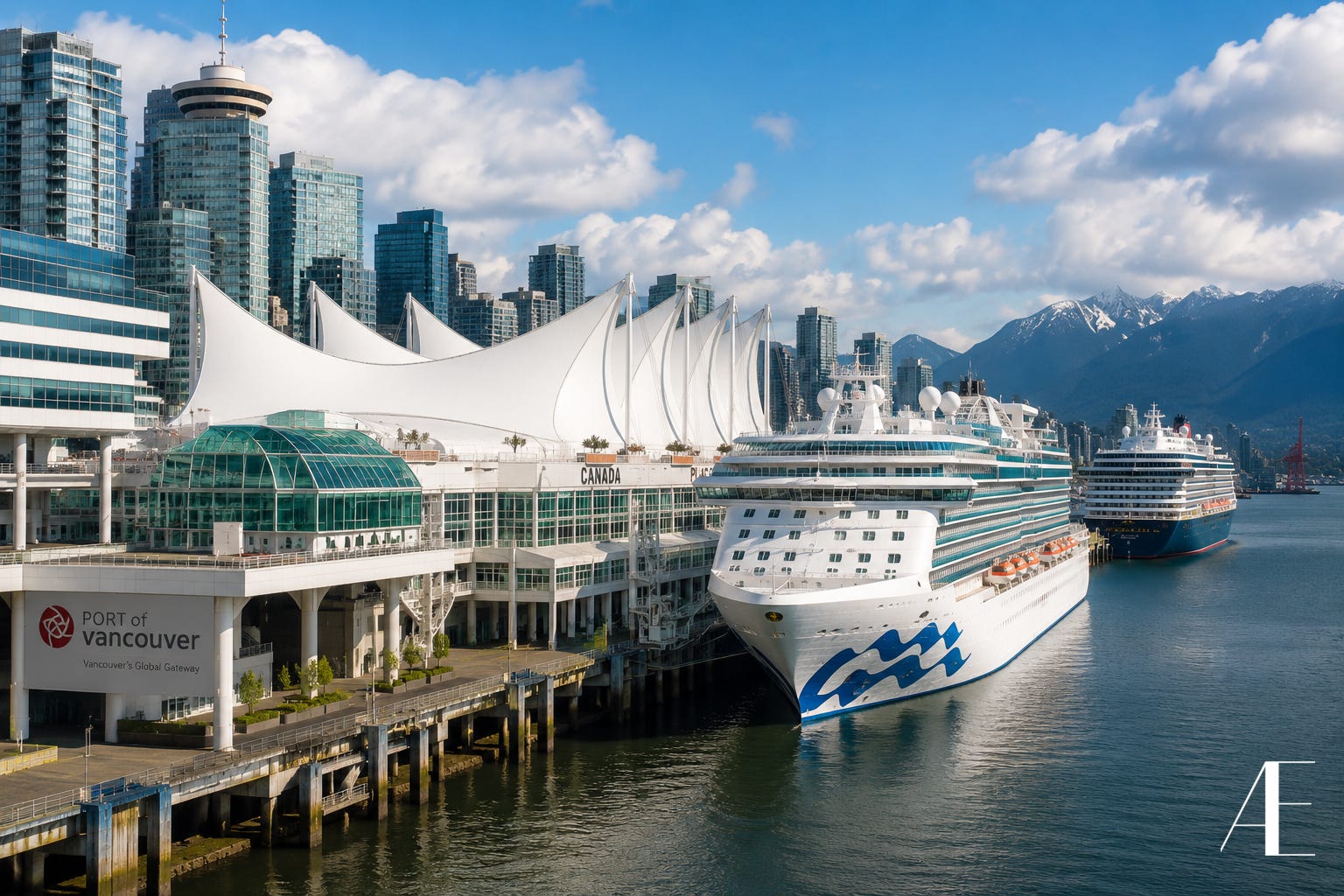
No other city in North America makes embarkation day feel as effortless as Vancouver. The Canada Place cruise terminal sits directly on the downtown waterfront, its distinctive white sail roof visible from the Seawall, five minutes on foot from Waterfront SkyTrain Station and walking distance from the best hotels in the city. You check out of your room, walk to the pier, and board. When you return, you disembark into one of the finest urban destinations on the continent, with a full day of restaurants, markets, and neighbourhoods waiting before your flight home. That combination, city quality at both ends of a sailing, is rarer than it should be.
The terminal and how it operates
Canada Place has been operating as a cruise terminal for forty years and was named North America’s Leading Cruise Port in the 2025 World Travel Awards. In 2026, it is expected to handle nearly 360 ship calls and 1.4 million passengers, the busiest season in the port’s history. Almost daily departures run from late April through mid-October, with peak activity in July and August. The busiest days see multiple ships berthed simultaneously; the single busiest day of the 2026 season, September 19th, has five ships scheduled, representing approximately 20,000 passengers moving through the terminal.
The terminal’s border processing is among the most efficient of any North American cruise port. In 2024, facial biometric technology was introduced at the US Customs and Border Protection area, reducing average processing times to under ten seconds per passenger. Eligible US and Canadian passport holders use the automated kiosks, which increased throughput by approximately four times compared to the previous system. US pre-clearance happens at Vancouver before departure, meaning ships arriving in Alaska do not need to clear US customs on arrival. For passengers, this is a significant practical advantage over ports where clearance happens at the destination.
One important logistical note: all ships arriving at and departing from Canada Place must pass under the Lions Gate Bridge, which has a clearance of 61 metres. This effectively limits Vancouver to mid-size ships rather than the largest mega-vessels in the industry. Norwegian Bliss and ships of similar scale occasionally call at Vancouver at low tide, sometimes departing in the middle of the night to make the crossing safely, but the standard fleet at Canada Place runs to ships in the 70,000 to 100,000-ton range. For travellers who prefer a more human-scaled ship experience, this is not a constraint but an advantage.
The Alaska Inside Passage sailings
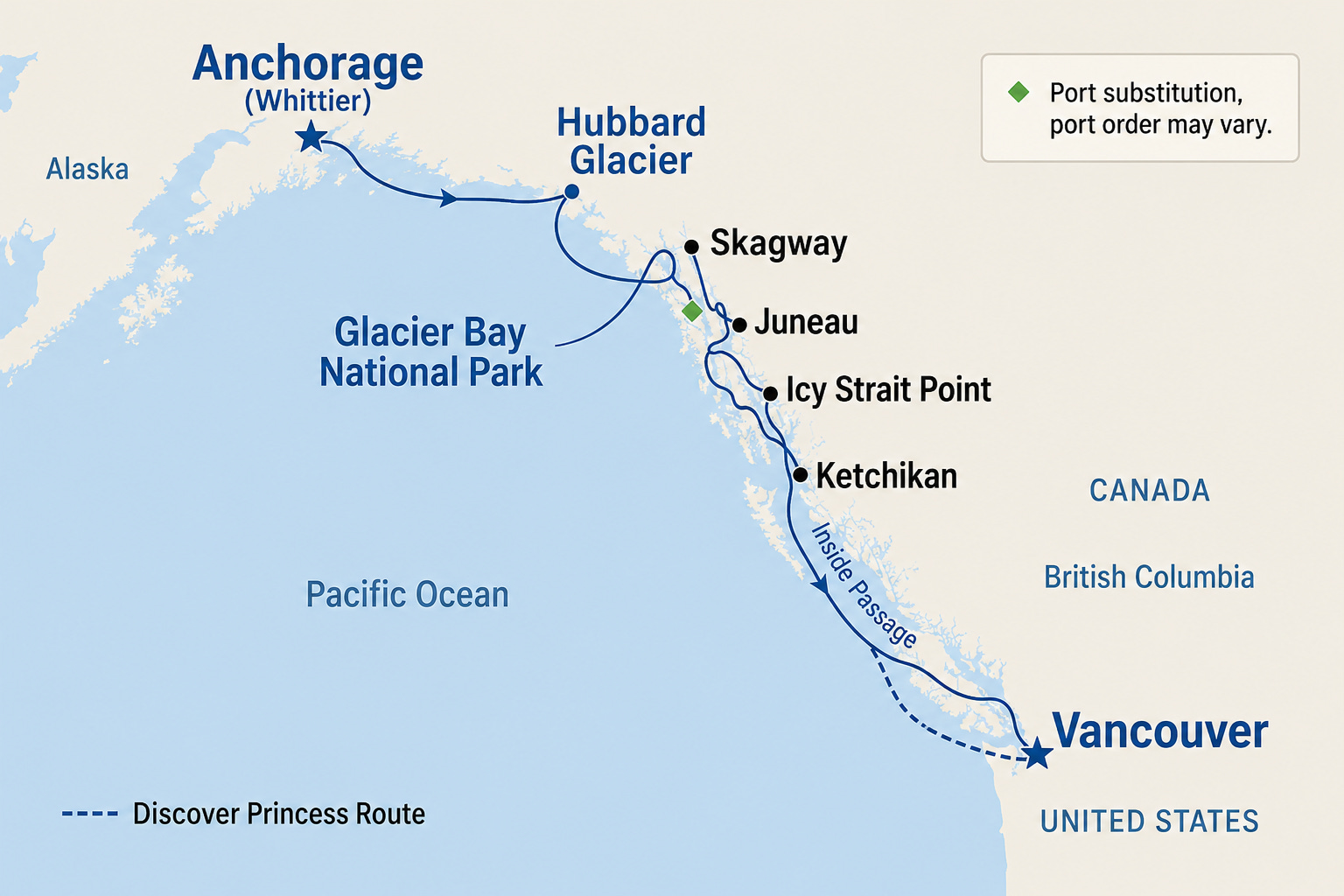
Vancouver is the primary embarkation port for Alaska Inside Passage cruises, and the itinerary is one of the great routes in ocean cruising. Ships depart in the late afternoon, typically allowing passengers a full day in the city before boarding, and sail west under the Lions Gate Bridge into English Bay, then south through the Strait of Georgia between Vancouver Island and the mainland. The passage through BC’s coastal waters, sheltered from the open Pacific, takes a full day before reaching Alaska waters, and wildlife sightings begin almost immediately: orca pods feed in the Strait of Georgia, humpbacks move through the passages north of Vancouver Island, and Dall’s porpoises regularly escort ships through narrow channels.
Standard seven-night Inside Passage itineraries from Vancouver typically call at Ketchikan (Alaska’s southernmost city, built on stilts above the Tongass Narrows, with the world’s largest collection of standing totem poles), Juneau (the only US state capital unreachable by road, set below the Juneau Icefield and within a short drive of Mendenhall Glacier), and either Skagway (the gold rush gateway town at the head of Lynn Canal, with the narrow-gauge White Pass & Yukon Route railway) or Icy Strait Point, a private destination in the Tlingit village of Hoonah. Most itineraries also include a full day of glacier viewing: Glacier Bay National Park, Tracy Arm Fjord, or Hubbard Glacier, the largest tidewater glacier in North America.
Cruisetours extend the Alaska experience by combining the sailing with a land program in the Alaskan Interior, typically including Denali National Park, Fairbanks, and the Kenai Peninsula. These sailings often operate one-way, either northbound (Vancouver to Seward or Whittier, near Anchorage) or southbound, with the land tour at one end. They are, without qualification, among the most comprehensive ways to experience Alaska, and Vancouver as embarkation or disembarkation makes the logistics considerably simpler than most alternatives.
Cruise lines sailing from Vancouver
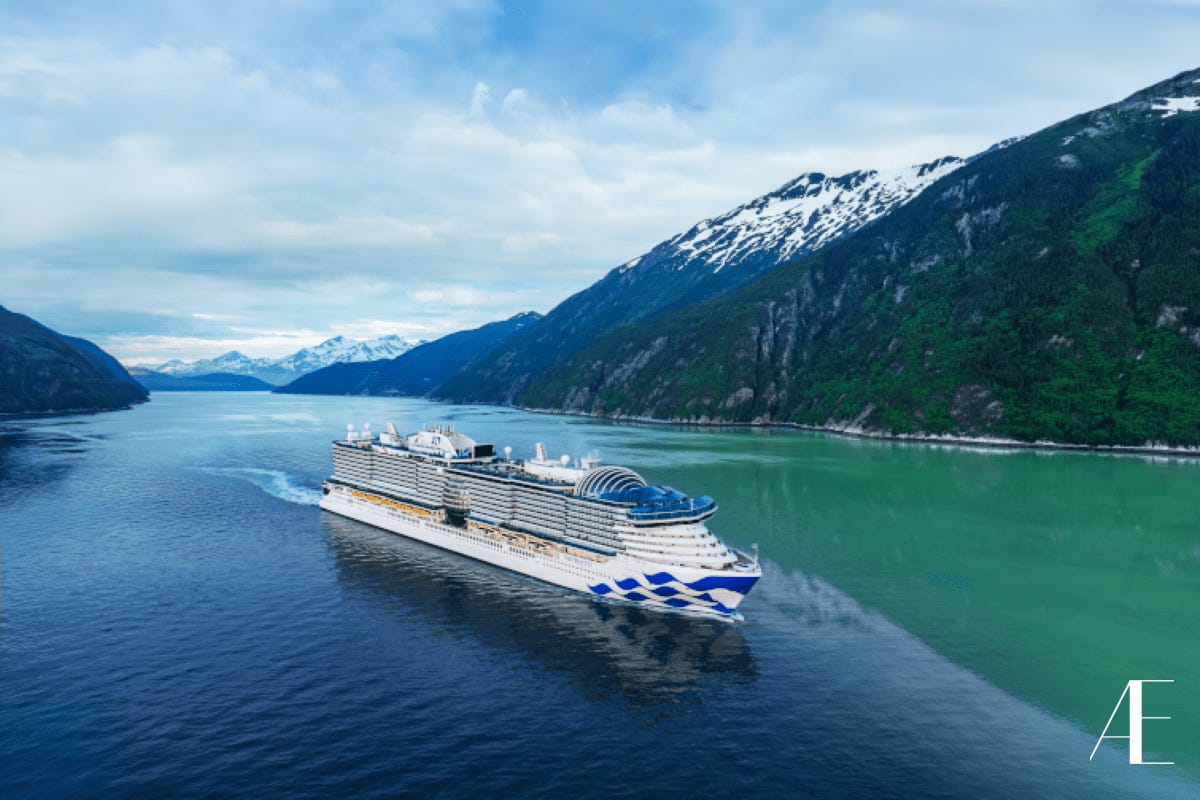
The 2026 season at Canada Place includes twenty cruise lines, ranging from the mainstream (Princess Cruises, Holland America Line, Norwegian Cruise Line, Royal Caribbean, Celebrity Cruises, Disney Cruise Line) to the premium and luxury segment (Oceania Cruises, Regent Seven Seas, Seabourn, Silversea, Crystal Cruises, Viking Ocean, Windstar) and two first-time deployments from Vancouver: Virgin Voyages, with its adults-only Brilliant Lady, and the Ritz-Carlton Yacht Collection’s Luminara. Expedition operators including Hurtigruten (HX) and National Geographic also sail from Canada Place for smaller-ship itineraries that reach more remote corners of the BC and Alaska coast.
Holland America Line has the deepest history in Vancouver and remains the largest operator by volume, with multiple ships running weekly departures through the full Alaska season. Princess Cruises is equally established, with roundtrip Inside Passage and cruisetour programs that have been the backbone of the Alaska market for decades. For first-time Alaska cruisers, either line offers the most developed shore excursion programs and the most consistent product.
Practical advice for cruise passengers
Pre-cruise stays: Three nights before sailing gives you time to recover from travel, explore the city properly, and board in a relaxed state. Two nights is workable. One night is survivable but leaves you arriving on the ship without having actually experienced Vancouver. The city is too good to treat as a transit stop.
Getting to the terminal: Canada Place is five minutes on foot from Waterfront Station, the terminus of the Canada Line SkyTrain from the airport. The journey from YVR takes 25 minutes. Taxis and rideshares from the airport run 25 to 35 minutes depending on traffic. Most major hotels in the Coal Harbour and West End area are within a ten to fifteen minute walk of the pier.
Embarkation timing: On peak days with multiple ships in port, embarkation can take anywhere from 20 minutes to 90 minutes depending on when you arrive. Arriving mid-morning rather than at the peak noon rush typically reduces wait times. The port recommends arriving at least two to three hours before scheduled departure.
After disembarkation: Luggage storage is available through PorterGenie citywide and at the Westcoast Sightseeing location at Canada Place (8am to 5pm). Most hotels within a fifteen-minute walk will hold luggage for guests regardless of check-in timing, which allows a full final day in the city before an afternoon or evening flight home.
Shore power: More than 80 percent of cruise ship calls to Vancouver in 2025 were shore power-enabled, allowing ships to connect to BC’s hydroelectric grid rather than running auxiliary engines at berth. The port is expanding this infrastructure further for 2027. It is a detail that matters increasingly to travellers who factor environmental standards into their choice of itinerary and operator.
Frequently asked questions
Is Vancouver worth it for a first trip to Canada?
Absolutely. Vancouver is one of the world’s most beautiful cities in terms of setting, has a food culture that competes with any North American destination, and offers a combination of urban and natural experience that is genuinely without equivalent. It is a different Canada from Toronto or Montreal, more Pacific in orientation and more outdoor in character, and that difference is worth experiencing on its own terms.
How many days does it take to see Vancouver properly?
Three days covers the essentials without feeling rushed. Four to five days allows a day trip to Whistler or Victoria and begins to reveal the neighbourhood character that makes the city more than its landmarks. A week reveals the restaurant scene, the North Shore properly, and enough of daily life to understand what Vancouver actually is.
What is the best time of year to visit?
Late spring (late April and May) and autumn (September and October) offer the best balance of weather, manageable crowds, and reasonable prices. Summer is the most popular time and the most spectacular for outdoor activities, but July and August in 2026 will be significantly more crowded than usual due to the FIFA World Cup. Cherry blossom season in late March or early April is worth planning around.
Is Vancouver expensive?
It is one of the most expensive cities in Canada, with hotel and restaurant prices broadly comparable to major American cities. The current CAD-USD exchange rate makes it notably more affordable for American travellers. Budget travellers can manage well on the city’s excellent public markets, free museums, and walkable neighbourhoods. Accommodation is the primary cost variable.
Are there free museums in Vancouver?
The Vancouver Art Gallery charges admission. The Museum of Anthropology at UBC charges admission but offers half-price entry on Thursday evenings. The Dr. Sun Yat-Sen Classical Chinese Garden charges a modest admission. The Capilano Suspension Bridge is a paid private attraction. Stanley Park is entirely free. The Granville Island Public Market is free to enter. Budget-conscious visitors can build a very full day around the free and low-cost options.
Do I need a car in Vancouver?
No, not for the city itself. Transit, walking, cycling, and the Aquabus ferries cover everything within the city centre effectively. For day trips to Whistler or the Fraser Valley, a rental car offers more flexibility, though shuttle services to Whistler are readily available. For Vancouver Island beyond Victoria, a car is useful.
Is Vancouver a good destination for cruise passengers?
It is one of the best. Canada Place is a downtown cruise terminal in the most literal sense: the ship is a fifteen-minute walk from the best hotels, restaurants, and neighbourhoods in the city. Pre-cruise and post-cruise stays in Vancouver are among the most satisfying in the industry, and combining the city with an Alaska Inside Passage itinerary is a pairing that justifies both halves completely.
What should not be missed under any circumstances?
Stanley Park, the Museum of Anthropology at UBC, a morning at the Granville Island Public Market, and one serious dinner: whether that means St. Lawrence, Kissa Tanto, or Burdock & Co. depends on preference, but the restaurant scene deserves at least one full evening of attention. The North Shore, for Grouse Mountain or Capilano, deserves a day. And the Seawall, in any weather, at any point in the visit.
Plan your Vancouver trip with ÆRIA Voyages
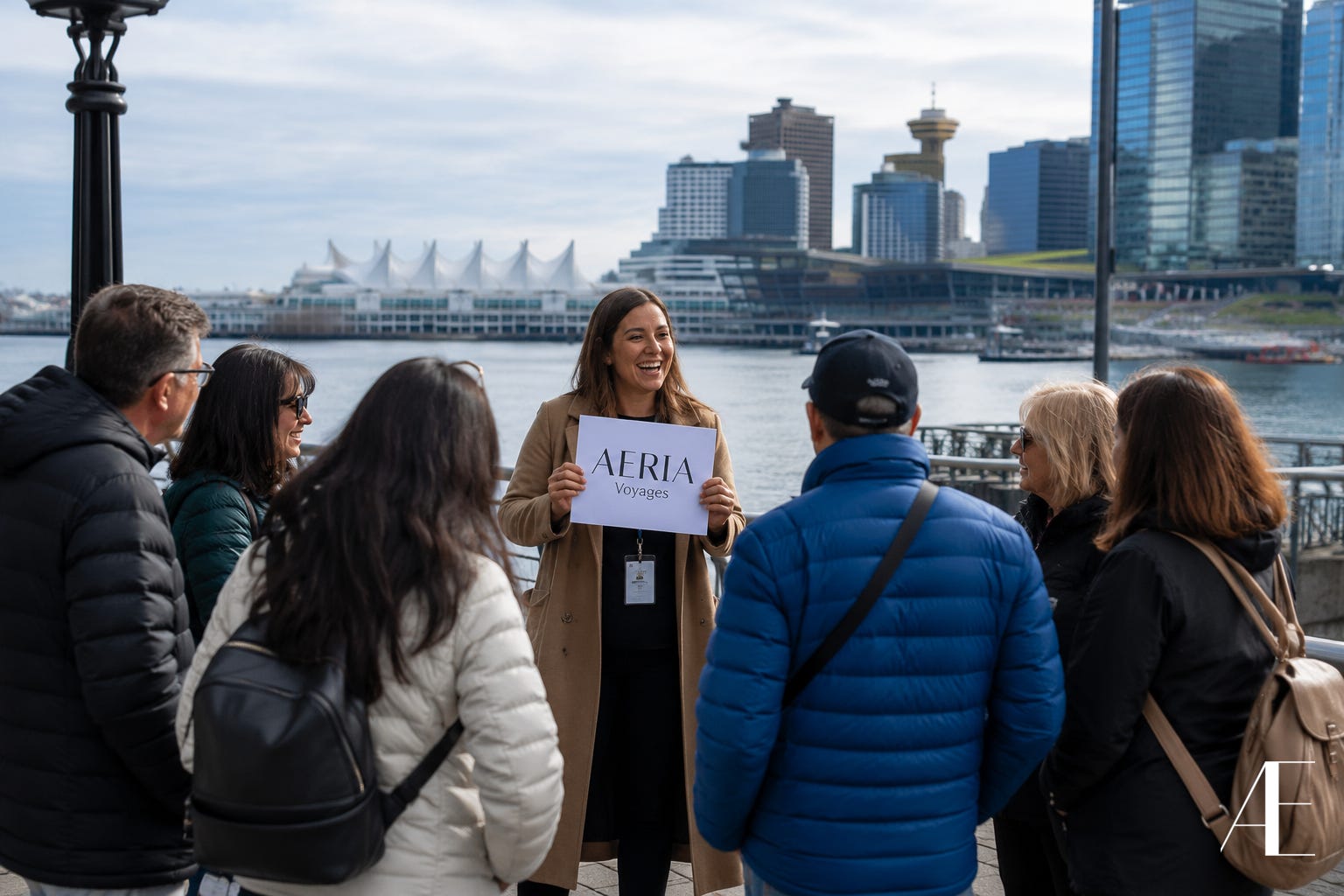
Every Vancouver trip is shaped differently depending on what brings you there. Some travellers want four days in the city before boarding an Alaska cruise at Canada Place. Others are using Vancouver as the start of a two-week BC road trip that ends in the Okanagan. Others are combining Vancouver with Victoria, or with a ski week at Whistler, or with a floatplane hop to the Gulf Islands.
The city is also one of the finest destinations in the world for combining cruise and land: Vancouver’s position as the primary embarkation point for Alaska Inside Passage sailings, combined with its quality as a destination in its own right, makes a pre- or post-cruise Vancouver stay one of the most consistently rewarding itineraries I put together.
If you are planning a trip to Vancouver and want to think through the options, whether that means choosing the right time of year, building the right land itinerary around a cruise, or simply knowing which hotel to book for your specific priorities, I would be happy to help.
Yvan Junior Blanchette
Travel & Cruise Specialist
ÆRIA Voyages📩 yvanblanchette@aeriavoyages.com
📞 1-888-460-3388
🌐 aeriavoyages.com