

A Day in PARIS | Through the Eyes of an ÆRIA Strategist
By Yvan Junior Blanchette | Travel and Cruise Specialist | ÆRIA Voyages
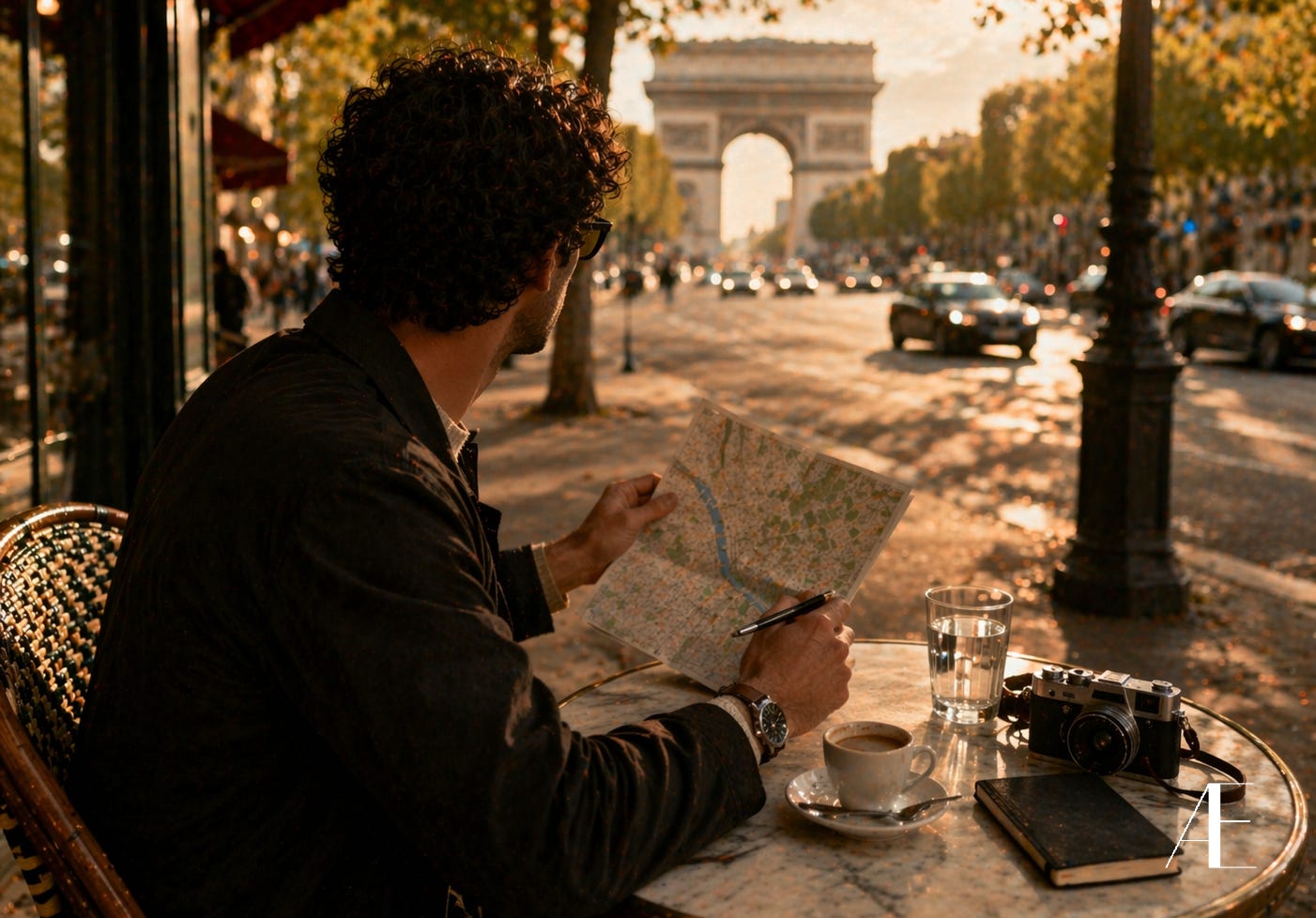
Your alarm is set for 6h45. You’ve been awake since 6h40.
You have four days in Paris. You’ve been thinking about this trip for six weeks. You know which sites you’re hitting, in which order, and why. You know which ones sell out if you wait too long and which ones reward an early arrival over a late one. You’ve read the reviews, mapped the arrondissements, and built a restaurant shortlist organized by neighbourhood so you’re never wasting twenty minutes deciding where to eat when you could be somewhere worth being.
Some people find this excessive. Those people spend their first morning in a ticket line at the Louvre while you’re already standing in front of the Winged Victory of Samothrace in near silence.
The morning you planned for
The Louvre at 9h on a Wednesday is a fundamentally different experience than the Louvre at 11h on a Saturday.
You booked the first entry slot online before you left home. You went in with a plan, not to see everything, that is the mistake everyone makes, but to see three things properly. The Winged Victory. The Dutch Masters. The Vermeer rooms that most visitors walk past on their way to somewhere more famous.
Two and a half hours later you leave feeling like you actually saw something. Not like you survived something.
You make it to your next stop with twelve minutes to spare because you knew exactly which exit to use and which Metro line to take. This is not luck. This is preparation paying off in real time.
The system that makes Paris manageable
Here is what most first-time visitors to Paris figure out too late: the city is best approached by arrondissement, not by landmark.
You figured this out before you left.
Your four days are structured around four distinct areas of the city, each explored completely before moving to the next. You are not crossing Paris twice in one day chasing individual sites. You move through each zone with intention, see what is worth seeing in it, eat in it, walk through it at the right hour, and end each evening in a neighbourhood that has something worth doing after dark.
It sounds simple. It changes everything. You cover more ground with less friction, spend less time in transit, and arrive at each place with enough energy to actually be present.
By early afternoon on day one you have already seen what most visitors spend a full day scrambling to reach.
The lunch decision
You had two restaurants shortlisted for today. Both within walking distance of where you are. You’d bookmarked them weeks ago, read the menus, checked the hours, noted which one takes reservations and which one doesn’t.
The one that doesn’t take reservations is better, according to everything you read. You arrive at 12h30, slightly ahead of the main lunch rush. You get a table immediately.
The food is exactly as good as the research suggested. Classic bistro cooking done with real care. A plat du jour that changes daily, which is always the sign of a kitchen that is actually cooking rather than reheating. You’re done in an hour, which is exactly what you needed because the Musée d’Orsay is a fifteen minute walk away and your timed entry is at 14h.
You arrive with eight minutes to spare.
This is what a good plan feels like from the inside.
The afternoon that rewards the preparation
The Musée d’Orsay with a pre-booked timed entry on a weekday afternoon is an entirely different experience from showing up and joining whatever line has formed.
You move through the Impressionist collection at your own pace. No bottlenecks at the Monet rooms. No group blocking the Degas pastels. The upper gallery in the afternoon light is exactly as good as everyone says it is, and you have the space to actually stand still and look.
By 16h30 you’re out and walking through Saint-Germain-des-Prés, which rewards exactly the kind of slow late afternoon hour you’ve left deliberately unscheduled. A coffee at a cafe that has been there longer than most countries have had their current governments. A walk past the bookshops on Rue de l’Odéon. A stop in a wine shop where you spend twenty minutes and leave with something for tonight.
Day one. Complete. Everything you wanted to see, seen properly. No wasted hours. No frustrating surprises. One small adjustment to tomorrow’s plan based on something you noticed today.
You make the note. You close the app.
The evening you earned
Dinner is at a restaurant you booked ten days ago.
It required a reservation. You made one. This is not a minor detail in Paris, where the places worth eating at are frequently full of people who thought ahead.
The meal is exactly as good as the research indicated it would be. You order deliberately, one dish you had already decided on and one thing the waiter recommends when you ask. Both are excellent. The wine is a Burgundy chosen with a brief but genuinely useful conversation with someone who knows what they’re talking about.
You’re back at the hotel by 22h. Early enough to review tomorrow’s plan. Late enough to feel like you used the day entirely.
You did.
The day after
The next morning you’re up at 6h45 again.
You already know what the day looks like. That’s the whole idea.
What you didn’t fully anticipate, lying there in the quiet before Paris wakes up, is how much you’re actually enjoying this. Not just the efficiency of it. The actual experience of the city. The museum this morning. The neighbourhood this afternoon. The meal last night.
The plan worked. And inside the plan, Paris had room to surprise you.
That, you think, is exactly what a well-built trip should feel like.
There’s a version of Paris where you figure everything out as you go. And there’s a version where you arrive knowing exactly how to make the most of every day.
The ÆRIA Ultimate PARIS Traveler Guide goes further. A four-day itinerary structured by arrondissement. Pre-booking instructions for every major site. Restaurant picks organized by neighbourhood and time of day. The sequencing logic that lets you cover one of the most complex cities in the world without backtracking, without wasted mornings, and without the feeling at the end that you missed something important.
👉 Access The Ultimate PARIS Travel Guide
Being in a new city is exciting. It is also, if we’re honest, a little overwhelming. How do you build an itinerary for a city this size that actually holds together? How do you know what needs to be booked in advance and what doesn’t? Where do you stay so the geography works in your favour? How do you make sure you don’t spend half a day fixing mistakes you could have avoided?
That’s exactly where I come in.
I help Strategists, and every other type of traveller, build trips designed around how they actually want to travel. Not a generic package. A real plan, built with you, that respects your time and makes the most of every day you have.
👉 Let’s plan your trip together
Yvan Junior Blanchette
Travel & Cruise Specialist
ÆRIA Voyages📩 yvanblanchette@aeriavoyages.com
📞 1-888-460-3388
🌐 aeriavoyages.com