

A Day in PARIS | Through the Eyes of an ÆRIA Epicurean
By Yvan Junior Blanchette | Travel and Cruise Specialist | ÆRIA Voyages
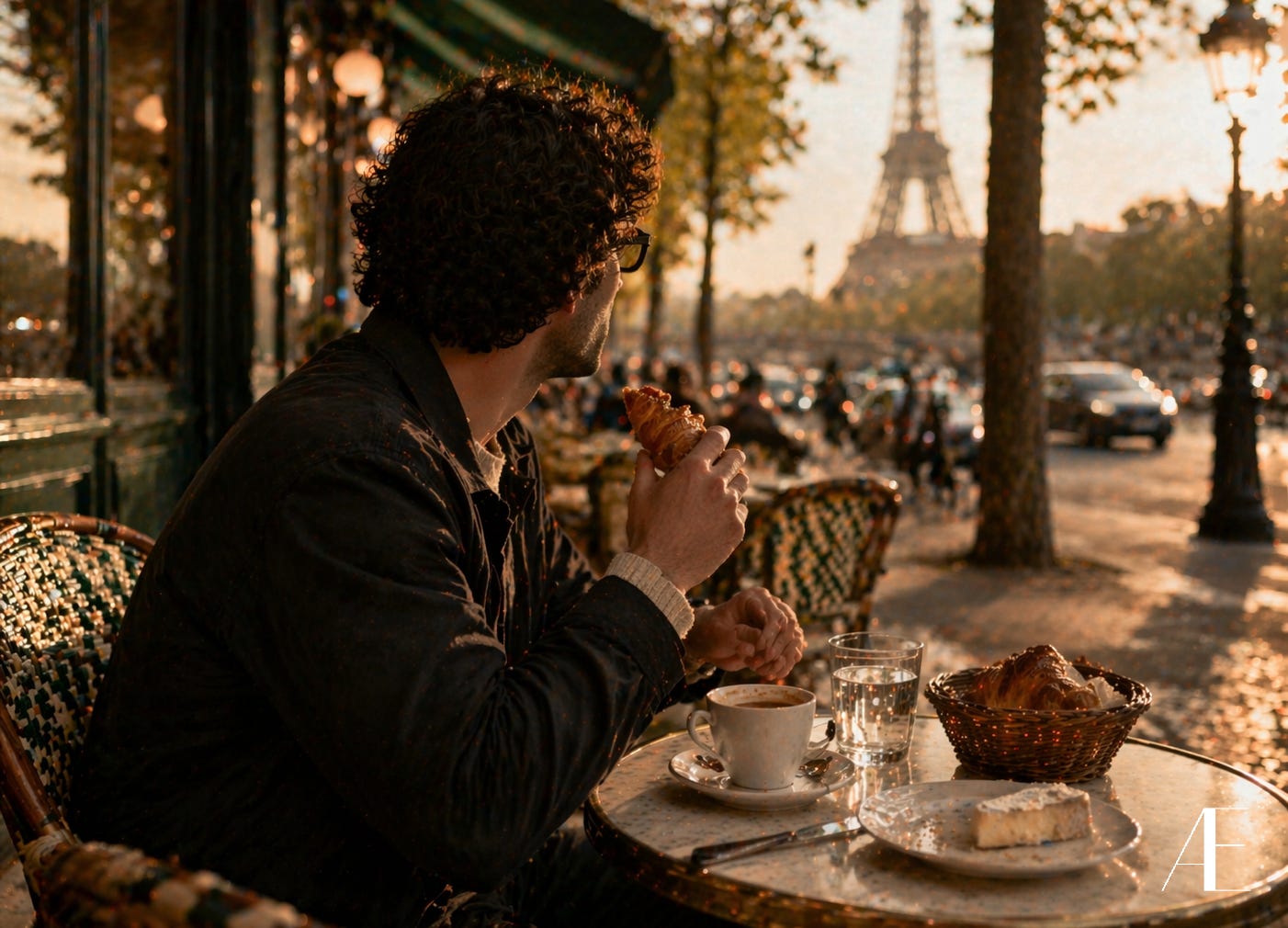
Your alarm is set for 8h. You’ve been awake since 7h45.
Not because of anxiety. Because you remembered, just as you were drifting off last night, that the market on Rue de Bretagne opens early on weekdays. And you want to be there before the best of it is gone.
You make coffee. You check the weather. You put on comfortable shoes, which for you means something that works for cobblestones but still looks like you made an effort. In Paris, this matters.
The morning that begins at the market
You’d done your research before leaving home. Not about museums. About food.
Specifically about where Parisians actually shop when they are cooking seriously. The answer kept coming back to the covered market halls, the marchés couverts, rather than the open air tourist markets most guidebooks send you to. Rue de Bretagne in the Marais. Marché d’Aligre in the 12th. Places where the vendors know the regulars and the produce arrives because someone chose it, not because it photographs well.
You arrive at Rue de Bretagne just after 8h. The fishmonger is arranging something extraordinary on crushed ice. The cheese vendor is unwrapping wheels with the quiet focus of someone who takes this seriously. You move through slowly, not buying yet, just looking. A vendor offers you a sliver of something aged and sharp and intensely savoury. You stop walking.
You buy enough for a picnic you haven’t planned yet. You eat a small piece of something standing at the edge of the market and feel, already, that the day is going exactly right.
The detour that earns its place
You had not planned to spend time at the Musée d’Orsay today. But the woman at the cheese stall, noticing your genuine interest in what she was telling you about a particular regional producer, started talking. Twenty minutes later you were still there, covering food, Paris, the way the city has changed, and then somehow the Impressionists, and she said, almost as an aside, that the light in the upper gallery of the Orsay on a clear morning is something you should see at least once.
You go.
She was right. The Impressionist collection at the Musée d’Orsay is the finest in the world, and seen in the right light on a clear morning, it does something to you that is difficult to explain to someone who hasn’t been there. Renoir and Monet and Degas arranged in rooms that feel like they were designed for looking slowly rather than moving through quickly.
You stay longer than you planned. You don’t mind at all.
The lunch you will think about for years
You had marked four restaurants before leaving home. Three of them found through careful research, reading menus in French, cross-referencing reviews written by people who clearly knew what they were writing about. The fourth recommended by someone in an online forum, described only as the bistro on the left past the pharmacy, no reservation needed before noon, just go.
You go to the fourth one.
The room is small and warm and smells of something braising. The menu is handwritten on a chalkboard and changes daily, which is always the right sign. The waiter explains the plat du jour with the focused enthusiasm of someone who ate it for staff meal this morning and is still thinking about it.
You order it. You order a carafe of the house red without looking at anything else. What arrives is the kind of French bistro cooking that people talk about as though it no longer exists in Paris, the kind that makes you understand why this city invented the very concept of the restaurant. A braise so long and so patient that the meat has become something else entirely. Bread that you keep tearing pieces from. A green salad dressed so simply and so perfectly that you make a mental note to ask how it’s done.
You sit there for two and a half hours. Nobody looks at you twice.
The afternoon built around pleasure
You hadn’t planned much for the afternoon. Which turns out to be exactly right.
You walk from the bistro through the covered passages of the 2nd arrondissement, the galeries couverts that most visitors walk straight past without knowing what they are. Galerie Vivienne. Passage des Panoramas. Glass ceilings and mosaic floors and shop windows that have looked more or less the same for a hundred and fifty years. A tea salon inside one of them that you step into and sit down in for no other reason than that it looks like the right thing to do.
You order something. You read. You watch people walk past the windows in the amber light of a Paris afternoon.
At some point you realize you’ve been sitting there for an hour and feel nothing but pleased about it.
The evening you planned for last
Dinner is at a restaurant you booked two weeks ago.
A modern French bistro in the 11th that a food writer whose taste you trust called the most exciting table in Paris right now. Not the most expensive. The most exciting. There is a difference, and in Paris that difference matters more than anywhere else.
You dress for it slightly. In Paris this is not vanity. It is respect.
What arrives over the course of the evening is the kind of meal that makes you slow down completely and pay attention. Dishes that are rooted in French technique and then pushed somewhere unexpected. A natural wine from a producer you’ve never heard of that the sommelier describes in three sentences that make you want to learn everything about it. Bread and butter so good they arrive as a course in themselves.
You walk back to the hotel slowly, taking streets you haven’t taken before, stopping once to look in a window, once to listen to something coming from a restaurant you pass. Paris at this hour is soft and warm and entirely itself.
You feel the way you feel after a great meal always leaves you. Full in every sense of the word.
The day after
The next morning you lie in bed a little longer than usual.
You’re running through yesterday in your head. The market and the cheese. The light in the Orsay. The bistro and the braise. The covered passages. The dinner.
You reach for your phone and open a note. Not a to-do list. A list of things to find when you get home. The regional producer from the cheese stall. The natural wine from last night. A recipe that might get you somewhere close to that braise, knowing it won’t be the same, knowing that’s part of the point.
You have two more days in Paris. You already know what the next market morning looks like.
There’s a version of Paris built for tourists. And there’s a version built for people who travel the way you do.
The ÆRIA Ultimate PARIS Travel Guide goes further. The markets worth your mornings. The bistros that still cook the way bistros are supposed to cook. The covered passages, the wine bars, the bakeries that justify getting up early. A three-day itinerary built around flavour, pleasure, and the particular French art of taking your time.
👉 Access The Ultimate PARIS Travel Guide
Being in a new city is exciting. It is also, if we’re honest, a little overwhelming. How do you find the restaurants that are worth it rather than just famous? How do you know which markets are for locals and which ones are for tourists? How do you build days that feel indulgent without feeling random?
That’s exactly where I come in.
I help Epicureans, and every other type of traveller, build trips designed around who they actually are. Not a package. Not a template. A real itinerary, built with you, around the experiences that matter most to the way you travel.
👉 Let’s plan your trip together
Yvan Junior Blanchette
Travel & Cruise Specialist
ÆRIA Voyages📩 yvanblanchette@aeriavoyages.com
📞 1-888-460-3388
🌐 aeriavoyages.com